

Most of what you know won't ever fit inside an AI prompt
Bertrand Russell divided human knowledge into two categories a century ago. One of them is everything AI will never hold and trying to compress it into a prompt is why your best work evaporates.

Do you ever get the feeling that the more thoroughly you describe what you want to AI, the more of it goes away?
Maybe you’ve added more context, more carefully worded instruction sets, and the result is loyal to every word while failing to understand the main idea. Or maybe it’s even earlier than that. A sense that some of what you know will never fit inside a prompt, no matter how hard you try.
Over a hundred years ago, Bertrand Russell distinguished between two types of knowledge.
The first, knowledge by description: everything you can put into language and hand to someone else.
The second, knowledge by acquaintance: everything you know through direct experience that’s always bigger than any description you can give of it. You know these things wholly and intimately, but the description always ends up being “smaller” than the knowing.
Every instruction you give AI is knowledge by description.
AI works with what you describe and it’s extraordinarily good at it until it isn’t, until you’ve rewritten the same prompt four times and the essential still gets lost in the translation.
Our instinct at that point is to describe harder. I like to define this as being similar to the encoding reflex, the assumption that your expertise, all of it, can be compressed into text. Sometimes that instinct is correct. Sometimes you’re just under-describing something describable, and a better brief fixes it.
But most of the time, you’re trying to compress acquaintance into description, something that can’t work because the knowledge doesn’t fully exist in language.
No prompt architecture will close that gap. The gap is in the nature of the knowledge, not in the quality of your writing or instructions.
One question changed how I work with AI.
What am I bringing to this prompt that the prompt will never hold on its own?
In this edition, I will:
Show you how Russell’s distinction plays out in my own visual work so you can apply it yourself (and what the architecture can’t contain)
Give you The Acquaintance Map to make AI pull the tacit knowledge out of you, and show you what to hand to the prompt and what to stop trying to describe.
─── ⋆⋅☆⋅⋆ ───
Hi, I’m Mia. Welcome to ROBOTS ATE MY HOMEWORK. On this side of the world, we use AI with a brain and zero circus tricks.
Most of what you know about your own work won’t fit inside a prompt, no matter how carefully you write it.

What the prompt can’t hold: knowledge by description vs. knowledge by acquaintance
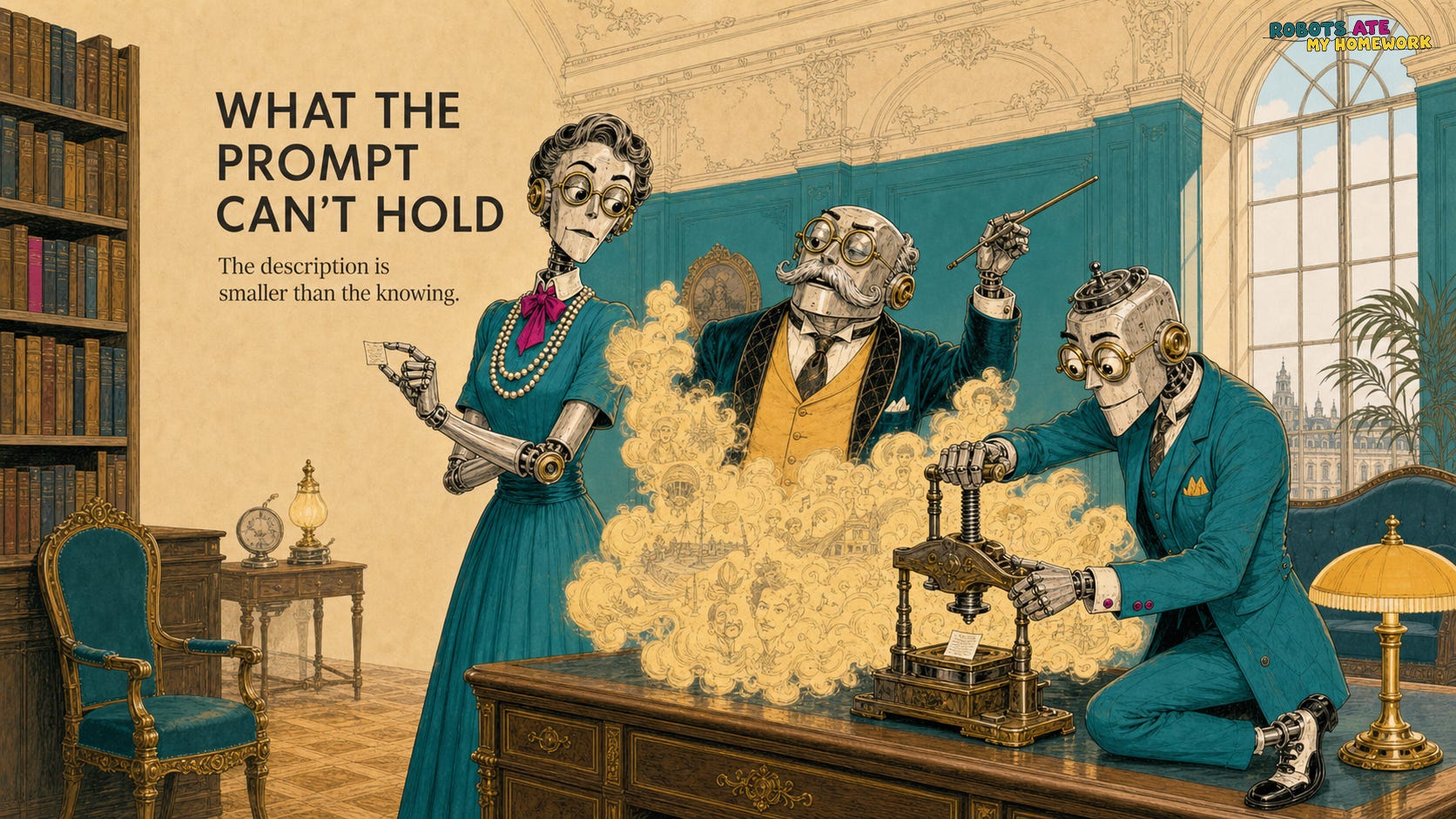
Over the (almost) past year of writing this newsletter, I’ve been building a strong visual world, full of characters with personality, locations close to my heart, emotions, a consistent aesthetic that runs through everything I publish.
I come from a creative background (film, writing, the arts) and I’ve always built worlds in one form or another. With AI, building these worlds became dramatically easier. You can generate infinite possibilities, whole atmospheres in minutes, iterate on something until it feels just right.
Russell’s distinction applies to any creative work you do with AI. And honestly, to any work that has you explain something fully and get something back that’s 99% there but just not good enough.
I talked about this more in this post - why do voice profiles capture the surface but AI still does not sound like you?

I’ve been thinking about this through my visual work, and I think the visuals are the best lens for a few reasons:
The prompt is the art direction, so naturally, the gap between description and acquaintance is sort of impossible to miss.
The visual output is immediate and visceral, and you can feel the difference between “okay-ish” and “mine”.
I’ve been building this visual world for a while, so I can point at specific decisions and name what’s in the prompt vs what I bring to it.
There are two parts to this, like there are two parts to Russell’s framework:
1. Knowledge by description: the prompt
The part I can give away: I have a prompt.
Around 5,000 characters of locked aesthetic instructions that handle the entire art direction. It includes:
color palette
period aesthetic
compositional rules
linework style
the way the characters are drawn and how expressive their mechanical faces should be.
These foundational instructions never change. That’s the description side of my visual work, and it’s solid architecture. You could read every word of it and understand exactly what I’m building toward.
2. Knowledge by acquaintance: everything else
And then there’s everything I bring to the prompt that makes the image mine. You could have the full prompt and it wouldn’t help you, because the prompt is the foundation, not the building.
My prompt has two open variables, two placeholders that I fill fresh every time (one for the overall mood, one for the scene).
The prompt handles the art style and I handle the meaning. That’s Russell’s knowledge system and it runs through every visual I create.
I recently sat down with Pinkie from AI Meets Girlboss and walked through the full visual process in detail. If you want the behind-the-scenes tour, it’s here.
Today I’m showing you why these visuals are proof that acquaintance and description work together, and that you already carry a version of this in your own domain, whether you’ve ever named it or not.

Here’s what goes into the placeholders and how you can apply these yourself:
Cast your characters / personas like a director casts actors
The one question you need to ask yourself when starting any piece with recurring voices in it, is: who is carrying this story?
The same idea can land differently depending on which character embodies it.
Every one of my visuals starts with a question that has nothing to do with color or composition too: who are these characters today?
Pompous small-town dignitaries squinting at something with enormous self-seriousness?
A lady robot glaring over a headline in a vintage newspaper with a very important announcement?
A detective investigating old London while wearing a cap he can fly with?
The casting changes the emotional register of the image, and I can’t give you rules for how I decide.
The decision comes from reading the essay and feeling which characters carry that particular story’s energy, which is something I know by acquaintance and couldn’t compress into a casting brief if I tried.
The next time you’re casting a piece, write down your first instinct for who the characters are. Then write down three completely different options. Notice which alternatives feel wrong and why. The reasons you give yourself for rejecting them are your casting rules, and you’ve never written them down.
Give every story a place to live in
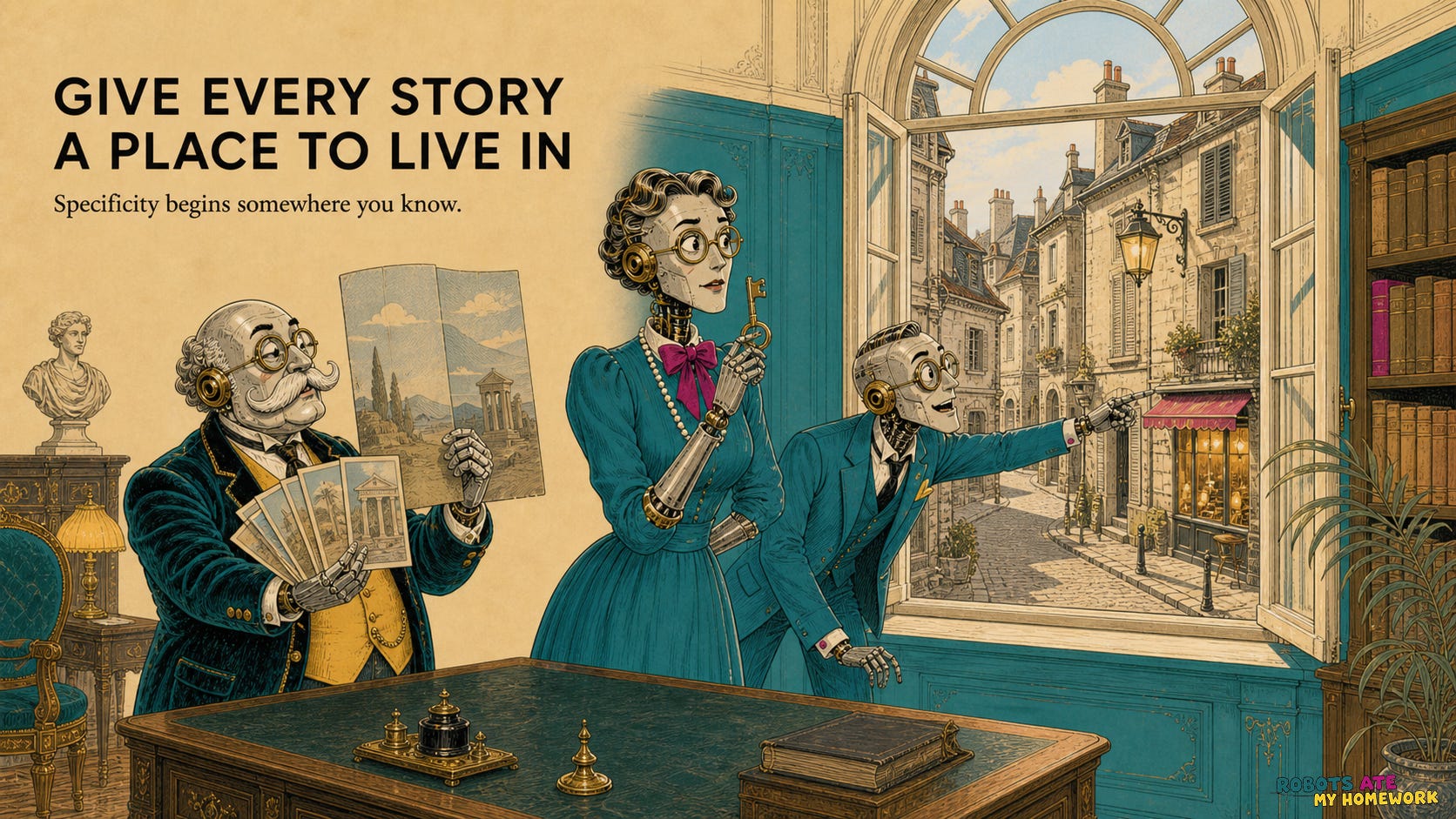
AI will never understand locations the way you do, and if it tries to do so, it’ll probably come back with “my childhood street on a Tuesday at 2 AM” (my friend Dallas Payne would “love” this!)
The locations in my visuals are places that carry atmospheric weight for me, locations I keep close to my heart. It’s never just a cave - it’s Cuevas del Drach in Spain. It’s never a random Greek tavern, never a random London street, never a random Viennese church.
You can always look for “less sexy” places and find the gold in those too. Think about the corner shop you go to every day, where the light hits the bread display differently. Or the smell of pine trees after rain that you can almost certainly translate into a color palette.
The specificity of these comes from real acquaintance with real places, and it shows up in the image even though the viewer will never know what’s real about it.
If and when your work feels generic, check whether you’re building from somewhere you know or somewhere you’ve assembled from a mood board. The difference is acquaintance, and your audience can feel it.
Give every word and every color a little job
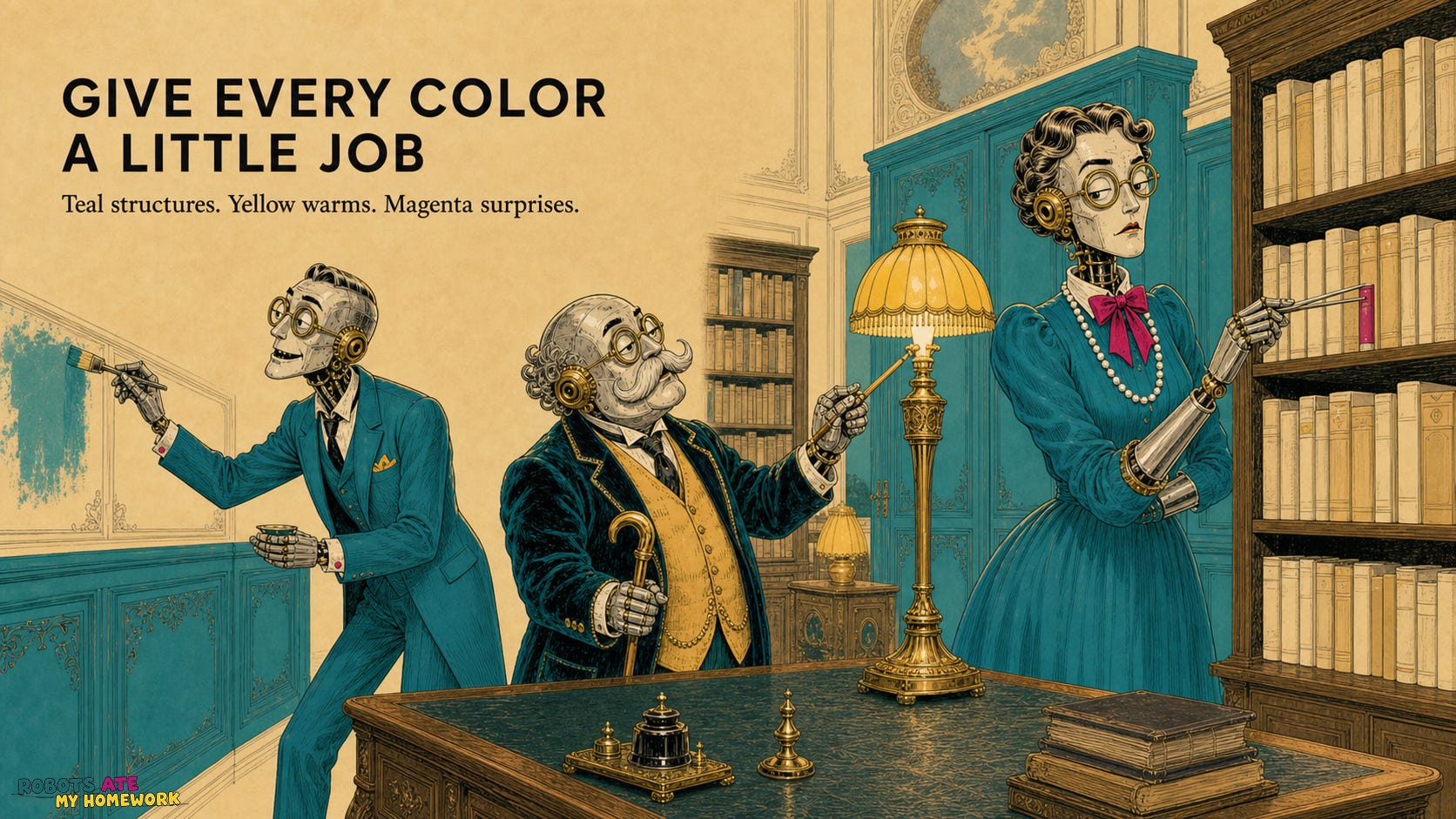
A lot of elements from our work aren’t earning their places, even though they should. You do have default phrases, colors, structures that show up because they’re comfortable. They’re just there, and they should stay there, right? Wrong.
Try to give each one a specific job, and then notice which ones are unemployed, and WHY.
For me, each color has a job. Teal carries the structural atmosphere, the architecture and places. Warm yellow represents all light sources and warmth. Magenta appears as few little accents per image, always functioning as surprise.
This is one of the rare cases where I’ve managed to convert acquaintance INTO description. The color rules started as a feeling that the visual weight was wrong, and over time I found the language to constrain it.
Some of what you know by acquaintance CAN eventually be described, you just need to put some effort into recognizing which parts have language waiting for them and which parts don’t.
Identify and hide things in your work that only YOU can identify
The best work out there has a layer, a “something something” that nobody sees on purpose. Like, details placed for people to feel without noticing.
Or atmospheric choices that make something feel alive.
You’ve probably already been doing this without having a name for it - tucking little things into your work that only register as “this feels right” or “this feels off.”
For me, when someone sees an image and feels a sudden warmth or a shift they can’t explain, the image has done its job.
For example, I’m always tuning to a mood with certain cultural anchors I can point at but can’t transmit through a prompt: sardonic characters inspired by Romanian playwrights, early silent film style, film noir, aged illustrations pulled from 1930s magazines.
One of the things my prompt says is “vintage editorial illustration in the style of 1920s–1940s European graphic art and satirical press illustration” and references different styles and artists from back then, absorbing their taste, NOT copying their work.
The frequency I’m reaching for when I create visuals comes from years of absorbing these references, studying them and building an internal “compass” that makes the difference between “right” and “close enough” before I explain the distinction.
Notice the structure here… years of absorption building an internal compass?
The Invisible Apprenticeship uses the same logic for extracting judgment from creators you admire, converting the dreaded passive exposure into a constraint file you can load into any session.
You’ve also been building this frequency for years, making choices, absorbing references. It can be the dry wit of an author. Or the way a particular filmmaker frames a scene. Or how a singer plays the guitar. You know this frequency just the way I know mine, and it’s showing up in everything you make, even when you can’t name it.
So what is it? What are your playwrights, your film noir, your 1930s magazine?

The Acquaintance Map: four prompts to surface the knowledge AI can’t hold
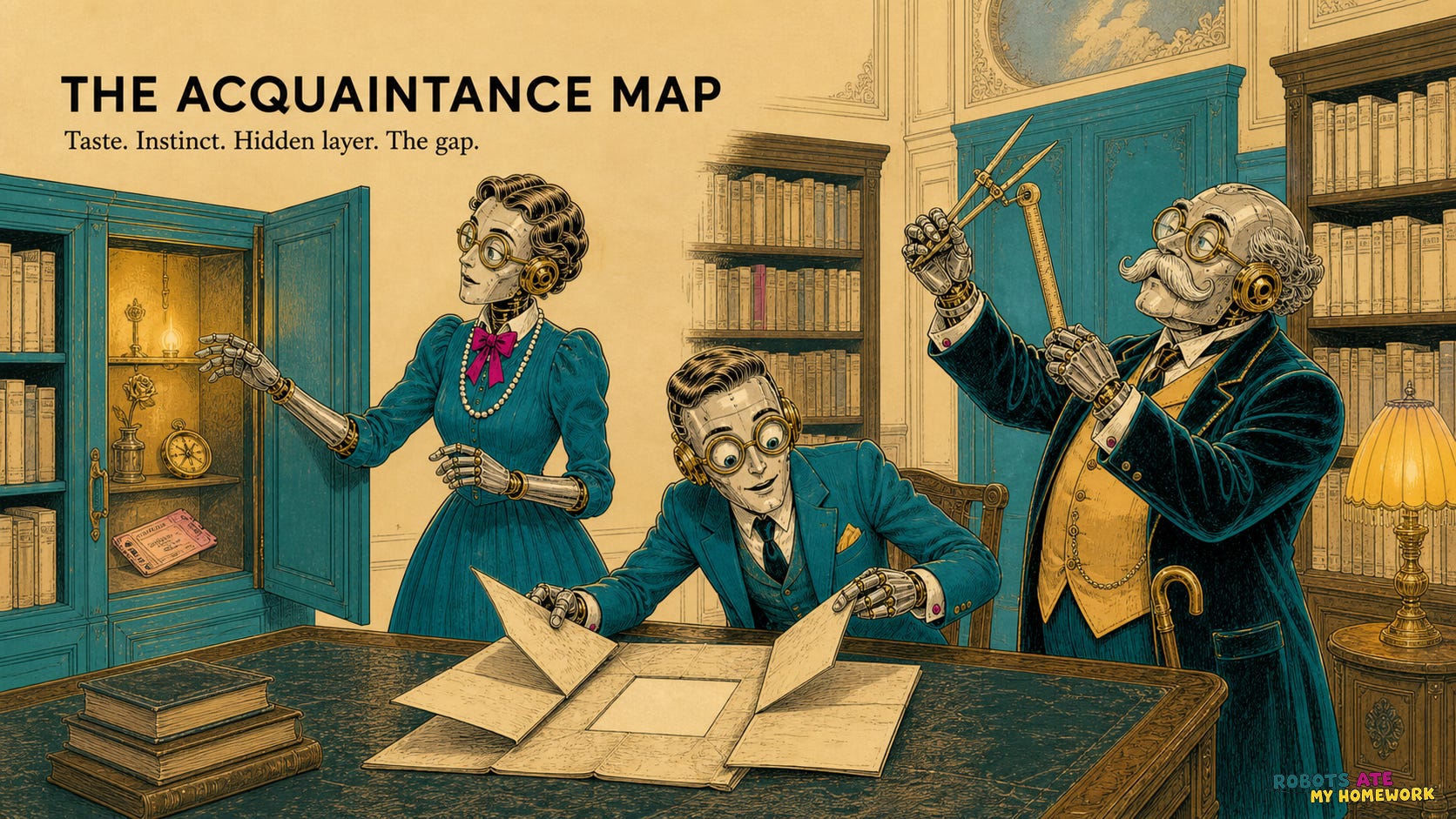
Guess what - you can use AI to surface the knowledge that AI can’t hold.
The prompt below is designed as an AI interview. Paste it into Claude or ChatGPT, fill in the placeholder, and let it ask you into clarity. AI won’t be able to capture those things by itself, you have to do the work.
It guides you through four layers:
1. TASTE
Surfaces your aesthetic world, your recognition instinct, what feels like yours before you can explain why.
2. INSTINCT
Surfaces the judgment calls you make before you can explain them.
3. HIDDEN LAYER
Surfaces the emotional architecture you design into your work that nobody consciously sees.
4. THE GAP
Surfaces the line between what you can encode and what you should stop trying to.
The interview prompt:
I want you to interview me about the knowledge I carry that I've been trying to compress into text for AI. I've been rewriting the same briefs and something essential keeps evaporating. I think the problem is that some of what I know won't fully survive the translation into language, and I want to surface it.

Context about my work:
[BRIEF DESCRIPTION: what you do, what you create, who it's for, what you've been trying to encode]

Your job is to help me excavate four layers of acquaintance, one at a time. Ask me one question at a time. After I answer each question, move to the next layer. Don't summarize or analyze between layers, just keep asking.

LAYER 1: TASTE
Help me surface my aesthetic world, my recognition instinct, what feels like mine before I can explain why. Start with what I'm drawn to in the world, not what I've made. Then dig into patterns: what do these things have in common? What's the thread? What am I recognizing that I haven't named?

LAYER 2: INSTINCT
Help me surface the judgment calls I make before I can explain them. When do I know something is "done"? When do I know an idea is good before I can defend it? When do I reject something and only figure out why later? What signals do I read that I haven't articulated?

LAYER 3: HIDDEN LAYER
Help me surface the details I embed that nobody consciously sees. What do I want people to feel when they experience my work? What specific choices create that feeling? What am I embedding that nobody would catch on a first pass? What's the atmospheric work I'm doing that makes my output feel alive instead of technically correct?

LAYER 4: THE GAP
Help me find the line between what I can encode and what I should stop trying to. Look back at everything I've said in layers 1–3. What's living in description (things I can encode, and AI can work with) versus what's living in acquaintance (things I know from direct experience that won't fully survive the translation)?

After all four layers, write back:

A short profile of my taste in this domain (3 sentences that should feel like a mirror)

A short profile of my instinctive decision-making (what patterns I follow, what signals I read)

A short description of my hidden layer (the emotional architecture I design into my work)

Two lists:

DESCRIPTION (encodable): the parts that CAN be written into a prompt, with specific language I can use

ACQUAINTANCE (bring it yourself): the parts that will stay in me, with a note on how to carry them into AI interactions without trying to flatten them into instructions
Your instinct after running this interview might be to take what came back and add it to a system prompt and turn everything into a set of instructions.
Don’t do that. It’s the encoding reflex again and it will flatten your work, inevitably.
The prompts you use are the base. Your acquaintance and the world you carry are what makes them yours.
Now, tell me:
What’s the one thing in your work that you can’t fully explain, but you know it’s what makes it yours?
You now know the difference between “description” and “acquaintance.” Use it wisely with your AI.
If this is the kind of thinking you want in your inbox, you know what to do.
★ Free subscribers get the Wednesday editions and a starter library inside RobotsOS — your starting point for changing how you use AI.
★ Premium subscribers get the full vault: every ready-to-use system, every framework I don’t publish anywhere else, and the posts that won’t let you think the same way twice.
To everything you know by acquaintance,
Mia Kiraki,
Chief 🤖 at ROBOTS ATE MY HOMEWORK
I’ve never heard of this concept knowledge by acquaintance… it’s going to stay with me!
I've had the feeling many times before that the more thoroughly I describe what I'm going for to AI, the more I realize that it isn't that difficult and I can do it myself. But also in many of those cases I found is because I'm tired or lazy and want the AI to do my work without giving it the necessary context so it produces quality results.
Your example of prompts for images is excellent because using AI for visuals is an area largely undiscovered for me since I'm not so visual and have no knowledge/experience in films, theater, or videos (but I do have lots of respect for those who have that kind of creativity).