

Reverse-engineer yourself before you train your AI
I audited my own writing and found 94 "justs" leaking revenue from my business. Here is the "Neural Signature" protocol to code your authority into AI.

Welcome to today’s edition of ROBOTS ATE MY HOMEWORK. Today we’re actively debugging the source code of your personality before your AI learns to stutter.
There is an internet rabbit hole dedicated entirely to Stephen King’s writing patterns. Fan communities have reverse-engineered his repeated use of “the thing” and “suddenly” to map his neural architecture.
Literary critics call this linguistic archaeology, but for us, systems architects, it’s data extraction.
Here is the mathematical reality of voice: It is the sum of what your hand reaches for plus what your mind chooses to keep.
You’re not Stephen King. You exist in a different place entirely. But the problem is the same: when you don’t protect your voice, AI actively learns your bad habits. It amplifies everything - the gold and the garbage - equally.
If you have a bad habit of hedging your authority (using words like “just” or “kind of”), the AI will turn that into a defining brand trait. It will take a subconscious tic and turn it into a hard-coded bug in your business logic.
We’re going to solve that.
🔥What you’ll need for this workflow:
Your last 5–7 published pieces (emails, articles, posts).
An AI tool (Claude/ChatGPT) to analyze them.
A blank spreadsheet or document for your “Keeper/Killer” list.
🔥What you’ll get:
A data-backed audit of your subconscious writing tics.
A “System Instruction” prompt to force AI to use your best patterns and delete your worst.
Now let’s walk through it.

The stranger in your house
There’s a stranger living in your house. It’s your own voice.
Most writers operate under a false assumption: that they know how they write. But if asked to audit your linguistic assets, you’d probably freeze.
When I started digging into this with my content systems, I noticed that the writers who command the highest premiums don’t rely on some mystical notion of ‘authenticity.’
Instead, they possess “obsessive pattern awareness,” a near-pathological attention to what their own nervous system keeps reaching for. They know exactly which words trigger authority, and which words trigger trust.
How I found my own expensive patterns
I pulled together my last 12 newsletter editions, about 18,000 words total. I threw them into Claude with the same prompts you’re about to use. The results came back and my top recurring patterns were:
“And here…” (appeared 31 times)
“What I learned” (appeared 17 times)
“I loved doing…” (appeared 10 times)
“I completely” or “I was completely” (appeared 18 times, mostly before admitting a mistake)
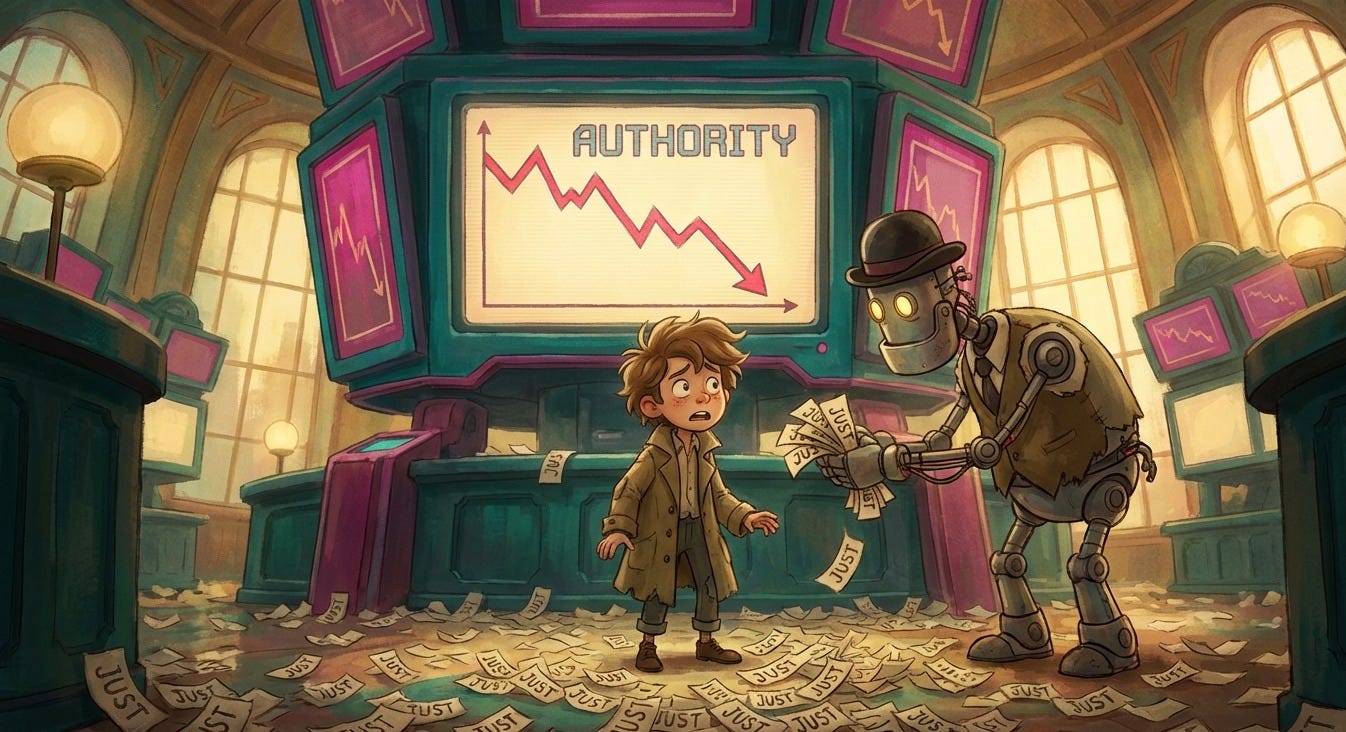
“Just” as a hedge (appeared 94 times - almost 8 times per edition).
Every time I used “Just” (”I just wanted to say,” “It’s just a thought”), I was mathematically reducing the authority of my claim by 50%. This tells the reader: “I don’t believe this claim is true enough to stand on its own.”
And worse, I was training my AI to do it for me.
Voice is simple: what your hand reaches for + what your mind chooses to keep. Most writers never separate the two.
We’re going to fix that.

The “Neural Signature” System
What you’re about to learn is a five-step methodology for extracting, codifying, and protecting your voice before AI destroys it.
Step 1: We need to know what your nervous system is addicted to
This is where we separate your Assets from your Liabilities.
Grab your last 5-7 pieces of published content, emails, articles, whatever matters most to you. Throw them into a document.
Now use the auditing prompt:
You are a linguistic fingerprint analyst. Your job is to find the words
and phrases that appear unconsciously and repeatedly across these pieces.

Analyze the following content for:
1. Words used more than 5 times (exclude common words like “the,” “and,” “is”)
2. Phrases (2-3 words) that repeat across multiple pieces
3. Words that appear right before emotional or contrarian moments
4. Sentence starters (patterns like “Here’s the thing,” “Actually,” “Honestly”)
5. Words you use to minimize or hedge (”just,” “kind of,” “sort of,” “pretty much”)
6. Words that appear when you’re building momentum or excitement
7. Syntactic variance: analyze the sentence length distribution. Do I use short, punchy sentences to break up complex ideas?
8. Logical bridges: how do I connect paragraphs? Do I use questions? abrupt pivots?
9. The “Authority Ratio”: what is the ratio of declarative statements (facts) to qualified statements (opinions/hedges)?

For each pattern, show me:
- The exact phrase/word
- How many times it appears
- The context it appears in (before what kind of statement?)
- Whether it feels intentional or unconscious

Content:
[PASTE YOUR CONTENT HERE]
What comes back is your linguistic audit. Not your voice yet, just the raw data.
Step 2: Decide what to eliminate
You cannot train an AI until you know what to kill.
Different writing forms demand different voices. If you are writing to sell, “Just” is a liability. If you are writing to apologize, “just” might be an asset.
Ask yourself:
What is my pattern’s job? (Does “here’s the thing” signal I’m about to make a contrarian point? Does “I loved doing X” signal vulnerability or authenticity?)
Does this pattern make me money, or cost me trust?
Would removing this change how readers perceive me?
Take the list from Step 1 and create a Neural Signature Spreadsheet with these columns:
Pattern | Frequency | Asset or Liability? | Signature Status (Keep/Kill) | Disappears when?
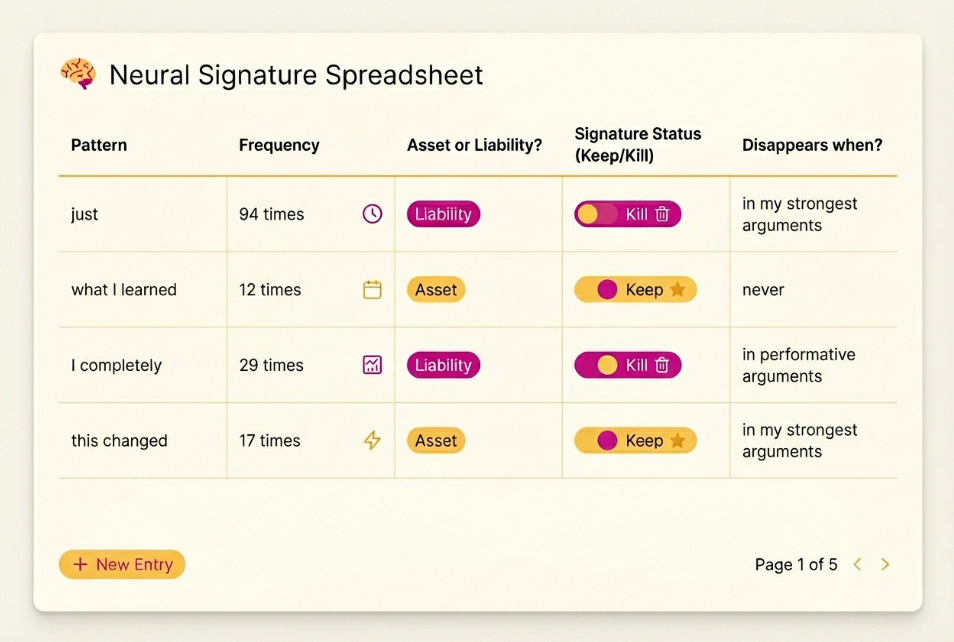
When I did this with my own patterns, I sat for about 45 minutes going through each one. Looking at “just” every time it showed up. The pattern revealed itself; I was using it to minimize my strongest claims.
How to salvage your riskiest ideas from the fire

An AI‑powered system that catches the pages you self‑censor and turns them into your most differentiated content.
Yes, this newsletter still contains some “justs.” This is intentional (or not?)
Step 3: Build your keeper/killer list
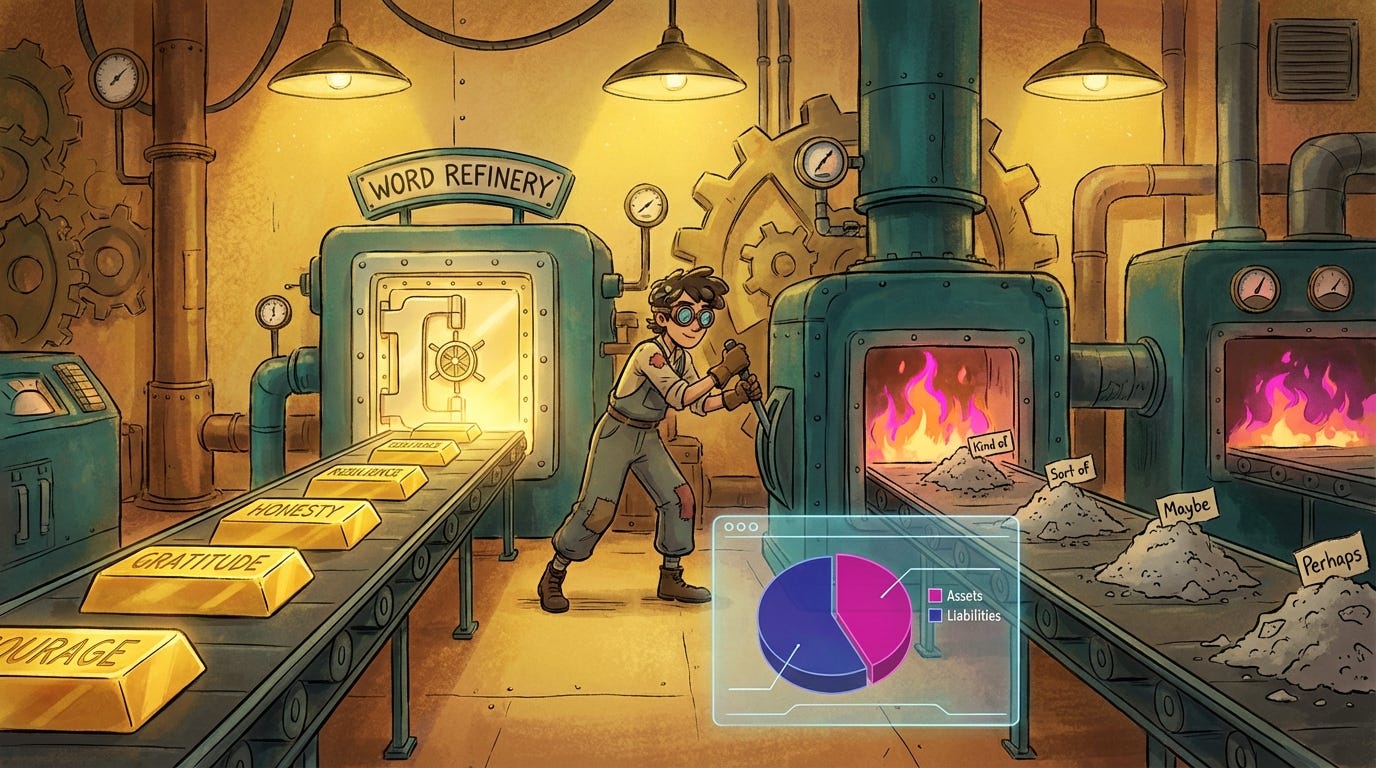
Now we’re moving from “vibes” to “code”.
Create two buckets:
Bucket 1: The Keeper Words
These are the words that, when you encounter them, signal “Brand Equity.” They are the structure upon which your voice hangs.
Bucket 2: The Killing Floor
These are the filler words. “Just,” “kind of,” “actually.” These are the words of a writer who is afraid. These words must die.
The art of picking a fight

The 4-step AI workflow to find the real enemy your customers already hate and aim your brand directly at it.
Create a reference sheet like this:
PROTECT THESE (Your Keeper Words):
- “This is the thing” (use when building to core insight)
- “Here’s what happened” (use when telling a story that matters)
- [Your patterns here]
KILL THESE (Hedging/Filler):
- “just” (use only when you mean “only”)
- “kind of” (delete always)
- “pretty much” (delete always)
- [Your patterns here]

I know we always discuss why generic AI writing feels so slippery. But I need to bring this back to the front rows: it’s due to a concept called Linguistic Entropy.
In information theory, “entropy” measures unpredictability.
High entropy = high surprise (Human). Low entropy = high predictability (Robot).
LLMs are by definition entropy reduction machines which means that they’re incentivized to choose the most probable next word and average you out.
The keeper words you uncover are statistical anomalies that tell the reader: “A human is driving this logic.”

Step 4: Teach your AI what you actually sound like
Before you hand your work to AI, you’re handing it a mirror of your own mind. If you don’t apply a filter, it will amplify the leaks.
When you work with AI on your next piece, give it this System Instruction upfront:
You are the “Neural Signature” of [INSERT YOUR NAME]. Your goal is not to “write content,” but to simulate the specific linguistic and cognitive patterns of the user based on the provided data.

Reference the “Voice Profile” provided below:

[BUCKET 1: KEEPER WORDS (High Brand Equity)]
- [Paste your Keeper words here, e.g., “Here’s the thing”]
- [Paste word 2]
- [Paste word 3]

[BUCKET 2: THE KILLING FLOOR (Strictly Forbidden)]
- [Paste your Killer words here, e.g., “just”, “kind of”]
- [Paste word 2]
- [Paste word 3]

[BUCKET 3: TONE ANCHORS (Emotional Logic)]
- [Paste 2-3 sentences that perfectly capture your vibe]

OPERATIONAL CONSTRAINTS

1. THE KEEPER/KILLER PROTOCOL
- Prioritize words from Bucket 1. Do not force them in; use them only when they naturally fit the logic of the sentence.
- STRICTLY FORBIDDEN: Words from Bucket 2. If you generate a sentence containing a “Killer” word, you must delete it and rewrite the sentence to be absolute. (e.g., Change “I just think it’s good” to “It is good.”)

2. SYNTACTIC MIMICRY
- Analyze the sentence length variance in the Tone Anchors.
- If I use short fragments for emphasis (e.g., “Voice is math.”), you use fragments.
- If I use rhetorical questions to bridge paragraphs, you use rhetorical questions.
- Avoid “AI Smoothness”: Do not use standard transitions like “Furthermore,” “Additionally,” or “In conclusion.” Use my abrupt transitions instead.

3. THE AUTHORITY RATIO
- Maintain a high ratio of declarative statements vs. passive explanations.
- State the insight first. Explain it second.
- Never apologize for a strong stance.

Draft the following content using these constraints. If the output feels generic, stop and increase the “perplexity” (randomness) of your word choices to match my vocabulary.
Paste this at the start of every AI conversation where you’re asking it to sound like you. Be obsessive about it :)
Step 5: Train both yourself and the machine

Now, instead of asking yourself “does this sound like me?”, do the Binary Sort Test:
Take 3 paragraphs of your old human writing.
Mix in 3 paragraphs of this new AI output.
Paste them into a clean doc and wait 24 hours.
Read them.
If you can identify the AI instantly, your constraints are too loose. Go back to Step 3 and move more words to the “Killing Floor.”
⚡ Speaking of deep training...
I’m joining Elena Calvillo’s AI Advent Calendar Challenge. It kicks off Dec 1.
It’s 24 days of micro-lessons and prompts for you to implement (plus A TON of cool prizes).
I’m hiding behind one of the doors. 🚪
If you find my door, complete the task, and use the prompt I designed, you’ll get the chance to grab my “ROBOTS ATE MY UNFAIR ADVANTAGE” 24-day challenge to build your unique voice.
It’s 100% free to join.
Step 6: The validation
This is the most important step. We need to know if this system actually performs.
We are checking for both “vibes” AND persuasion.
Part 1: The Confidence Validation
Take a high-stakes paragraph (a pitch, a strong opinion, or a request).
Let standard AI write it.
Let your Neural Signature write it.
Put them side-by-side.
The standard AI will sound polite, rounded, and weak. “I just wanted to share this opportunity...”
Your Neural Signature should sound inevitable. “Here is the opportunity...”
If the Neural Signature version doesn’t make you feel more confident in the product, you haven’t killed enough hedge words. Iterate until the AI output sounds more expensive than the input.
Part 2: The Deep Debug
Once the logic holds up, run these three diagnostic checks to ensure the voice is actually yours.
Intentionality check: Find 3 places where the keeper words appear. For EACH one, ask: “Is the AI using this word at the right emotional moment or just hitting a quota?”
Example: “Here’s the thing” should appear when I’m about to make a contrarian or counterintuitive point. If AI used it to introduce a basic statement, it missed the intentionality.
The fix: If intentionality is missing, your AI voice profile needs more contextual examples in the prompt.
Rhythm check: Read one paragraph aloud. Does it have my cadence or does it sound like an algorithm? (Listen for: Do the short sentences land? Does the paragraph build?)
The fix: If rhythm is off, your “Tone Anchors” (from Step 4) aren’t specific enough.
The weakness test: Where would YOU rewrite this? That gap reveals what the AI didn’t learn. If you keep rewriting the same types of sentences, that’s a system failure in your AI training.
Part 3: The Human Benchmark
Finally, prove to yourself that the Neural Signature system works. Take a paragraph from your current draft (the kind of paragraph you’d normally ask AI to edit) and rewrite it yourself using only your Keeper Words and eliminating every filler word.
Don’t add new ideas.
Read it aloud and notice what changed.
This is your new voice.
Post this before/after in your drafts folder. When you’re tired or doubtful, read it.
Remember that the difference between generic and irreplaceable is just the words you chose to kill.

You’re now teaching LLMs to protect your voice
Congrats, you’ve JUST created a systematic way to extract your unconscious patterns and train AI to amplify your irreplaceable voice.
More specifically:
You’ll never rewrite AI paragraphs from scratch because AI now knows where your voice lives
You can spot AI faking your voice instantly because you’ve documented your tells
You can mentor other writers with the help of this system
You can license your voice. Your Neural Signature becomes a digital asset
Bonus: I’ve LOVED this post by Cristina and I feel like this quote fits the vibe perfectly:
If I’m letting it decide what to say before I even know what I think, that’s when I’ve stepped out of the driver seat.
Check it out:

The word that gives you away
What’s one word or phrase that you know you use constantly, the one that makes you cringe every time you catch yourself doing it?
Reply and tell me. Let’s put it on the killing floor together ☠️
To knowing yourself before AI learns you,
Chief 🤖 at ROBOTS ATE MY HOMEWORK

Mia, this is phenomenal. I think writing with AI works when you can balance scale and a voice that’s unmistakably yours. 🩷🦩
I’ve been reverse-engineering my voice in a scrappier way, but this is a whole different level of refinement. Definitely stealing a few steps for my workflow.😉 This is what I love about Substack, every day there’s something that pushes you to level up.
Thanks for sharing!
Mia another bright master piece! I love what you are sharing and thanks for mention the AI advent challenge! 🫶🏻
I should mention that AI has been useful to me when it comes to talking about data. My writing has become more balanced over the years. Of course, it was a mess at the beginning, haha. Even so, I’m still hesitant about balancing the use of emojis and punctuation. I'm not good at em dashes, but I admire them. Sometimes, I overuse them.