

You built a voice profile so why does AI still not sound like you?
AI voice profiles document how you write but your voice is a decision engine profiles can't hold. Here's what to build instead, from the creator of a voice profile tool.

I built a voice profile tool and I’m about to tell you that the entire category of voice profiles, mine included, has a framing problem.
The Voice Profile Builder lives inside RobotsOS, free for every subscriber. People have used it to document their writing patterns, feed them into Claude and GPT, and generate drafts that “sound” like them.
The voice profile is one of the best ideas to come out of the AI writing conversation. I’ve built mine, used several others that are excellent, and recommended them to every subscriber I have, and the more I studied what voice is made of, the more I realized every profile was capturing the surface of something much deeper.
Every voice profile ever built is a detailed document that inventories how you write. It is useful (not a throwaway concession), but your voice is something a profile can’t hold, because you aren’t reproducible.
I think in four languages and speak them with varying levels of cooperation from my own brain. In Romanian, there’s a word, dor, that carries homesickness, longing, love, and an ache for something that may not exist anymore, all compressed into three letters. You can translate every semantic component and still lose the word.
The word doesn’t exist in English because centuries of a culture’s experience of loss and distance built it, and no inventory of its parts reconstructs what it feels like to say it.
The same way your voice profile is the translation, thorough, useful, structurally accurate. Your voice is the untranslatable word.
So what is your voice made of, if no inventory reconstructs it? And what should the inventory I built you be doing instead?
─── ⋆⋅☆⋅⋆ ───
Hi, I’m Mia. I write about using AI with a brain and zero circus tricks.
Fair warning: this one’s me admitting I sold you the wrong promise. I fixed it. Here’s why it matters.

What AI voice profiles capture, and the layer they structurally miss
We paste our voice docs into Claude and at first glance, the draft all sounds and looks just about right. Then we keep reading, and reading, and we reach a slightly weird sentence, a paragraph that made a choice we wouldn’t have made.
One of my subscribers used the voice doc generated from my Voice Profile Builder and described his last AI-generated draft as “pretty solid.” That’s the most precise description I’ve ever heard of what a voice profile produces.
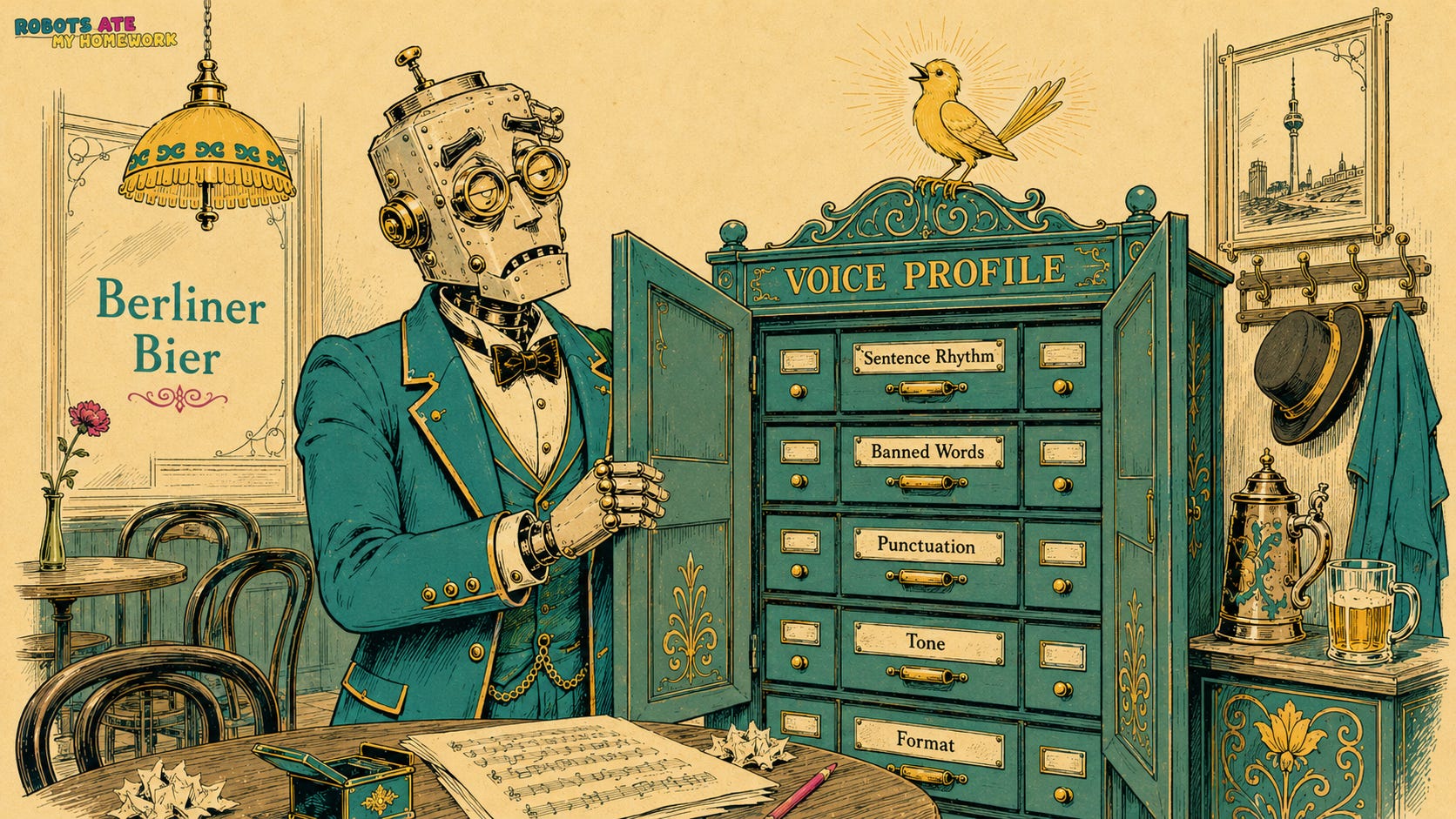
A voice profile is an inventory, it documents WHAT you do on the page:
sentence patterns
banned words
tone preferences
formatting habits
vocabulary range
punctuation signatures.
Your voice is an engine: a responsive decision-making system that generates those patterns in real time, differently every time, depending on the argument you’re making and the audience you’re making it for and the mood you woke up in and the sentence you just deleted because it felt dishonest.
Christin , one of my RAMH community members, compared it to asking a cat to bark like a dog. You could teach the cat to approximate a bark, and it would always sound like a cat doing a dog impression.
So what would you need to hand the cat for it to bark convincingly? Everything.
You’d have to hand over your entire life
Linguists call your unique language patterns your idiolect. It’s shaped by every language you think in, every book you read at fifteen, every city where you learned to argue, every grandmother whose storytelling cadence you absorbed without noticing.
Mine was shaped by four languages, but also by poetry and by the kind of dinner tables where an argument about art could last longer than the meal.
When I reach for a metaphor, my mind sometimes offers one from Romanian or Spanish logic before it offers an English one, and the resulting sentence carries a structural foreignness that no vocabulary list would predict. That foreignness is part of my voice and it’s not documentable.
Yours has its own version of this, patterns shaped by forces you never cataloged.
Amelia Stewart told me that getting AI to replicate her voice has been IMPOSSIBLE because so much of how she thinks and writes isn't linear. AI forms ideas fully, even when it's guessing, but humans have half-thoughts, partial connections, threads that trail off and loop back. The thing about humans, she said, is that:
We're imperfect beings, and AI doesn't know that a half-finished thought is a thing that can be good, so it fakes one.
And your idiolect isn’t even stable. You shift your voice all the time. Jean Duteau told me he looked at his own papers and couldn’t find a consistent voice himself, so what sense does it make to ask Claude to find one?
A voice profile captures one configuration and treats it as the whole system.
Underneath both of these sits the layer that matters most for understanding why AI drafts feel off: your rejection architecture.
What you delete matters MORE than what you keep. Voice is defined as much by what makes you cringe as by what makes you proud, what you’d never write.
Think about the last time you deleted a sentence that you didn’t quite like... You probably couldn’t articulate a rule for why you killed it. You just knew. That “just knew” is your engine operating below the surface, built from writing you’ve admired and writing you’ve despised, and it’s contextual, emotional, instinctive in ways that no document could hold.
It’s the part you can’t hand to an AI, because you can’t hand it to yourself.
You’d have to hand over your entire life, wouldn’t you?
Why AI always drifts away from your writing voice
So you’ve built a detailed voice profile and loaded it into your AI project.
Here’s what happens when the model picks it up, and why the ceiling is structural:
Instruction degradation. Your voice profile acts as a soft bias competing against the AI’s training data. In the first few hundred words, the bias is strong, your patterns are fresh in the context, and the output sounds like you. By paragraph twelve of a 3,000-word generation, your patterns have lost their grip and the output has reverted to its statistical average. Your voice, loud at the start, fading by the middle. Built into how these models work.
Surface pattern mimicry. LLMs reproduce the WHAT without the WHY. It can match your sentence rhythm but can’t judge when to break that rhythm because the argument demands it. It copies the pattern without grasping the logic that generated it. For example, Dallas Payne has a voice profile that’s a blend of three different approaches (all excellent, none quite right) and she asked Claude what it struggles with most, to which it responded:
"Tempo has to be right on the first pass or the whole thing feels retrofitted. And my default rhythm is longer, more composed, more resolved than yours. I build toward conclusions. I complete thoughts. I close loops. Dallas interrupts herself, drops a one-word reaction, trails into dry resignation, then cuts dead with three words in full caps." - Claude
Probabilistic consistency. It’s already common knowledge that LLMs predict the most statistically likely next token given everything that came before. This strips out natural human variance, like your creative unpredictability. Juan Gonzalez told the RAMH community his AI output sounds like an overly enthusiastic, obnoxiously encouraging YouTube explainer narrator. He thinks it’s because he’s so diverse in perspectives that every attempt to pin him down turns his voice into a caricature version of itself. And he’s right, because the model can only converge on one statistical center.
The textual uncanny valley. Not wrong. Not right. The structure is there, the vocabulary is yours, the rhythm is close, but SOMETHING (the psychological depth, maybe?) is absent. You and your readers can feel it before you can name it.
“The AI puts words together that look like they work, but when you reach for them, there’s nothing there.” - Matt Thieleman
How to actually use your AI voice profile
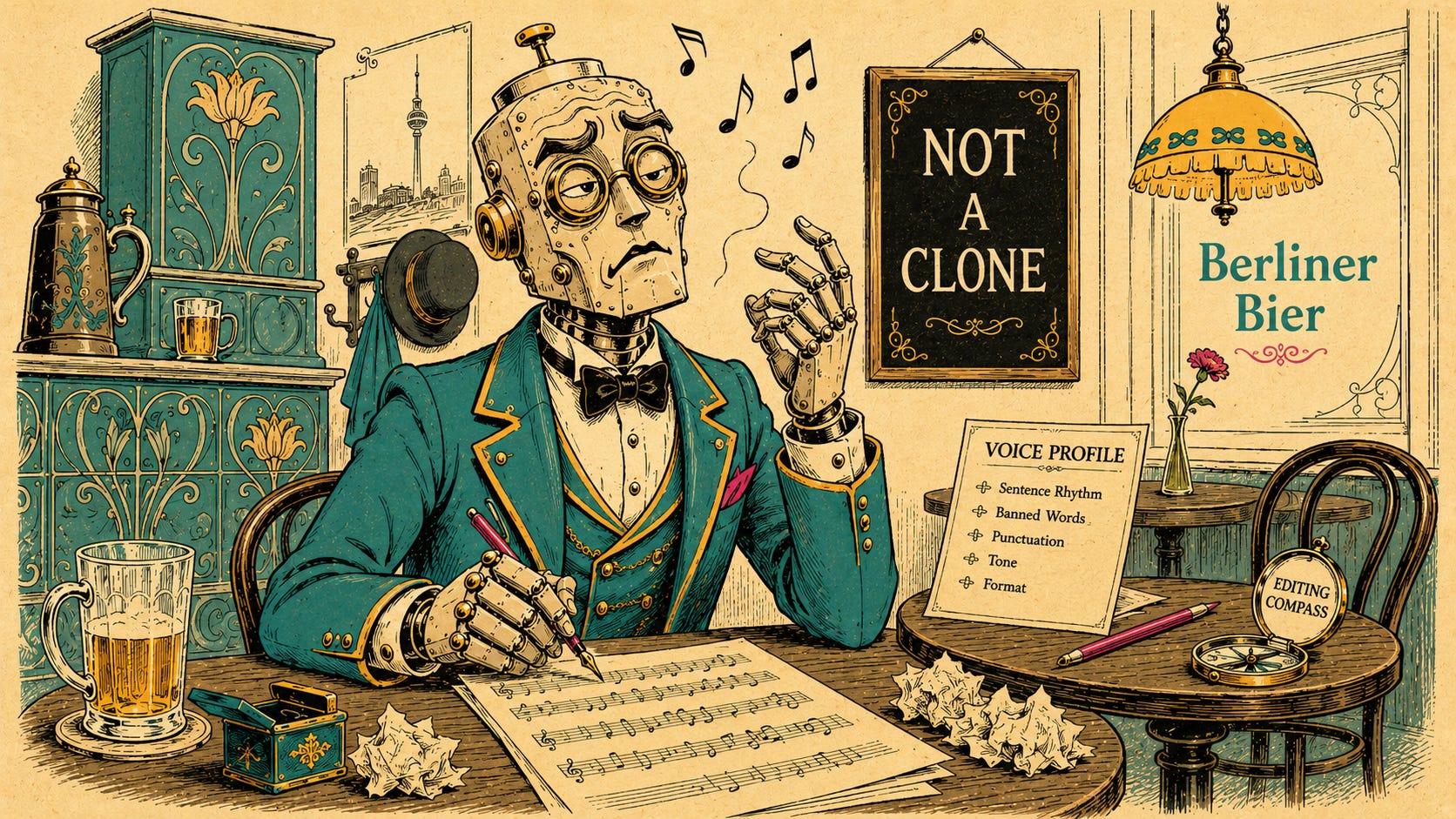
Voice profiles are mislabeled. They were sold (by me, among others) as voice reproduction tools. They are something more useful than that, once you stop expecting them to do what they structurally can’t do.
Ryan Sears, PharmD told me he doesn't use his AI voice profile as a 1:1 replacement for his identity and doesn't want to. The cognitive scaffolding is everything, he said, especially with ADHD: it's easier to rework something that's off than to build from a blank page. Michael Bender , who has been creating content since the early 2000s, uses his profile the same way, recording walking talks on his iPhone and letting AI produce a rough draft he can shape. Both of them treat the profile as a starting engine.
I asked my RAMH community what AI keeps getting wrong about their voice and the answers were so good. Nobody uses voice profiles to clone their voices. The thread is worth reading, so, join our chat:

It seems that, for a lot of people, a voice profile is a mirror that shows you yourself by showing you what you’re not.
Use AI to brainstorm. Use it to organize your thinking. Use it to generate a first pass you can work from. Use your voice profile to guide all of that. But NEVER believe it will sound like you. “Pretty solid” is the ceiling.
Once you accept the ceiling, the voice profile becomes three things:
An editing compass. Your voice profile tells you where to look when something feels off. Instead of reading an entire draft with a vague sense of wrongness, you can check the patterns the profile documents and find the sentences where AI substituted its preferences for yours.
A drift detector. Load your profile into a project, generate a draft, then use the profile as a diagnostic overlay.
A quality gate. Before anything you publish, the profile gives you checkable criteria for “does this pass as mine.”
The profile handles the reproducible 80%. Your job is the irreproducible 20%.
How I rebuilt the Voice Profile Builder
The Voice Profile Builder was one of the first tools I shipped in RobotsOS.
The interview process, the Mirror Moment, the Cringe Test, the Rewrite Test, the Never List, all of that worked.
The original product description said it would “teach AI your exact writing voice” and that “from that point on, everything it generates sounds like you wrote it.”
I wrote that copy, then I spent months watching people use the tool and noticing the same ceiling I just spent three sections explaining to you.
So I did make some changes.
Voice clone vs. working system
The Voice Profile Builder no longer claims AI will sound like you. The new framing:
Turn the way you write into a working system for AI.
The profile documents your patterns so precisely that AI output stays close to you on the surface, and your editing becomes fast and targeted because you know exactly where to look.
The old promise set you up to be disappointed by a structural ceiling, then blame yourself (or the profile) when the output stopped sounding like you.
The new promise describes what the tool delivers.
What the updated voice profile maps
The original template documented your patterns across seventeen sections, all limited to the reproducible surface.
The updated version adds an Engine Decisions layer underneath, with three sections that try to document the judgment patterns no inventory captures:
First: rejection architecture. This traces your bans back to their origins, a specific influence, an experience, a conviction that formed the allergy, giving AI reasoning to work with instead of probability alone. Lee Drozak discovered this herself. Her written samples were so self-edited that AI was learning a filtered version of her voice, and switching to raw voice dictation changed everything.
Second: contextual shift logic. This maps how your voice reconfigures for different audiences and stakes, and why.
Third: judgment calls the AI will get wrong. This names the decision types where AI’s probable choice diverges from yours.
Giving AI a map of your judgment patterns narrows the gap, and every percentage point you close on the AI side is editing time you get back.
The interview you go through to create your voice profile changed too.
After the Cringe Test identifies your strongest reactions, it now asks where the reaction came from, the writer, the trend, the moment where you thought “I never want to sound like that.”
A new Judgment Audit section asks you to walk through a sentence where you made a choice you couldn’t explain and a piece that surprised even you. Hard to answer (I struggled with my own), but even two or three concrete examples make the Engine Decisions section much more real than before.
And the profile now handles drift honestly.
I added a degradation warning that tells you upfront: the voice profile holds strongest at the start of a generation, and you should expect increased drift over 800+ words. Two new flags, [DRIFT CHECK] and [JUDGMENT CALL NEEDED], make the LLM’s uncertainty visible instead of burying it under smooth-sounding output.
Your idiolect is still yours, shaped by every dinner table argument and every book you read at fifteen. No profile is going to hold all of that (and if one ever claims to, be suspicious).
However, a document that maps your judgment patterns, your allergies, your contextual shifts, gets AI close enough that when you sit down to edit, you're fixing sentences instead of rewriting a stranger's draft.
Is your voice profile still the old version?
The updated Voice Profile Builder is free to download for all subscribers. It lives in RobotsOS.
★ Free subscribers get the Wednesday editions and a starter library inside RobotsOS — enough to change how you use AI.
★ Premium subscribers get the full vault: every ready-to-use system, every framework I don’t publish anywhere else, and the posts that won’t let you think the same way twice.
If you’ve already built a voice profile with the original version, you can download the updated version and ask your AI to take you through it so you can update your voice profile. Trust me, it’s worth it.

Now I want to hear yours: What’s one thing your AI output keeps getting wrong about your voice that you can’t seem to fix, no matter how detailed your profile gets?
To every untranslatable word and every writer who knew the profile was just the beginning,
Mia Kiraki,
Chief 🤖 at ROBOTS ATE MY HOMEWORK
Phenomenal writeup as always, Mia!
When you said “a voice profile is a mirror that shows you yourself by showing you what you’re not,” that crystallized things in a way that my own response did not.
I love that you took the responses and made tweaks to your service!
Your brilliance shines through in every language. 🙂
I really respect your willingness to pivot and say "this didn't work exactly how I thought it would" and then reshape it. I think that's much more valuable than expecting to get everything perfectly right the first time.