

The post-AI internet needs a different kind of literacy
Professors spotted the emptiness in student essays. These six markers help you spot it everywhere you scroll.


Most of you reading this newsletter have experienced the internet back in the '90s and 2000s and it was magical, more interesting and full of substance than it is today. We know how good it felt to switch off for the day and spend an hour doing “internet stuff” - in my case downloading and making music, scrolling forums and downloading pics of my favorite actors, and reading summaries of my favorite films because I wasn’t home to watch them.
These ordinary moments have long gone and have been replaced by vapidness.
I can’t scroll for fun anymore. I post on LinkedIn and vanish (which is probably not great, but I can’t be bothered reading anything there). When a blog post ranks at the top for something I’m researching, I click in hoping and leave extra annoyed because I just wasted my time. When something goes viral and everyone’s sharing it, I go read it and the whole time I’m thinking, this really could’ve been two paragraphs.
In a New Yorker piece from Jay Caspian Kang, twelve professors describe what happened when AI arrived in their classrooms. Jane Sloan Peters said her students produce “perfectly vapid” essays that cover everything but say nothing.
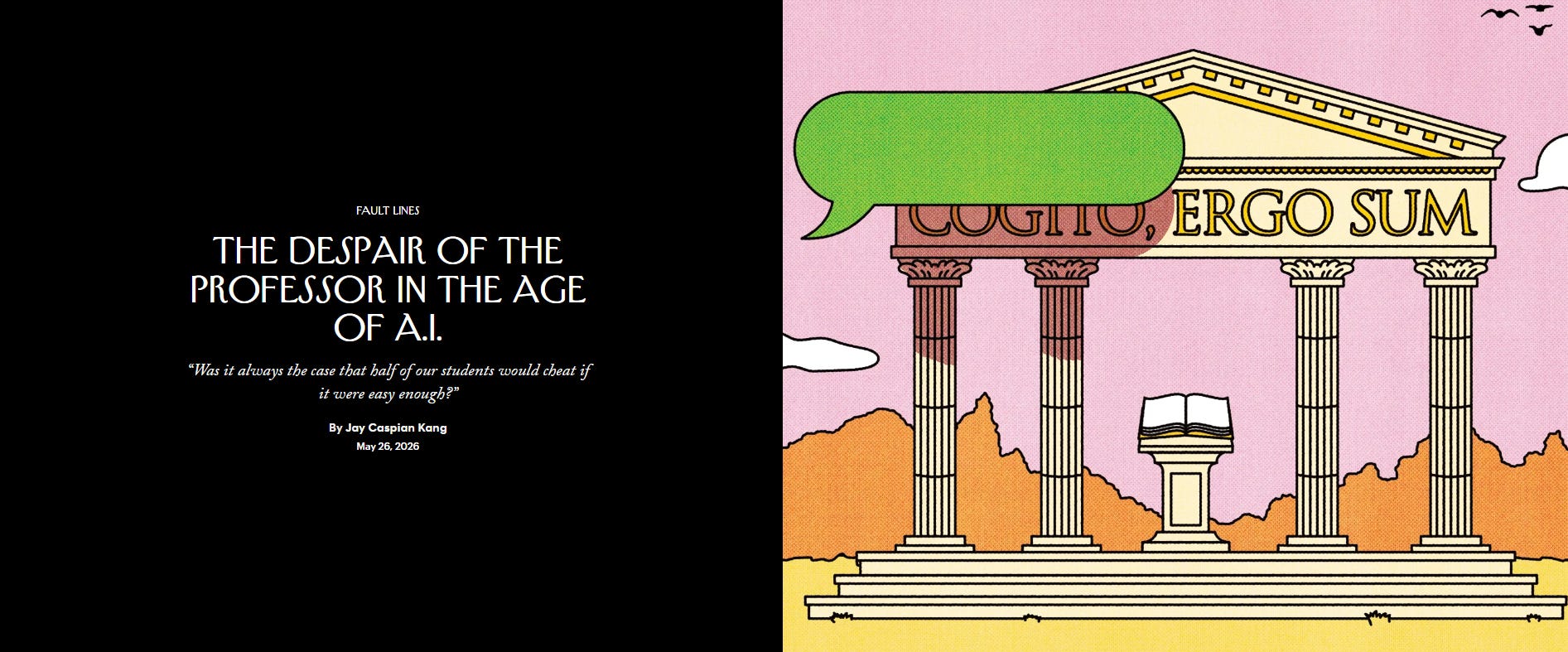
Peters suspected AI, but couldn’t prove it.
From an educational POV, these professors spent months with these minds. They’ve seen how the same students would argue, struggle, discover, and not long after that, watched them hand in something bland, vapid.
This seems to be a pattern, whether it’s in a classroom or in front of our screens.
I’ve read the professors, I’ve studied their strategies, and I built a few markers that once you have them, you’ll spot vapid content the same way these professors spot a student who handed their thinking to a machine.
We’ll start changing what gets rewarded online.
For this piece, I invited Dr Sam Illingworth to contribute.
He's a full professor of critical AI literacy, founder of Slow AI , a friend, and one of the few people whose work I respect most in this space. Slow AI is also 1 today! To celebrate readers can enjoy 30% discount off an annual membership. This will apply automatically to all new subscribers up until 23:59 on Sunday 5th July.
While the rest of us are debating whether AI makes us lazier, Sam is researching what it does to our capacity to think critically. That's a harder and more important question.
─── ⋆⋅☆⋅⋆ ───
Hi, I’m Mia. Welcome to ROBOTS ATE MY HOMEWORK. On this side of the world, we use AI with a brain and zero circus tricks.
After today, you won’t be able to scroll the way you used to.

What happens when forty essays sound like one?
Neal Hebert teaches theater at Grambling State University. Last year he assigned papers on Fences, August Wilson’s Pulitzer-winning play about a Black family in 1950s Pittsburgh. Out of forty students, the majority of them turned in work with similar phrasing, similar concepts, and similar structure, written in what Hebert called
“elevator muzak, but in words.”
The students had all read the play and they’d all sat in the same classroom and discussed it.
But the papers read like one mind approaching the material from one direction, then copying its own answer forty times. The phrasing varied just enough to avoid an exact match, which is what made it so easy to feel and so hard to prove.
Jane Sloan Peters saw the same phenomenon but from a different angle. Her students were creating work that covered everything and said nothing: tidy summaries that read like book jackets, organized and fluent and hollow.
“perfectly vapid” course themes that somehow took account of everything while not saying much.
The work hit every required point, but it was empty.
And then, the most surprising example, at least for me: Beth Ritter-Conn, who teaches religion at Belmont University, gave her Honors students a reflection journal. The only instruction was
“tell me what you are thinking inside your own head.”
The only task was the thinking itself, and guess what, the students handed it to a machine.
Those accounts are all from Kang’s piece, and they all mean a great deal for our conversation today, but I wanted to hear this from someone I could actually sit down with.
Dr Sam Illingworth is a professor of critical AI literacy at Edinburgh Napier University and a great friend of mine. His whole discipline is about teaching people what happens to their thinking when they hand it to a machine. And what to do about it.
I asked Sam what he’s seeing from inside that:
Watch what happens when a student hands their thinking to a machine. The essay arrives polished, on time, and hollow.
Critical thinking is a muscle you build by doing the lower-order work badly. Remembering. Struggling to understand. Writing a first paragraph that is wrong and feeling, in your body, why it is wrong. That friction is where judgement forms. It is slow, it is uncomfortable, and it was always the point.
AI removes exactly that part. The output still appears, faster and cleaner than before, so nothing looks broken. The deadline is met, the points are covered, the prose is fluent. What has gone is the bit you cannot see on the page: the moment a person took a position and risked being wrong.
This is why the essays read as vapid. Vapidness is what is left when you take the commitment out of a piece of writing, and commitment needs someone willing to be challenged. As professors we can feel the absence because spend hours watching these students argue, struggle and change their minds. We knew what was there before, so we can name what is missing now.
The same thing is happening to all of us, one scroll at a time. Each time the thinking gets quietly outsourced, the capacity to do it ourselves thins a little further. The skill fades slowly. Silence is usually the first sign.
These professors could see the emptiness because they could see the whole person behind the work. They had semesters of conversations, so the before and the after were both visible.
When you’re reading an article or scrolling through a feed, you don’t have that context. You only see the surface.

The six markers and how to train your eye for what’s missing
Daniel Silver, a sociology professor at the University of Toronto, showed his students their AI-generated assignments side by side. Work that seemed perfectly fine on its own suddenly felt totally generic.
He calls these replacement-level assignments. Borrowed from sports analytics: the minimum viable output that could come from anywhere.
Now, you can train the same eye without a professor holding the mirror, and without comparing pieces side by side.
I started building six markers after the constant feeling of consuming content that left me with nothing.
The professors’ testimony were an eye opener and gave me a name for it, but naming it didn’t really solve the problem. You still need a way to see it.
So I looked at how humans evaluate whether something has substance or not. I looked into research on how people judge credibility and how the brain decides if something that’s said is worth remembering.
The pattern was: substance is commitment.
Every piece of content that actually says something is committed to something, a little detail, a position that could be wrong, a voice behind the words, a tension that doesn’t resolve neatly.
Take away the commitment and you’re left with the shape of content without the content.
That’s what these six markers test:
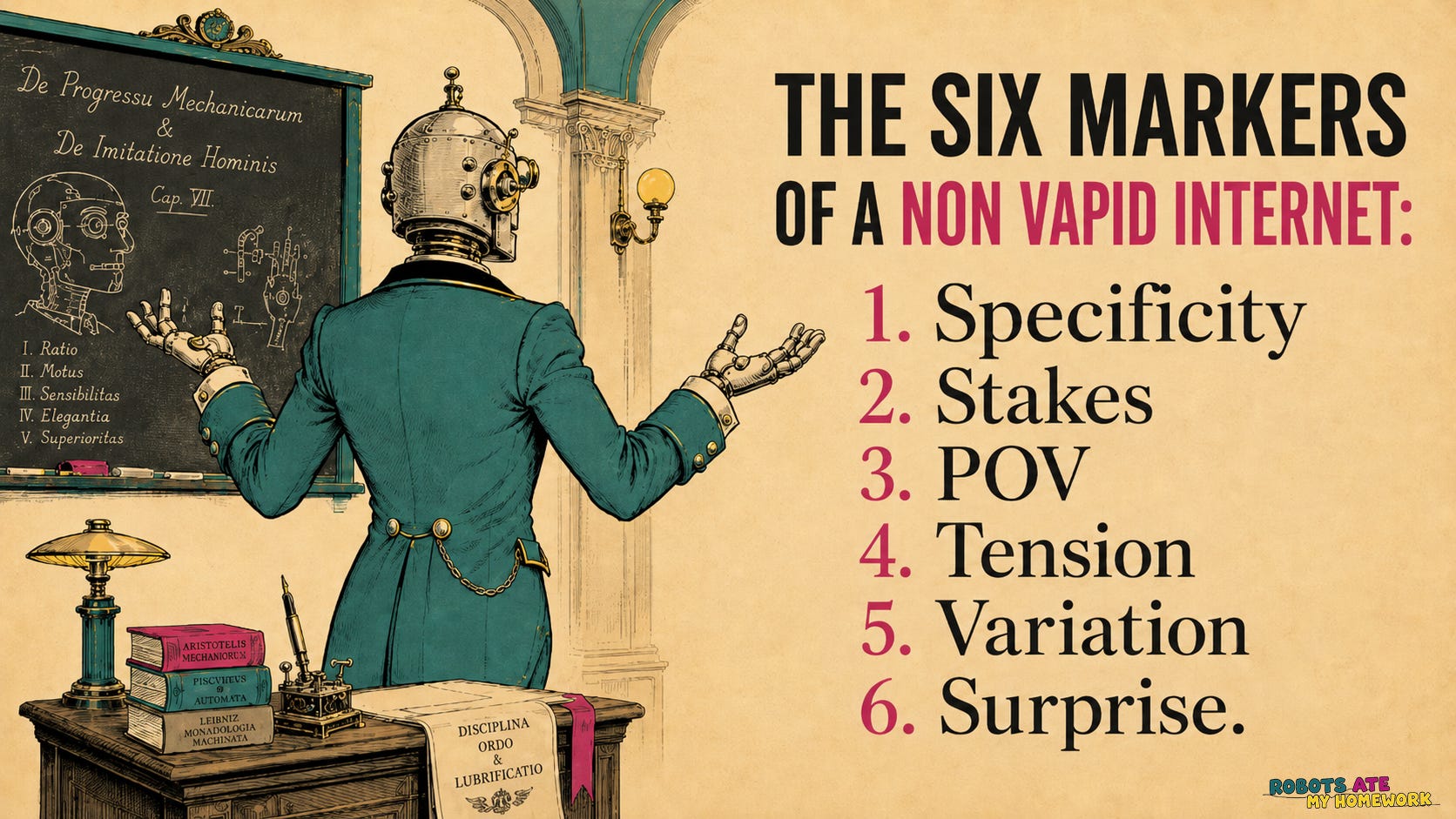
Specificity - does this name things?
Vapid content talks about “approaches” or “Strategies” in ways that could apply to any topic.
Substantive content names the strategy, who used it, what happened when they did it.
In psychology, construal level refers to how abstract language creates psychological distance and concrete language pulls things close.
Vapid content lives in the abstract - nothing can be wrong if nothing is specific.
How to spot it: if you can swap the topic of what you’re reading for a completely different one and the sentences still work.. you’re reading something vapid.
Stakes - does this commit to a claim that could be wrong?
Harry Frankfurt defined bullshit as communication that is indifferent to whether it’s true or false.
INDIFFERENT.
Vapid content doesn’t commit to anything. Committing means risking being challenged.
How to spot it: after you’ve read / watched the whole thing, ask whether or not it was arguing against or for something. If the answer is “not really”, that’s the stakes marker failing.
POV - does this argue from somewhere, or does it balance everything into neutrality?
You can sense this one almost instantly. Vapid content accounts for all perspectives equally - like it’s afraid of losing any potential reader.
Substantive content must have a person behind the argument who deliberately chose a side.
Research on how writers signal authorship (linguists call this “stance”) shows that real writers make deliberate choices about what they emphasize and what they choose to commit to.
Vapid content hedges everything because commitment always requires a person.
How to spot it: ask “who’s saying this?” That’s it, you know where to go from there.
Tension - does this acknowledge that something is contested or unresolved?
As opposed to vapid content, substantive content sits with at least one contradiction.
The real world involves a ton of friction, so, naturally, real thinking involves friction too.
Arguments in rhetorical theory have a component called rebuttal: the acknowledgment that reasonable people might disagree, that the evidence cuts both ways.
Vapid content skips this step because it never actually argued or pushed against something.
How to spot it: does the piece admit anything is complicated? Anything at all? If every sentence reinforces the same point without a single “except” in sight, then the tension marker failed.
Variation - does this shift in direction at any point?
If it reads at one speed from start to finish, it’s vapid.
When information is easy to process, people judge it as more truthful. That doesn’t mean making a piece of content dumb, not at all. I repeat, do NOT dumb down your content, or make it shorter, or use simpler words, just because someone tells you to. This is about something else entirely.
Fluency creates a false sense of substance. Content that feels smooth from start to finish triggers that judgement automatically, which is why it’s so hard to catch.
The mechanics behind that trick (why your brain reads smoothness as substance) involve something called perplexity and burstiness. I broke down the numbers here:

Real thinking has peaks and valleys, of different heights. It speeds up during interesting parts, and sometimes slows down for the complicated ones.
How to spot it: read it aloud or just imagine reading it aloud. Does your internal pace ever change? Do you feel like performing for an audience? That’s good news!
Surprise - does this include at least one idea you didn’t expect?
Substantive content makes you pause, at least once.
We, as humans, LOVE unexpected and interesting connections. Vapid content never does. It conforms.
How to spot it: close the tab and name one thing the piece said that you didn’t already know.
Any single marker failing might not mean much on its own… Some writing is specific but has no POV. Some writing takes bold positions but never acknowledges tension.
As with everything we analyze, praise, and judge over here, what you’re looking for is the pattern. When three or four markers fail at the same time, you’re reading or watching something vapid.
Once you see these patterns, you’ll spot them everywhere.
Redesigning the room where thinking happens
The professors saw the emptiness settling in their classrooms, and instead of just accepting it (like most of us would probably do), they started redesigning their environments.
Daniel Silver built multi-agent simulations where his sociology students had to construct representations of thinkers, and then experiment with them. To make an agent argue credibly as Adam Smith, a student has to actually understand what Smith believed, doesn’t he? That’s not a small thing, at all.

The best projects showed way more creativity and intellectual depth than a typical second-year essay would have managed.
The lesson is, when you come across a piece of content claiming to explain a position or methodology, ask yourself whether it could survive a real conversation with someone who holds that position. Vapid content collapses there… it was never built for that pressure.
Neal Hebert went in the opposite direction and instead of assigning better-known plays, he started assigning obscure ones. He scoured lesser-known anthologies for plays so rare that ChatGPT had nothing to go on.
“If ChatGPT is used on these assignments now, it hallucinates characters, plotlines.. it just makes shit up.”
Silver redesigned the assignment, Hebert restricted the material and both approaches worked because they made the task impossible for AI to fake.
Dr Sam Illingworth is doing something different:
I do not tell students to put the tool down. Telling people not to use AI has the same success rate as telling them not to use the internet, and it teaches them nothing about either. I do something slower. I make them read what the machine gives back.
My whole discipline rests on one move: treat the AI output as a text to be close-read, the way you would read a poem. I train students to ask one question of any AI answer: what is it doing, and what has it quietly left out.
Here is what that looks like in a room.
I give students a prompt, a tool, and a question they actually care about. I ask them to run it. Then, before anyone reacts to the answer, we read it together, slowly, out loud. And I ask three things:
Where does it sound most confident? That is usually where it has the least to stand on.
What has it flattened? Name the specific thing it smoothed into a category.
What is missing that you, in this room, happen to know is there?
That last question is the one that changes people. I once asked a group to have an AI describe a place each of them knew well. Their own street, a grandmother’s kitchen, a ward they had worked on. The tool produced fluent, plausible, generic prose every time. And every student could point to the exact sentence where the real thing had been replaced by the average of a million other things. They felt the missingness because they brought the knowledge the machine did not have.
That is the skill: standing next to the output and saying, precisely, what is absent from it.
The four things I am really protecting are student-centredness, trust, relevance and agency. The detector model attacks all four. It casts the teacher as a police officer and the student as a suspect, and it teaches nobody to think. Close-reading the output does the opposite work. The student becomes the one with judgement in the room. The machine becomes the thing being assessed.
What changes when someone develops this? They stop outsourcing the question of value. They read a confident paragraph and feel, automatically now, whether anyone committed to it. They have done to AI writing exactly what these six markers do to a feed: trained the eye for what is not there.
You cannot police a person into thinking critically. You can give them a tool, an output, and permission to take it apart. Most of them have never been told they are allowed to.
At the time I designed the six markers, I thought they were obvious… I imagined that of course we check for surprise when we browse the internet. Of course we like strong takes!
In hindsight, the “obvious” part isn’t so obvious anymore.
Every time you stop giving attention to something vapid and go find something substantive instead, you’re raising the bar for what gets rewarded.

We’re not going back to dial-up and burning CDs (but feel free to listen to music in any shape or form, I still use my CDs, cassettes, and vinyls!).
That internet is gone, and the people filling feeds with elevator-muzak prose aren’t going to stop anytime soon.
The markers above aren’t nostalgia, but a filter. You apply them and the noise drops. What’s left gets your attention.
That’s how we raise the bar. One reader at a time, choosing substance over the surface that looks like substance but isn’t.
I built an AI skill called The Vapidness Checker that flips this lens onto your own work. Everything above trains your eye for what you read. The skill catches vapidness in what you’re about to publish.
It runs the six markers on any draft, brief, or document you paste in and gives you a marker-by-marker read:
Where you’re being specific and where you’re gesturing at categories
Where you’ve committed to a position and where you’re hedging
Where you have real tension and where you’ve smoothed everything into agreement
The skill is free for all ROBOTS ATE MY HOMEWORK premium subscribers. Download it here:
Peters stood in front of her class and grieved because the thinking had disappeared behind a wall of coherent, tidy, perfectly organized prose. She could see what was missing because she knew what it looked like when it was there.
You can see it now too.
To you, the one who stopped scrolling and asked “does this say anything?”,
Mia Kiraki,
Chief 🤖 at ROBOTS ATE MY HOMEWORK
 | A guest post by
|
A digital friend of mine teaches media law. She is also on the stack. She built a custom GPT whose only job is to argue against her students. Basically, to attack their reasoning until they either had an answer or didn't. Sam's approach reminds me of hers. Both of them understood that the tool isn't the problem. The absence of friction is the problem. Remove the struggle, and you remove the learning. Every educator I know who's getting this right is building friction back in, not banning the tool.
Great collab, Mia and Sam.
I do remember and have nostalgia for the internet of the late 90s early 2000s. It was a magical place with so much possibilities. That's why if people now could skip everything hollow, they would skip 90% of what's online (maybe more) and then have more time to be outside. Sad thing.
On the other hand, AI usage in academia and "traditional education" didn't create a crisis or "destroyed" students thinking. It just revealed the system for what it is. A heavily outdated system that doesn't educate but rather indoctrinate people. A relic of the past century that refuses to die because the incentives are monetary rather than educational.
And in my case, since I've spent quite the years in this learning space I've seen the writing appearing on the wall.
But also, the 6 markers you presented reminds me of my first posts online and my first talks given. I can just give general abstract examples and let the people fill in with their more concrete ones. I don't give any hot takes so no one can come and challenge me on the views. I present the content to people and come out unscathed of the criticism 😆(that of course would keep working if it weren't for the pesky AI that forced us to me more "personable" and put in our POVs).
Anyway... Great work on this piece, folks. Naming the problem but also presenting great solutions!