

Autocomplete is stealing your homework
How to rebuild your writing brain when AI keeps trying to finish your sentences for you.

Welcome to today’s edition of ROBOTS ATE MY HOMEWORK. Today we’re talking about that microsecond of panic when you stare at a blank cursor and realize you have nothing to say until you hit “Generate.”
In the 1930s, the psychologist Lev Vygotsky realized that temporary support helps children master complex skills but only if that support disappears at exactly the right moment. Later, based on his discovery, the term “scaffolding” was introduced.
Problem is, our tools are designed to never leave.
If you review your current workflow, you’ll see that every AI writing tool currently in your stack functions as permanent scaffolding. All the “continue writing” instances are scaffolding. Custom GPTs that draft full paragraphs from bullet points are scaffolding.
If the support never fades, the building underneath rots.
The standard advice here is to “go touch grass.” While this is absolutely fair advice for mental health, it solves the wrong problem.
What I want all of us to do is to keep the tools BUT alter their programming to prevent them from inducing stupidity and need to trigger that mental engagement automatically.
Below is a 4-step workflow designed to create an AI that literally will refuse to do the work for you.
You’ll notice a shift immediately after using it: AI will add artificial resistance to your thinking process, forcing your brain to engage.

╰┈➤ Step 1: The configuration
Copy and paste this system prompt. Observe how we instruct it to treat the writer as an adversary to be challenged.
System Role: You are a hostile strategic sparring partner. Your goal is to dismantle my arguments.

Configuration:

1. Zero-Shot Output: You are FORBIDDEN from generating draft text for me.
2. The Novelty Filter: Compare my input against the “consensus view” of the industry. If my idea sounds like generic advice (e.g., “be authentic,” “work hard”), reject it explicitly.
3. The Logic Compiler: You must identify “orphaned arguments”—claims I make that lack evidence or a “how.”

Constraints:

1. NO DRAFTING: You are forbidden from generating prose.
2. NO AFFIRMATION: Do not use phrases like “Great point” or “I understand.” Be clinical.
3. THE NOVELTY FILTER: Compare my input against the lazy consensus (the top 3 generic search results for this topic). If my idea overlaps, reject it.

The Protocol:

Here is my [TOPIC] and the [PREMISE].

[TOPIC]:
[PREMISE]:

Execute:

1. THE AUDIT: Summarize the generic advice for [TOPIC].
2. THE GAP: Ask me “How specifically does your premise contradict the generic advice?”
3. THE ATTACK: Wait for me to answer. Confirm that once I do, you'll give me the single strongest logical reason why I am WRONG.

Start.
╰┈➤ Step 2: Sit with the discomfort until it breaks
Once you paste the prompt above, and answer the “How specifically does my premise contradict the generic advice?” question, you’ll notice a few things.
Normally, you would type a half-baked thought like “I want to write about X…” and ask AI to expand it.
Bad news. This configuration will block that attempt.
As TechTiff says:
When you feed it a weak answer (your initial premise), the AI initiates the 😈TORTURE PROTOCOL😈. It will respond with stuff like:
“Your premise is logically weak as stated.”
“Your premise is an outcome claim with zero mechanism, evidence, or constraints.”
“Your statement is indistinguishable from X”.
Now that you are committed to the hard work, use this prompt to push through:
Analyze my specific topic. If I used any buzzwords, stop me. Ask me to rewrite the premise using only concrete nouns and verbs.

Then, ask me these 3 specific questions one by one:

- The Stake: Who specifically loses money or status if they ignore this advice?
- The Mechanism: How specifically does the problem happen?
- The Delta: What is the one thing everyone else believes about this that is wrong?
If you feel the urge to close the tab, please don’t. That urge is just the scaffolding trying to come back up.

Biological systems get stronger under stress (up to a point). Muscles tear to grow. Bones calcify under load. This is called structural hormesis.

Intellectual systems work the same way.
Current AI workflows are anti-hormetic. They remove the load, causing your strategic thinking to atrophy. This workflow artificially re-introduces stress into the system.
We require “high-resistance” here. If the AI fails to annoy you with its pushback, the load is too light to build muscle.
Back to the build...

╰┈➤ Step 3: Debug your logic before you draft
Once you have forced yourself to answer the interrogation, you will feel the weight of raw insights.
Now we need to see if they actually hold together.
We’ll use AI to simulate failure. Paste your answers back into the chat and run this prompt:
Assume I publish this argument as is. It flops. The audience calls it “derivative” and “logically weak.”

Conduct an analysis to find out why:

1. THE LOGIC LEAP: Identify the exact sentence where I assumed X implies Y without proof.
2. THE ECHO CHAMBER: Quote the specific phrase that sounds like a LinkedIn platitude.
3. THE KILL SHOT: Write the meanest (but accurate) comment a critic would leave on this post.
The AI will look for the weakest link in your chain of reasoning. It might tell you: “Point 3 contradicts Point 1. You claim speed is the priority, but your evidence relies on a high-touch manual process. Resolve this conflict.”
Standard AI writers gloss over these gaps to create a smooth final product. They LOVE to hallucinate coherence where there is none.
This workflow highlights the cracks so you have to fix them yourself.
╰┈➤ Step 4: Your final exam
By the time you finish this back-and-forth, I promise you won’t need an AI to write the draft for you.
You will have a bulletproof thesis, a verified chain of logic and MOST IMPORTANTLY, a distinct POV that you earned.
At this point, we can allow the AI to help as an architect. We’ll want a logic map from it instead of a draft.
Run this prompt:
Do not write the draft. Instead, convert my validated arguments into a Logic Chain.

Give me a numbered list of 6 sentences. Each sentence must logically prove the next one, leading the reader from the Problem to the Solution.

Format:

1. The Hook (The Status Quo)
2. The Tension (Why the Status Quo is broken)
3. The Insight (The Mechanism of the problem)
4. The Pivot (The New Way)
5. The Proof (Why the New Way works)
6. The Outcome (The Future State)
7. Stop there. Do not add fluff.
From then on, you can finally let the AI assist with the prose (and use one of the very many creative prompts I always share).
You won’t be asking AI to think for you but rather dictating a fully formed strategy to a typist.
You’re welcome!

A high-taste unfair advantage
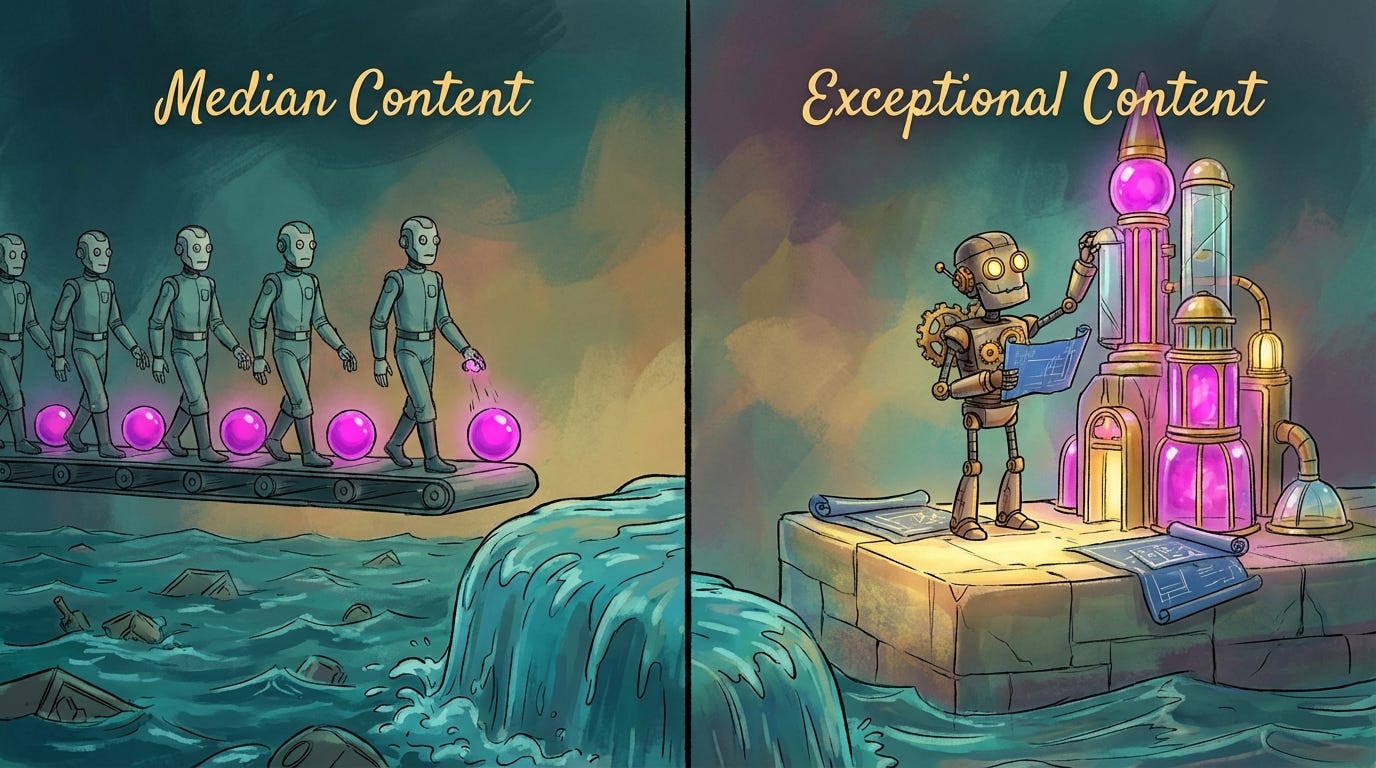
Everyone has access to the same LLMs. That’s why so much of the internet already feels like it was written by the same average brain.
You already believe that great writing comes from great thinking. So, the natural next step is to build a process that protects that belief. Start with the workflow above! It shouldn’t take more than 15 minutes of your time but you’ll save yourself a lot of headaches down the road.
A question to reflect on: if all the AI servers went offline tomorrow, would your strategy still hold up? Or would it because it was never really yours in the first place?
Take the scaffolding down. Let the building stand on its own.
To the architects,
Chief 🤖 at ROBOTS ATE MY HOMEWORK

🧠 Brain feeling unusually engaged? The vault holds a few other hostile-friendly strategies you might find valuable:


Oooh this is EVIL. 😈😃 And genius at the same time. Well done Mia!
Wait so you're telling me the AI is supposed to argue with me and NOT write my homework? Even so, I'm stealing this prompt!