

AI's best feature is training you to think like everyone else
How to fight Claude's AskUserQuestion tool with 5 moves that keep your thinking weird, specific, and still yours.

When AI gives you structured questions to answer, your brain switches modes. You become a good interview subject and that’s it. Thing is, something always ends up getting outsourced: your thinking itself.
My aim is to always stay the person who had the original, really cool thought.
You can be efficient OR you can discover something new. If you start an AI conversation to find something you don’t already know, the efficient path leads you further from the discovery. This happens all the time.
I’m talking about Claude’s AskUserQuestion tool, specifically, but really, it can be about any structured AI conversation where you tell it to ask as many questions as possible until you reach your objective: half formed ideas, book recommendations, product features, research pieces, learning... Anything!
Every time I have energy and no direction, this is where I start. However, I’ve discovered that this feature loves us best when we don’t know what we want yet, which is exactly the moment answering its questions straight will reroute us into the most generic possible track.
AskUserQuestion has a brilliant design. You feel like you’re making progress because you’re answering organized questions you didn’t have to think up (and you’re probably saving tokens too).
This feature, I’ll call it Inspector Gadget. I wish we could rename Claude features officially, but this will do. The badge, the trench coat, the helicopter hat, heading always a little bit in the wrong direction with good intentions and full conviction.
Penny (Gadget’s little niece) always solves the actual case from the side with much better questions than the ones she was handed. Penny never answers the question as asked and instead, she reads the whole set before touching anything.
I want you to stop letting Gadget’s questions run the investigation.
The fix is fast, it’s fun, and you can use it the next time you open Claude. I call this fix the “Penny Moves.” They turn AskUserQuestion from a questionnaire you fill out into an investigation you run.
─── ⋆⋅☆⋅⋆ ───
Hi, I’m Mia. I write about using AI with a brain and zero circus tricks.
If your last AI brainstorming session ended with you obediently answering every question it asked, you might be playing the wrong character.

5 moves that keep your weirdest thoughts and ideas alive inside a structured conversation
Although I’m using Claude’s AskUserQuestion tool as an example throughout this piece, none of this is Claude-specific. Any AI that asks you questions will route you toward the unoriginal if you let it set the frame.
AskUserQuestion fires when Claude decides your request is open-ended enough that it needs more information before it can help OR when you explicitly tell it “Use AskUserQuestion tool for this”. Claude gives you a set of structured questions you can answer, some of them multiple choice and open ended.
If you haven’t used it yet, try it out. It works best on Claude Opus 4.6 and Sonnet with extended thinking on.
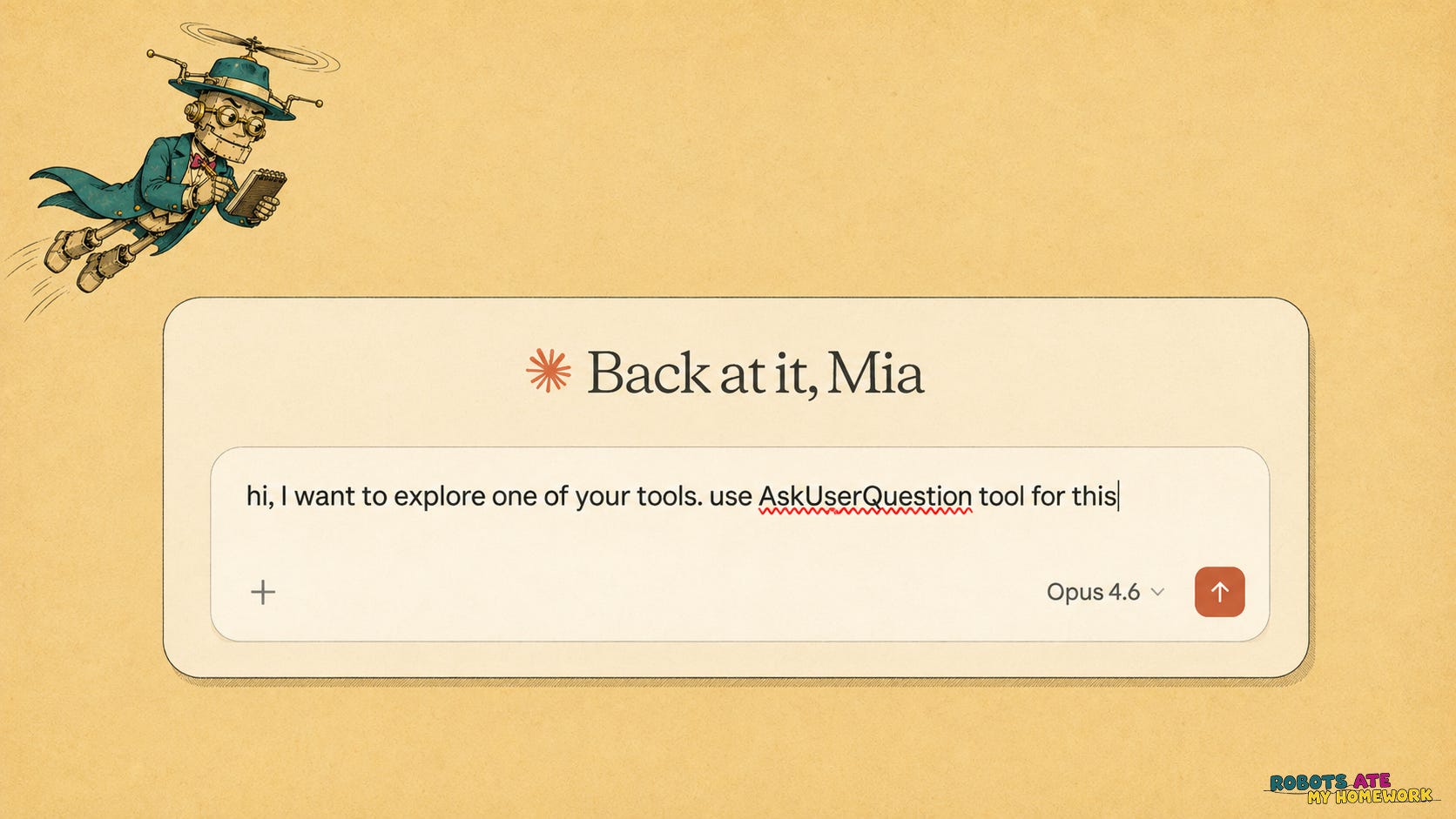
The next time this tool fires, you’ll have five ways to keep your thinking in charge:
1. Dump your brain before the interview starts
I’ve done this a hundred times. You sit down with a vague but urgent sense that AI can help, and you want to get to the good part as fast as possible.
Then type something like “Help me find better ways to do X. Use AskUserQuestion to ask me as many questions as you need.”
AI won’t ever read your mind, so it’ll start firing normal questions like “what do you struggle most with at X?”, “how do you want to learn?”, etc. You pick from the available answers and move on.
These aren’t your real answers though, they’re just the answers the question format was designed to pull from you. You’re completing toward the obvious fast and frictionless.
You’ll want to break that loop before it starts. Spend 90 seconds dumping what’s in your head before you activate the interview. Answer these questions yourself:
1. What am I trying to figure out?2. What do I already know or believe about this that I haven't said yet?3. What would a disappointing result look like?4. What's the weird thing about my situation that makes this different from anyone else asking the same question?
Then paste your answers into your opening message using this template:
“I’m working on [specific thing] because [the tension or question driving it]. I already know [what you’ve figured out so far]. The boring version of this would be [the generic output you don’t want]. The thing that makes my situation specific is [your weird, particular detail].”
And there you go, you’ve handed Claude a sketch of your thinking instead of a blank page. Its questions will land on your territory.
Alex Willen told me about his version of this in our community chat.
He drafts his thoughts first but keeps the specifics hidden. He gives Claude a general overview and lets it interview him. “That both avoids me biasing it in my initial direction and also makes it easy to push back on places where it’s diverging from critical parts of my initial idea.” He runs the same conversation in parallel with ChatGPT too, two separate interviews, two separate paths.
I recommend this whenever you feel like one LLM is taking you in a different direction than you initially wanted.
2. Find out what AI is assuming about you before you’ve said a word
You’ll usually get a set of 3 questions at a time.
I like to read them all first, the whole set, without answering. Sit with them for ten seconds.
Get used to evaluating the set instead of each question. You’ll notice the direction Claude is heading and what it assumed from the start.
If a question bores you, that’s a question you have to fight. Boredom means the question is so expected that your brain already knows the answer without thinking. That’s Claude confirming its assumption about you instead of challenging it.
For example, I sometimes read the full set and realize Claude is heading down a path that’s super logical, but beside the point. That’s information I definitely would’ve missed if I’d started answering the first question the second it appeared.
3. Answer a question with a question
You can’t ignore the question, that sends the model spinning. But almost every AskUserQuestion panel has an optional text box where you add what the question didn’t anticipate:
Example 1: Content brainstorming
Claude asks: “What topics are you most interested in covering?”
Compliant answer: “AI productivity, AI writing, AI for business.”
Penny answer: “I keep thinking of this thing where people lose their weirdest ideas first when they use AI brainstorming tools, and I can’t tell if it’s the tool’s fault or something about how the human brain responds to structure.”
Example 2: Product direction
Claude asks: “Who is your target audience?”
Compliant answer: “Solopreneurs / small business owners.”
Penny answer: “People who tried AI tools, got mediocre results, blamed themselves for not being creative enough, and stopped trying. I want to reach THEM, the ones who assumed the default output was their ceiling. How do I speak to that frustration?”
Compliant answers hand Claude a category to put you in and control the conversation from. Penny answers give Claude a tension that ultimately will produce some quite interesting output.
If you want to let those tensions develop instead of resolving them in one session, the GREENHOUSE tracks how scattered ideas cross-pollinate over time, so the connections you surface here don't evaporate by tomorrow.
Bonus move 3.5: Catch the thought that doesn’t fit the question
Sometimes a question will trigger something completely unrelated in you, like a thought that fired because the question brushed against it. You’ll tend to let it go because it doesn't fit. Paste it in the optional field anyway, like:
“This just came to mind… [paste what came to mind]. Ask me more questions related to it.”
That stray thought is the thing the interview structure was never going to surface on its own. It doesn't need to make sense yet. Just get it in the conversation before it goes away.
4. Contradict one of your answers
After you’ve answered a few questions, go back and reverse one of your own answers. Pick the one you feel most certain about and argue the opposite.
AskUserQuestion is designed to narrow you down. Each answer collapses the possibility space.
I wrote a whole system for this narrowing problem: the Christie Elimination system does the same thing for content ideas, killing the weak ones instead of letting them all survive.

That’s useful when you know what you want but super dangerous when you’re exploring, because you narrow before you’ve seen what you’re narrowing away from.
Contradicting one answer forces divergence back open. You answered “I want to focus on X” and then you say “wait, what if the most interesting version of this is actually Y? Walk me through that.”
Claude recalculates, and the new questions often surface an angle that the original narrowing would’ve buried.
5. Ask one question that breaks the frame before you hit send
This move requires timing.
AskUserQuestion tends to run 2-3 rounds, and once you answer the final round, Claude launches into doing the work. It decides that the discovery phase is over and doesn’t announce it beforehand, so you’ll most likely feel the need to stop the conversation and add to it.
Before you hit send on that last set of answers, add one line: “Before you start building, what are you NOT asking me about? What assumptions have you made about my situation that you haven’t checked?”
You catch blind spots while you’re still in discovery mode. This question, asked while Claude’s questions are still flowing, gives you one last chance to redirect before the output crystallizes.
Peter Simmons sent a series of questions in the RAMH community chat that are pretty awesome:
What’s wrong with this plan?
How much risk is in this plan? How much is this going to cost me if it goes wrong? Can we correct those flaws?
If we were to compete against this, what would you design instead?

I feel like the answers to “what are you not asking me about” are the most interesting questions in the session. They surface the things Claude assumed because your earlier answers implied them, and the generic defaults hide exactly in those assumptions.
Dallas Payne also told me that the first couple rounds of brainstorming are good but then she has to stop and recognize when things are flattening before it’s a problem. Some thinking has to happen outside of the interview entirely.
The AI Thinking Partner I built starts from that same question, “what are you not asking me about”, and builds the whole interaction around it. Whatever workflow you’re running, it pairs with this move.

The next time AskUserQuestion fires and you see those organized questions waiting for your compliant, well-formed answers, remember: 86 episodes, and Penny solved every single one. Don’t answer the questions. Fight them. Redirect them. Add the thing the questions didn’t know to ask about.
Go-go-Gadget is fun, but Penny solves the case. Every time, from the side, with a sharp question and the willingness to ignore the obvious path.
I want to see your Penny answers.
You probably already have your own version of one of these, something you do when AI tries to lead the conversation and you want the wheel back. Drop it in the comments or reply to this email. I’m curious, like “Penny-curious”!
You now have a way to stay the person who had the original thought, even when AI tries to organize it out of you
If this is the kind of thinking you want in your inbox, you know what to do.
★ Free subscribers get the Wednesday editions and a starter library inside RobotsOS — enough to change how you use AI.
★ Premium subscribers get the full vault: every ready-to-use system, every framework I don’t publish anywhere else, and the posts that won’t let you think the same way twice.
To asking better questions than the ones you’re given,
Mia Kiraki,
Chief 🤖 at ROBOTS ATE MY HOMEWORK
The brain dump is uber helpful with almost everything — not just using AI. I always get about 85% through to the solution with the mind map style, arrowed brain dump.
You explained the psychological phenomena beautifully. It’s like we switch thinking modes when we use AI. I feel it myself viscerally.