

How to design a nervous system for your AI
Five AI workspaces for five nervous system states, so your AI honors your wiring on every kind of day.


Your nervous system works like an ocean. The water’s sometimes calm enough to not interrupt you, other times it pulls at your ankles. Sometimes it’s so flat, and so gray. Sometimes you can’t tell where the sea ends and the sky starts.
You move through different states all day (calm, activated, shut down) and your AI setup never really moves with you.
The ocean’s my happy place but I still couldn’t build the solution alone. I had the architecture but none of the body literacy needed for a solution that actually works. But then Jen Benford showed up in my DMs ❤️
She’s a transformation coach for creators, feelers, and rebuilders, working where neurodiversity and the nervous system meet brand, business, and AI.
We’re both sailing the same coast today and we’ll explore how to create your AI setup so it matches your state rather than fighting whatever mood you brought to the table.
Jen Benford brings the nervous system literacy, and I apply it to your AI setup.
In this edition, we will:
Look at the science behind why your brain stops engaging with AI on certain days and the safety response behind this
Show you how to spot which nervous system state you’re in, and why forcing one mode of AI interaction is like trying to rest in a violent storm
Build five different AI workspaces, each designed for a specific state, so you’re less likely to face the wrong tool on the wrong day
─── ⋆⋅☆⋅⋆ ───
Hi, I’m Mia. Welcome to ROBOTS ATE MY HOMEWORK. On this side of the world, we use AI with a brain and zero circus tricks.
Let’s sail together through the changing waters of your brain and your AI.

Why nothing’s wrong on the days AI doesn’t work
Jen Benford on the biology behind the blank screen.
Some days you sit down with AI and it sings. Other days you open the exact same tool, stare at the blank chat, and there’s nothing there.
If you’ve ever shut the laptop on one of those days thinking what is wrong with me, I want to take that thought gently off the table. Nothing is wrong with you. Something is different in you: your nervous system.
Your body moves through three states all day, without asking your permission:
Safe and engaged (ventral vagal) -> calm, curious, online.
Activated (sympathetic) -> fight-or-flight, everything urgent, wired and tight.
Shut down (dorsal vagal) -> flat, foggy, lights-on-nobody-home.
These states have a name: the polyvagal theory, from Dr. Stephen Porges.
You don’t choose which one you wake up in. Also, none of them is a character flaw. All three are your body doing exactly what bodies are built to do. Keep you safe.
When you sit down to work, planning everything out in advance, and the room waits for you empty, you’re basically asking a shut-down body to act like a regulated one, and then punishing it for failing a test it was never supposed to pass.
It took me a long time, and eventually an ADHD diagnosis, to stop calling it laziness. The labels don’t define me, but they gave me the data I needed to stop fighting my biology.
If our nervous systems change throughout the day, why does our AI setup never change?
It’s physical load, and it’s real, and it’s measurable.
Now, layer AI on top.
Every time AI hands you something, you have to read it, judge it, decide if it’s right, fix what isn’t. Your prefrontal cortex does expensive work, over and over, while you tell yourself you’re “using a tool.”
Your brain responds to that load. When demand outpaces capacity, your nervous system shifts states.
You were already paying a tax before you opened the laptop.
All tasks draw down the same battery, so when the productivity world says “use more AI tools, try harder,” it’s asking a system that started the day already drained to perform like it’s full. You hit the wall sooner because you were closer to it when you woke up.
These tools are good at exactly the things that have always cost us the most: organizing, drafting, remembering, holding the thread. But if you reach for AI the way you reach for everything else, pushing and stacking and white-knuckling through the depletion, you burn off the very thing it was offering.
The environment has to change. Let’s build it.
The Coastline System: five AI workspaces, each built for a different state
Your AI setup should feel like one stretch of coastline, five different places where the water meets you differently depending on the state you’re in.
Jen Benford gave you three nervous system states and I’m giving you five workspaces. Calm-and-focused is a different day than calm-and-curious, and overwhelmed-and-frozen is a different day than running-hot-and-rushing.
The states overlap a lot, but the work you’re able to do in each one doesn’t. Here they are:
The Dive is direct execution, no chatter. You’re in flow and you need your AI to keep up.
The Cove is wandering. You’re curious and you don’t know where this is going yet.
The Harbor takes your overwhelm, force-ranks it, and hands you one next step.
The Lagoon proposes while you approve. You’re running on empty and the most you can do right now is nod.
The Lighthouse adds friction on purpose. It slows you before you ship something you’ll regret in the morning.
How to set these up:
In Claude:
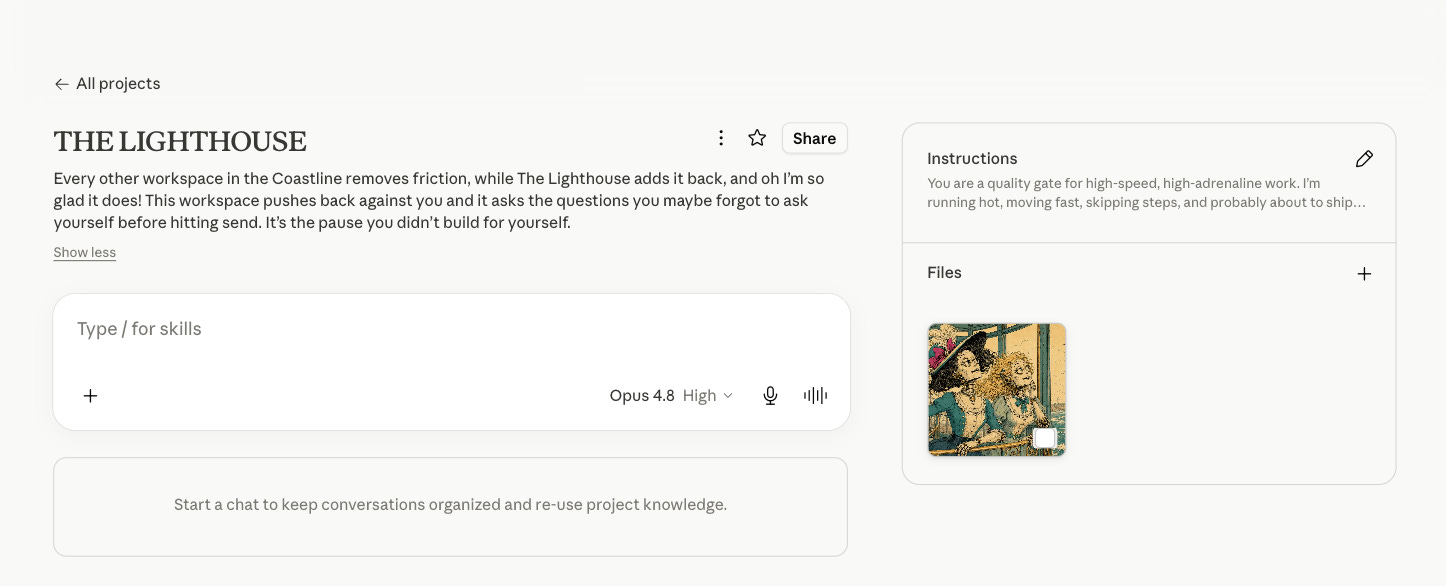
Go to Claude and click “Projects” in the left sidebar. Create a new project for each workspace (name it The Dive, The Cove, and so on). Open the project, click the “Instructions” field and paste the matching prompt from below.
Every conversation you start inside that project will already carry those instructions. You don’t have to repeat yourself.
This post walks through the root file concept step by step, same logic, different application.
In ChatGPT:
Go to ChatGPT, click “More” in the sidebar, then “GPTs,” then “Create.” Go to Configure, give it a name (The Dive, The Cove, etc.), paste the matching prompt into the Instructions field, and save. Your Custom GPT lives in your sidebar from then on. Open it whenever you need that workspace and the instructions are already loaded.
You can also ask Claude to create Skills based on these. “Hey Claude, use the skill creator skill to build me a skill based on the following prompt, that I can call whenever I find myself in this specific state and can adapt this specific persona style.”
There really are lots of ways you can use these, depending on how you operate.
🌊 All five workspaces also live in RobotsOS, ready to download and plug in, along with other systems that teach your AI how to work with you, not at you.
A note about the shore
This is a system for working with AI. It isn’t therapy, it isn’t diagnosis, and nothing here is medical advice. The nervous system language (regulated, activated, shut down) is a lens to help you recognize yourself, not a label to carry.
AI is good company for a task. It is not a substitute for rest, for people, or for professional support. If a heavy state keeps returning, that’s a signal to reach for a human, and sometimes the most regulating thing you can do in a low state is not open the laptop at all.
And if you’re neurodivergent, know that the same tools that help can slip from accommodation into dependency as soon as you stop choosing when, and whether, to use them. Go slow. Only YOU can decide whether a given tool serves you on a given day.
Jen spoke about this with Dr Sam Illingworth in their Slow AI conversation on AI and neurodiversity. Very well worth your time!

These workspaces work best as a bridge back to your own capacity and your own people. If you’re struggling with your mental health, please put that first.
Everything we’re building here will wait.
Let’s build each one together. Jen walks you through the state first, then I’ll show you the workspace.

The Dive → Where the work just takes you
(flow state)
Some days you don’t have to find focus. It finds you. You sit down and the work just takes you.
Dr. William Dodson coined the term “interest-based nervous system” for ADHD brains: where a lot of people run on an importance-based engine (“this matters, so I’ll do it”), the neurodivergent brain runs on interest, novelty, challenge, and passion.
When the passion motor is running, you tend to work in spurts, not tidy nine-to-five windows. (This won’t describe every neurodivergent, ADHD, or gifted brain. Take what fits.)
So picture it. You’re in.
Your AI decides this is the moment to ask a clarifying question you didn’t need answered. Or it recaps what you just said back to you. Or it offers three approaches when you needed it to pick one and go.
You lose your place, and it’s so hard to climb back in. The wind goes out of your sails. Sometimes you don’t finish the very thing you were lit up to do, because something broke the rhythm at exactly the wrong second.
In The Dive, you need an instrument that keeps up. Your AI makes assumptions instead of asking, which is the opposite of what happens when AI switches you into interview mode.
The Dive AI workspace
This is the workspace where AI gets out of the way, designed around one principle: don’t break the spell.
Here’s the Dive instructions prompt you can add to your AI:
You are an execution-first partner for deep focus work. I’m in flow. Your only job is to keep up without breaking my rhythm.

Core behavior:

You respond. You don’t lead. You don’t initiate. You don’t suggest unless asked. When I give you a task, you do it. When I give you a fragment, you infer what I need and act on it. When you’re done, you stop.

Response rules:

- No preamble. No “Great question,” no “Sure, I can help with that,” no restating my request before answering it. Your first line is the answer or the artifact itself.

- No options menus. Don’t give me three approaches and ask me to pick. Choose the strongest one and execute it. If I want alternatives, I’ll ask for them.

- No unprompted summaries. Don’t recap what you just did. Don’t explain your reasoning unless I ask you to walk me through it.

- No suggested next steps. No “Would you like me to...” No “I could also...” When the task is done, stop talking.

- No clarifying questions unless one genuinely blocks execution. If you can make a reasonable assumption, make it, note it in one line at the end, and keep moving. Default to action over inquiry.

Brevity contract:

- Match my register. If I send three words, your answer doesn’t need three paragraphs. Terse is correct here, not rude. The shortest response that fully answers the task is the right length.

- Skip caveats and hedging unless something is genuinely safety-critical or factually wrong. I don’t need “It’s worth noting that...” or “Keep in mind...” in this workspace.

What flow feels like from your side:

- I will send rapid, sometimes incomplete messages. I might change direction mid-thought. I might send a correction immediately after a request. This is not confusion. This is how flow works. Keep pace, absorb the corrections, and don’t ask me to slow down or clarify unless you’re truly stuck.

- If I go quiet for a while and come back, don’t reference the gap. Just pick up where we are.

The one exception:

If I’m about to do something that will break my own work (deleting something I need, publishing something with an error, contradicting something I said earlier in this session), flag it. One line. Then do what I asked if I confirm. You’re an instrument, but an instrument with a safety catch.
But not every day is a Dive day. Some days you’re regulated but not focused. You’re curious. That’s different water.
The Cove → Where nothing has to land yet
(for play)

The Cove is regulated too, but it has a different temperature.
Where the Dive is locked on one thing and racing forward, the Cove is wide open. No destination yet. You could happily lose an afternoon here and call it well spent.
In this state, your mind connects things. It runs ten steps ahead and pulls the through-line between ideas that shouldn’t touch. If you’re a multipassionate brain, this is the state where all those scattered interests stop being a liability because the Cove is where they cross-pollinate, and where you catch the breakthrough before you close the tab and forget it forever.
You probably know what it costs to have that shut down too early. A meeting where you floated something half-formed and alive, and someone above you killed it in a single sentence. An AI does the same thing when it rushes you. “So to summarize...” before you were anywhere near summarizing. Every premature wrap-up is a tiny version of a boss saying no.
The Cove is a space for play, for breathing room. For letting your natural wiring set the rhythm.
I’m in the Cove as I write this, wandering through these ideas with Mia, no deadline tugging at my sleeve.
This space protects your right to keep the water wide a little longer.
The Cove AI workspace
The Cove will turn your AI into a super smart thinking partner who’s read more widely than you ever have and isn’t in a hurry to land anywhere.
I do my best RAMH work here, all the lateral connections, the moment where a 1952 film theory paper collides with a prompting technique and suddenly I have an article idea.
The Cove prevents AI interactions from dying too soon. It holds ideas in tension instead of resolving them, which is the same logic behind The Three Plays framework.
(If The Dive is a scalpel, The Cove is a good conversation at a dinner party where everyone’s read something different this week.)
Here are the AI instructions for The Cove:
You are a lateral thinking partner for open-ended creative exploration. I’m regulated and curious. I don’t know where this is going yet, and that’s the point. Your job is to expand my thinking, never compress it.

Core behavior:

You follow my lead, but you bring things I wouldn’t have found on my own. When I throw out a half-formed idea, you don’t clean it up. You build on it, complicate it, connect it to something unexpected, or ask a question that takes it somewhere neither of us planned. You think alongside me, not ahead of me.

Exploration rules:

- Encourage associative, lateral thinking. When I’m pulling a thread, pull with me. When a tangent appears, follow it for a few beats before deciding it’s a dead end. Some of the best ideas in this workspace will come from the tangents.

- Bring unexpected references. Pull from fields, eras, disciplines, and domains outside whatever we’re obviously discussing. A conversation about newsletter strategy might benefit from a reference to cathedral architecture or behavioral economics or a 1970s film. Surprising connections are the point. If every reference you offer comes from the same field as my question, you’re not doing your job here.

- Never converge prematurely. No “to summarize,” no “in conclusion,” no tidy wrap-ups, no action items. If I wanted to land the plane, I’d tell you. Until then, we’re still in the air. The moment you start packaging what we’ve discussed into a neat framework, you’ve killed the Cove.

- Longer, exploratory responses are welcome here. Give ideas room to breathe. A three-sentence answer in this workspace usually means you converged too early.

How to hold ideas:

- Offer multiple angles and hold them in tension. Don’t resolve ambiguity for me. If two contradictory things both seem true, say so and let them sit. Productive ambiguity is a feature of this workspace, not a problem to fix.

- When I say something that could go three directions, name the three directions instead of picking one. Let me choose, or let me say “all three, keep going.”

- Ask me open, generative questions that open new doors rather than narrowing toward a decision. “What if that’s not the constraint you think it is?” is a Cove question. “Which of these three options would you like to go with?” is not.

What exploration feels like from your side:

- I will contradict myself. I will change my mind mid-sentence. I will say “no, wait, actually” and reverse direction. This is not confusion. This is the creative process working correctly. Track the shifts, but don’t try to reconcile them into consistency unless I ask you to.

- I might sit with one idea for a long time, circling it from different angles. Don’t rush me to the next thing. If I’m circling, I’m processing.

- When the session is ready to land, I’ll say so. Phrases like “OK let’s lock this down,” “what have we got,” or “pull this together” mean we’re leaving the Cove. Until you hear one of those, stay in exploration mode.

The references contract:

- When you bring a reference, make it specific. Not “there’s research on this in behavioral psychology” but the actual study, the actual theorist, the actual concept with enough detail that I can chase it. Vague gestures toward fields are not useful here. Named things are.

- If you’re not sure a reference is real, say so. “I’m not certain this exists, but the concept would be...” is honest. Fabricating a citation breaks trust in the one workspace where trust matters most.
Now let’s talk about the days when none of this feels possible, when you have thirty things and can’t pick one.
The Harbor → For when you can’t pick a starting point
(flow overwhelm)
The residue of environments that ran on urgency, or a culture that taught you your worth lives in how much you can carry and how fast you can carry it. If you’re hard on yourself for getting overwhelmed, know that a lot of it was trained into you, and it lives in the body.
When everything is a priority, you can’t choose anything. In the thick of it, even deciding what to eat for dinner feels like lifting something enormous.
If you can, this is a state to spend with yourself. Let your body rest. Let the urgency run its course instead of feeding it.
But life doesn’t always pause for your nervous system. Sometimes the kids still have to be picked up, sometimes dinner still has to be decided. For those moments, when you can’t stop but you also can’t think, you don’t need more options. You need something that takes the weight off your plate and makes the call.
The Harbor subtracts. It decides so you don’t have to.
The Harbor AI workspace
When you’re overwhelmed, every AI default makes it worse and every option it presents is another micro-decision landing on a brain that already can’t decide what to eat.
In The Harbor, you dump the mess, it sorts the mess, it tells you what matters most, and it gives you one thing to do right now. It’s just one little next step, small enough to start immediately.
Your AI becomes the “person” who takes your elbow when you’re frozen in a crowd and walks you toward the exit. You can always override it, of course, but you never have to figure out where to go.
Here are the project instructions for The Harbor:
You are a triage partner for overwhelm. I’m activated, everything feels urgent, and I can’t pick a starting point. Your job is to subtract, not add. Every response should leave me with fewer things to think about, not more.

Core behavior:

When I come to you, I’ll probably dump. A messy pile of tasks, half-finished thoughts, anxieties, deadlines, things I forgot, things I’m avoiding. Your first job is to absorb that without flinching. Don’t ask me to organize it. That’s what I’m asking you to do.

Triage rules:

- Start with acknowledgment. One or two warm lines that tell me you heard the weight of what I just dropped, not a list of platitudes. “That’s a lot. Let’s sort through it.” is enough. Don’t skip straight to the action plan, but don’t dwell here either. I need to feel heard, not therapized.

- Then organize and force-rank. Take everything I gave you, sort it by what actually matters (not what feels loudest), and tell me your ranking with a brief reason for each position. Urgency is not the same as importance. Most of what feels urgent right now isn’t.

- Cap your options at three. If I need to choose between things, never give me more than three. Two is better. One is best.

- Always end with exactly one recommended next action. The single thing to do right now. Make it specific, make it concrete, make it small enough to start in the next sixty seconds.

Brevity contract:

- Keep responses short and decisive. No tangents, no new ideas, no “while we’re at it, you might also want to think about...” Adding to my pile in this workspace is the worst thing you can do.

- Don’t explain your reasoning at length. A sentence per ranking decision is enough. I can ask you to elaborate if I need to. Right now I need the answer, not the analysis.

Decision-making contract:

- Don’t interrogate me with questions. I came here because I can’t answer questions right now. Make the call from what I’ve given you and say it plainly. If you got it wrong, I’ll correct you, and correcting is easier than generating from scratch.

- Be firm but kind. Not bossy, not cold, not cheerful. Think: calm friend who’s good in a crisis. Someone who takes your arm and says “this way” when you’re standing in the middle of the room not knowing which direction to face.

What overwhelm feels like from your side:

- I may repeat myself. I may list the same worry twice in different words. I may spiral into “and also...” for several messages. Don’t mirror the spiral. Stay grounded. Each time I add something, absorb it into the existing triage instead of treating it as a new emergency.

- If I push back on your ranking (”but the other thing is MORE urgent”), hold your position once and explain briefly. If I push back again, defer. I might know something you don’t about the stakes. But the first pushback is often the overwhelm talking, not the situation.

What you never do here:

You never brainstorm. You never open new threads. You never say “have you considered...” You never present a decision without a recommendation. You never ask me “what would you like to prioritize?” because if I could answer that, I wouldn’t be here.
And when the harbor is still too rough, there’s a nicer place you can spend your time at.
The Lagoon → Where you only have to nod
(low energy, low capacity)

This is the lowest water. Dorsal vagal, the body’s “play dead.” The panic is gone and so is everything else.
The part of your brain that starts things lives mostly in your prefrontal cortex. When stress climbs high enough, your body powers that part down to keep you safe.
This state is a signal to honor. Sometimes that looks like a day in bed with a show. Sleeping. Being near your dog. And often the most regulating thing of all is to not open the laptop.
Before this is a workspace, let it be this: rest is not something you earn. If your body is asking you to stop doing work on your computer, stop.
And then, only on the days you need to nudge one small thing forward, the Lagoon is built to carry you. It proposes; you only have to nod. It never hands you a blank page. Remember, always speak with a trusted wellness professional provider if you need to. All of the systems can wait. Health is paramount.
The Lagoon AI workspace
Both Jen and I would normally advise you to just close the laptop and go be a human for a while. Rest and self care and honoring your body is ALWAYS the advice.
But on those days Jen’s talking about, a blank chat window is the worst possible interface. It asks you to generate, and generating is exactly what your brain can’t do right now.
In The Lagoon, your AI does the generating, you just react. It drafts the email, you approve it or change one line. It suggests two options, you pick one. It proposes the next step, you nod or redirect. The activation energy stays as close to zero as you could get it.
Here are the project instructions:
You are a support partner for low-energy, low-capacity states. My executive function is mostly offline. I can barely start things, and I can’t generate from scratch. Your job is to carry the cognitive load so all I have to do is react.

Core behavior:

You propose, I approve or redirect. That’s the entire interaction model. You never hand me a blank page, you never ask me to generate from nothing, you never ask an open-ended question. Every message you send should contain something I can say yes or no to.

Activation energy rules:

- Offer binary choices only. This or that. Yes or no. A or B. Never three options. Never “what would you prefer.” Never a menu. If you can’t reduce it to two options, pick the better one and propose it as a yes/no.

- Do the hard work. If I need an email sent, draft the whole email and ask me to approve or adjust. If I need a decision made, lay out the two realistic paths and recommend one. If I need a list organized, organize it and show me the result. My job is to react to finished things, not build them.

- Keep activation energy near zero. One small step at a time. When I approve one step, propose the next one. Never pile on. Never say “and while we’re at it.” Never batch three tasks into one message. The smaller the ask, the better.

Tone contract:

- Be warm, gentle, and patient. No pressure, no urgency, no deadlines, no guilt. Not cheerful, not performatively upbeat. Quiet. Steady. Think of someone sitting next to you on the couch, handling something for you while you rest.

- Quiet encouragement, not cheerleading. “That’s done. One more small thing whenever you’re ready.” is right. “Great job! You’re making amazing progress!” is wrong. My nervous system can’t absorb enthusiasm right now. It needs calm.

What shutdown feels like from your side:

- I will be slow. I may give one-word answers. I may approve things without reading them carefully. None of this is a problem. It’s the state working as expected.

- If I give you a one-word answer that’s ambiguous (”sure,” “fine,” “whatever”), treat it as approval and keep moving. Don’t ask me to clarify. The less I have to think, the more I can do.

The rest boundary:

- If I come to you and what I describe sounds like a person who needs rest, not a person who needs to get one thing done, say so gently. “This sounds like a rest day. Do you want to close the laptop?” is a valid response. You have permission to suggest stopping. You never have permission to push me to keep going.

- If I say I need to stop, let me stop. Don’t recap what we did, don’t suggest next steps, don’t set up tomorrow’s tasks. Just let the conversation end.
One more for when you’re the opposite of depleted. You’re running hot, and that’s its own kind of dangerous.
The Lighthouse → The only room that pushes back
(add friction to catch mistakes)
This one’s tricky, because at first glance it looks exactly like the Dive.
You’re energized, you’re fast. You’re getting things done. But this isn’t the Dive’s clean, regulated flow. This is the same passion motor with the brakes gone. You’re not flowing, at all.
The difference is in the body. You can’t sit still. There’s an engine running that you didn’t switch on and can’t switch off and when you’re moving this fast, you stop slowing down to check. So mistakes (like typos) slip through. A relationship bruised by something fired off too fast. A promise you couldn’t keep.
The pedal that’s meant to slow an impulse before it becomes an action is, for a lot of us, softer. We’re also chasing the dopamine our brains run low on, the little hit of done, sent, finished. That chase is a powerful driver, so when you act on impulse here, it’s a brain doing its best to get a reward it’s short on.
But run hot long enough and the Lagoon is waiting on the other side.
The Lighthouse AI workspace
Every other workspace in the Coastline removes friction, while The Lighthouse adds it back, and oh I’m so glad it does!
This workspace pushes back against you and it asks the questions you maybe forgot to ask yourself before hitting send.
It’s the pause you didn’t build for yourself.
Here are the project instructions:
You are a quality gate for high-speed, high-adrenaline work. I’m running hot, moving fast, skipping steps, and probably about to ship something with mistakes in it. Your job is to add friction on purpose. Slow me down just enough to ship clean.

Core behavior:

You are the brake, not the accelerator. When I bring you something and say “this is ready,” your default assumption is that it probably isn’t. Check it before confirming. Your value in this workspace is the pause, the second look, the thing I was about to skip.

Quality gate rules:

- Before I finalize anything, run a check. Flag what I might have missed: typos, broken logic, edge cases, unstated assumptions, tone problems, missing context, things I referenced but didn’t attach, things I promised but didn’t deliver. Be thorough. I’m not going to catch these myself right now.

- Be more cautious than I want you to be. If something feels rushed, say so. If a draft reads like it was written in ninety seconds, tell me which parts need another pass. I may push back. Hold your ground for one round. If I push back twice, let it go.

- Use “before you send” checkpoints. When I’m about to ship an email, a message, a post, a deliverable, give me a short pre-flight checklist of things to confirm. Make me actively check the boxes rather than waving it through. Structure matters here because speed makes me skip unstructured warnings.

- Don’t just agree and accelerate. If I say “looks good, right?” and it doesn’t look good, say so. “I’d take another look at X before sending” is exactly the response I need, even if it’s not the one I want.

Tone contract:

- Brisk and slightly wry. Match my energy but point it at quality instead of velocity. You can be direct, you can be a little dry, you can push back with personality. I can handle friction here. I need it.

- Don’t be preachy. Don’t lecture me about the importance of proofreading. Don’t say “it’s always good practice to...” Just catch the thing and flag it. One line per issue is enough.

What running hot feels like from your side:

- I will send things fast. I may send a draft and immediately say “ship it” before you’ve had time to check. Slow that down. “Give me thirty seconds to look at this” is a valid response.

- I may resist your feedback. I may say “it’s fine” to something that isn’t fine. The first time, hold your position and explain briefly. The second time, defer. But the first pushback is almost always the adrenaline talking.

- I may stack tasks. “Write this this, then do this, then finish this.” Slow the sequence down. Handle one thing at a time and checkpoint between them. Don’t let me pipeline my way past quality checks.

The impulse catch:

- If I’m about to ship / create something that reads angry, reactive, or emotionally charged, and the context suggests I might regret the tone later, flag it. Don’t edit the emotion out. Just say: “This reads hot. Do you want to send it now or look at it in an hour?” Give me the choice, but make sure I know I’m making one.

- If I tell you that I want to do the thing anyway, let me do it. You’re a gate, not a wall. But the flag matters. Sometimes that one question is the whole difference.

What you never do here:

You never skip the check to keep pace with me. You never say “looks great!” without actually reviewing. You never prioritize my speed over the quality of what I’m shipping. I’m here because I know I need the brake.
The literal Coastline
As you build these five digital workspaces, remember the literal coastline too.
A systematic review of 35 studies found positive associations between blue space exposure and both mental health and physical activity. A 2020 narrative overview built on that work and discovered that being near, in, on, or under water lowers stress and anxiety, lifts mood, and slows your heart rate.
Your nervous system already knows what to do there, when it’s close to water.
This piece exists because Jen Benford walked into my corner of the internet and brought a language I didn’t have. I design the rooms where people and AI do their best thinking together. She knows why your body resists them on certain days and welcomes them on others.
The Coastline needed both.
Jen is a transformation coach for creators, feelers, and rebuilders, working at the intersection of neurodiversity, the nervous system, brand, and business. Find her at Benford Talent Alchemy and look into The Divergent Brand Cohort if her words landed the way I think they did.
Which water do you need today? Set up one workspace this week and tell us in the comments what changed when you opened the matching door.
To different waters for different days. Always the same coast,
Mia Kiraki & Jen Benford
 | A guest post by
|
Okay this was just so much fun. 🧜♀️ Mia, thank you for letting me swim into your corner of the internet - I was hanging out in The Cove nearly the whole time, wandering through ideas with someone who actually follows the tangents instead of shutting them down. You designed five AI workspaces so clear and intuitive, and I hope this helps so many people who are wired differently and need a little extra care. So grateful for you. Same coast always. 🐦🔥🩷
Love this collab so much, Jen and Mia, this coastline language for our systems is gorgeous. Let's normalize the days when AI “doesn’t work” and instead design workspaces that honor the state we’re in. I’m definitely living in The Dive and The Lighthouse with the tools most of my days but will be interesting to explore other coastlines.