

Why complexity is your superpower (and 6 AI rituals to prove it)
How to use 12th-century "Pattern Architecture" and 6 AI rituals to turn your scattered obsessions into a high-value empire.


Welcome to today’s edition of ROBOTS ATE MY HOMEWORK. Today we’re borrowing a bit of 12th‑century pattern thinking and using AI to bring order to our messy minds.
You’ve trained AI models, but have you ever trained one to think the way you create? Probably not. Don’t worry, by the end of this post, no one will ever ask what you do again, they’ll just want what you build.
Long before neural networks and prompt engineering, one extraordinary woman wrestled with her own version of cognitive complexity: Hildegard von Bingen, the 12th‑century abbess, mystic, and polymath (a person of wide knowledge or learning).
Imagine sitting in a drafty stone room in 1141. The air smells like beeswax and old parchment. You are Hildegard, a woman who, against all odds, writes musical plays, records medical discoveries and advises emperors. To outsiders, it looks like chaos, a tangle of unrelated callings.

But what she was really doing was pattern recognition before its time. She turned her own cognitive friction into organized brilliance.
Modern observers would call her “scattered,” yet she succeeded as a pattern architect by finding the invisible lines that make all those lanes look like one grand highway.
We now have tools built for that. LLMs that can translate the noise of our polymathic minds into structured insight and story.
Today, you’ll learn how to do exactly that.
And, in this edition, I’m joined by Rebecca Wicker from The Strategic Linguist.
She works in tech product and business strategy and applies the science of language to decode power dynamics. She writes about how linguistic patterns and frameworks determine whose stories get believed, how narratives get controlled in meetings, and the measurable features of language that signal credibility and authority in discourse.
Subscribe to her here:
What we’re covering:
Why cognitive friction erodes trust in complex thinkers.
How Hildegard mapped chaos into pattern clarity.
Why standard AI limits polymathic creativity (and the fix).
Six AI rituals to turn your range into a single, irresistible narrative.

Why the market trusts a simple box over your deep range

When people can’t easily explain what you do, they hesitate. Labels create cognitive safety, i.e. mental shortcuts that let buyers categorize you without burning brainpower.
Here’s why this hits polymaths hardest:
Cognitive effort. A fitness coach? One clear box, instant understanding. You coding at night + history by day? That’s mental work to connect the dots.
Risk aversion. Simple = predictable. A specialist’s outcome feels safe because you know what you’re getting. Your polymathic range? Not so much… novel combinations are hard to trust when you can’t predict the result.
Broken heuristics. We all use mental shortcuts to make fast decisions. A clear label leads to instant categorization.
Word-of-mouth killer. Simple boxes spread easily: “Hire the funnel guy.” Your complex value? “They do… a lot of things, I think?” When people can’t explain you, they don’t recommend you.
Your diverse skills unintentionally whisper “jack of all trades” unless you show how they form one integrated solution.

How Hildegard cracked this 900 years ago
Hildegard invented an entire lexicon long before Esperanto or JRR Tolkien’s Elvish languages. Lingua Ignota, her constructed language, gave her a way to name things that Latin and German couldn’t quite hold.
She created over a thousand terms, many for plants, animals, and celestial beings, but also for abstract concepts that lived in the spaces between theology, medicine, and music. She saw things in a very different way, she connected dots across meaning far beyond linguistic play. This skill helped her build a vocabulary that matched the shape of her thinking.
What Hildegard intuited, twentieth-century linguists would formalize as the Sapir-Whorf hypothesis:
💭 Language shapes thought.
The categories available in your vocabulary determine what you can easily perceive and articulate.
When your thinking spans multiple domains, you’re working against the limits of specialized languages constantly. You’re navigating specialized terms and meanings created by speech communities and tribal knowledge. Each field’s terminology pulls your ideas into its own shape, distorting the pattern you actually see.
Hildegard solved this by creating words for the connections themselves. Her lexicon went beyond the ability to describe her insights, it made them thinkable in the first place.
These constructed lexicons do something powerful for polymathic minds.
They establish cognitive sovereignty.
When you name your own categories, you stop having to justify why your connections matter to people working within established taxonomies. Hildegard’s language said: these relationships I see are real enough to have their own words. That move transforms you from someone who “dabbles in everything” into someone who has discovered a territory others haven’t mapped yet. The lexicon becomes proof that the pattern exists.
Modern polymaths face the same challenge. Your insights cross domains, but domain-specific language can box you in. Each field wants you to use its terms, which makes your unifying vision look fragmented. Hildegard understood this friction eight centuries before we had the term “interdisciplinary.” She recognized that authority comes from having the right language for what you actually see, even if you have to invent it yourself.
Standard AI kills your complexity
Standard AI functions as a specialist’s tool even for tasks like drafting a social media bio due to their training paradigm and inherent limitations. That can be limiting if you want something truly original, since LLMs mostly just remix patterns from their training data instead of coming up with genuinely new ideas.
Here are five reasons why LLMs behave as specialists and how this limits expansive thinking:
Training data patterns ➺ LLMs learn from tons of text, so they’re great at remixing common writing patterns. Perfect for polished, standard bios but terrible for truly original thinking.
No lived experience ➺ Unlike humans drawing from real life, LLMs lack consciousness or comprehension. Their “knowledge” is just word correlations, so nothing feels deeply personal or insightful.
Hallucination risk ➺ When LLMs are pushed beyond what they know, they can start to “hallucinate”, making up information that sounds right but isn’t. That’s unreliable for the speculative work polymaths need.
Fine-tuning locks them in ➺ A general model might know a bit about everything, but when it’s trained on a niche dataset, it gets really good at that specific style. This locks the model into familiar patterns. In the end, fine-tuning keeps the LLM focused on doing one job really well, not thinking outside the box.
Before you can teach AI to recognize your polysemy networks, you need to reverse-engineer the linguistic fingerprints that make your thinking uniquely yours:

Without a clear strategy first, AI simply helps you be confused faster and at a larger scale.

To make it work, you need to build AI systems that hunt for “Polysemy Networks”.
This is the linguistic way of saying “words with multiple, related meanings”.
Instead of asking LLMs to summarize you, you’ll ask them to find the hidden structural metaphors in your work.
When you speak about your sales funnel using the language of “ecosystem health” (borrowed from your fishing side hustle) you’ll be framing yourself as a systems thinker who sees what others miss.
You’ll become Hildegard herself and architect a new cognitive map that proves your scattered interests are actually a single, high-value system.
1. Why polysemy fits polymathic minds
Polysemy networks mirror how polymaths actually think. Just as a single word holds multiple related meanings that share a conceptual core, polymathic expertise holds multiple domains together through underlying patterns.
Linguistically, this makes polysemous language the natural vehicle for cross-domain insight.
2. Let your words do the credentialing
Polysemy networks give polymaths a linguistic advantage that single-domain experts don’t necessarily have. Words with multiple, related meanings let you operate across professional registers without announcing the switch - linguistic code switching.
When you describe a business challenge using ecological metaphors, you’re performing expertise in both domains at once. The audience hears “systems thinker” without you having to claim it directly. Your word choices do the credentialing work through pragmatic positioning.
3. Speaking multiple communities at once
This works because polysemous terms function as boundary objects across discourse communities. Words like “flow,” “architecture,” “ecosystem,” or “rhythm” carry technical weight in multiple fields. When you use them, you create semantic bridges.
Different audiences recognize their own expertise in your work. You’re not hiding complexity like others do - you’re making it legible to multiple interpretive communities simultaneously.
4. Signal depth without stating it
The real power comes from implicature. When you say “ecosystem health” in a business context, you’re again signaling systemic thinking without stating it outright. The metaphorical extension does the work for you.
This matters because polymaths often sound defensive when they explain their range directly, like you have to explain why you know so many things all at once. Polysemy lets the language choice imply cognitive depth instead.
5. Making language work harder
What you’re actually deploying is productive ambiguity. Your audience interprets your meaning through whichever domain-specific lens they bring, and multiple readings can be correct at once.
This may sound like vagueness but semantic density is strategic efficiency in ways many don’t understand.
One utterance activates multiple knowledge networks simultaneously, making your communication work harder than single-domain language can. You become what Hildegard was: someone whose apparent scatter reveals itself as integrated vision, once people have the right linguistic frame to perceive it.
If success is built on flexibility, then learning how to speak differently across industries, companies, countries, is going to be key.
Will everyone understand you, certainly not. Will people claim you’re wrong, absolutely. But as someone who holds many frames of expertise in their head at once, you will be understood at the moments that matter by the people who need to hear you - you’re speaking to many people at once because you’re able to navigate the complexities of other worlds.
You’re flexible, and in today’s world, that’s a differentiating superpower.

The 6 AI rituals to resolve the cognitive friction
You can run six distinct rituals, which each handle a different part of the chaos, from the “messy dump” to the “market-ready narrative.”
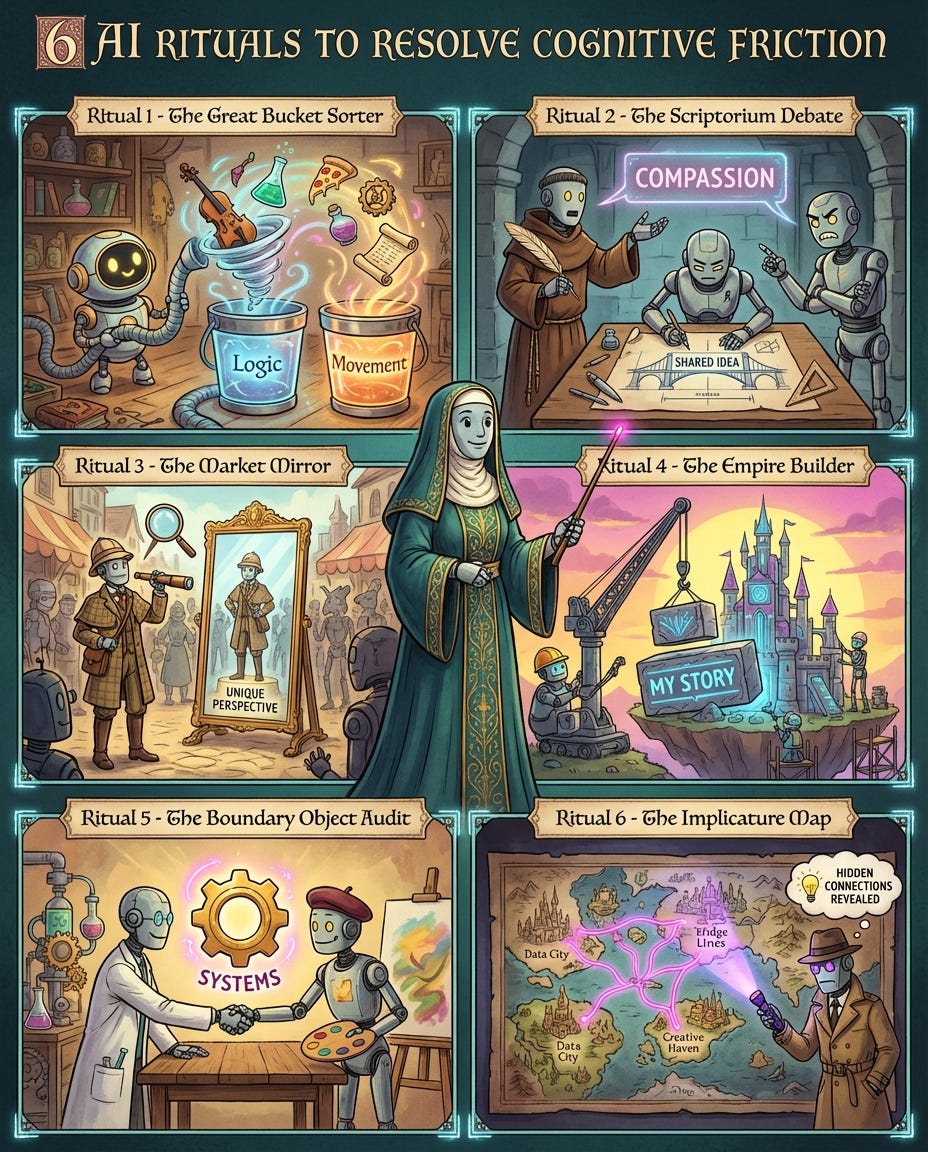
✎𓂃 Ritual 1: The Great Bucket Sorter
Problem: Most people edit themselves way too early. Polymaths do it even more, trimming their wild ideas before they’ve had a chance to breathe. When you focus only on what you do (the nouns), you miss the deeper rhythms hiding underneath, like how you move through the world.
How this ritual helps: This ritual asks the AI to ignore the surface labels and look for the patterns of motion and logic that connect everything you do. The model spots threads you might not notice. It finds the emotional or creative pulse that ties your mix together.
Outcome: A clear table showing the hidden movements behind your work.
Use this prompt:
I am doing a ‘Visions Dump’. I am going to give you 30 random things I love, skills I have, services and products I offer and topics I can’t stop reading about. [PASTE LIST].

Your job: Don’t group these by industry. Group them by Movement and Logic. Use categories. For each group, find a single action or feeling that exists in every item in that bucket.

Show me a table with: Bucket Name | The Hidden Sameness | Items Included.
✎𓂃 Ritual 2: The Scriptorium Debate
Problem: Sometimes, the bridges between your worlds sound poetic but collapse under pressure. You might feel the connection, but others just see word salad. Your links need to survive skepticism.
How this ritual helps: Here, you let the AI argue with itself. The Advocate defends your idea, the Cynic tears it apart and the Architect rebuilds it stronger. It’ll burn off vagueness until only the solid, believable connections remain.
Outcome: Sharp, memorable links. Names or phrases that can take criticism and still stand tall.
Use this prompt:
I have these 3 potential core links between my disparate worlds: [PASTE LINKS FROM RITUAL 1].

Perform a ‘Trinity Debate’ for each:

- The Advocate: Argue why this link is a unique superpower that a client would pay 2x for.

- The Cynic: Attack this link. Call it vague, ‘word salad,’ or a stretch. Tell me why a customer would roll their eyes.

- The Architect: Based on the debate, refine the link into a single, punchy name. How does this link solve a specific problem better than a specialist could?”
✎𓂃 Ritual 3: The Market Mirror
Problem: Polymaths often feel like they’re starting from scratch (inventing a new language for themselves) when in reality, others have already found ways to talk about similar blends. That isolation can make your message sound foggy or flat.
How this ritual helps: This step uses the AI as a researcher, scanning the “world” for people who’ve already nailed what you’re trying to express. It looks at how they weave their worlds together and from there, it helps you see your own gap: the space where your mix of talents adds something new to the conversation.
Outcome: A single, tight statement that shows exactly where you stand apart.
Use this prompt:
Analyze these 3 leaders: [Names].

For each leader, identify:

- Their Disparate Worlds (e.g., tech vs. philosophy).

- Their Connective Tissue (the specific language or metaphor they use to make it feel like one thing).

- The Gap: Where does my unique mix [PASTE YOUR MIX] offer something they don’t? Write a sentence that starts with: ‘While [Leader] focuses on X, I bridge the gap between Y and Z to create [Result].’
✎𓂃 Ritual 4: The Empire Builder
Problem: Having great ideas isn’t enough because they also need to sound as strong as they are. Many polymaths think deeply but speak vaguely, which makes their brilliance easy to overlook.
How this ritual helps: This is where everything comes together. The AI helps you shape your story into powerful, ready-to-use language that lands better with customers and/or readers.
Outcome: A full toolkit of words that carry your pattern out into the world. Alive, consistent, and unmistakably you.
Use this prompt:
Take all the winners from the previous rituals. We are building my narrative. Give me:

- The ‘Viriditas’ Statement: Write a 30-word identity that uses one powerful metaphor to link all my skills.

- The 3 Hooks: Give me 3 content ‘hooks’ that sound like a story only I can tell.

- The Rebuttal: When a client asks ‘Why should I hire someone like you?’, write the perfect 2-sentence response.
✎𓂃 Ritual 5: The Boundary Object Audit
Problem: Polymaths struggle to find language that feels authentic across all their domains. They either oversimplify to sound accessible or use jargon that alienates half their audience. The result feels fragmented or watered down.
How this ritual helps: This step uses the AI to identify which terms in your existing work already function as boundary objects - words that carry technical meaning in multiple fields you work across. It reveals the semantic bridges you’re unconsciously building and shows you how to use them strategically.
Outcome: A curated lexicon of 8-12 polysemous terms that work as your cross-domain vocabulary, plus guidance on which audiences will recognize which layers of meaning.
Use this prompt:
Analyse this sample of my work: [PASTE 500-1000 WORDS].

Identify every term that carries technical or specialised meaning in more than one professional field. For each term, specify: Which discourse communities would recognise it (e.g., "architecture" = software engineers, urban planners, information designers).

- What conceptual core connects these meanings.
- How I'm currently using it and which meaning I'm activating.
- Then rank these terms by "bridge strength" by how effectively they let multiple audiences see their expertise in my work simultaneously.
✎𓂃 Ritual 6: The Implicature Map
Problem: Polymaths often over-explain their range because they’re used to defending it. This makes them sound scattered or defensive rather than authoritative. The constant justification undermines the very expertise they’re trying to establish.
How this ritual helps: This step trains the AI to spot where your language choices already signal cross-domain thinking without stating it directly. It shows you which metaphorical extensions and semantic choices do the credentialing work for you, so you can lean into implicature instead of explicit claims.
Outcome: A before-and-after revision of key positioning statements that replace direct claims with language choices that imply your cognitive depth.
Use this prompt:
Review these 3-5 statements where I describe my work or expertise: [PASTE STATEMENTS].
For each one, identify:

- Where I'm making explicit claims about my range or abilities (e.g., "I combine X and Y").
- What polysemous terms or metaphorical language could signal the same depth through implicature instead.
- How the semantic choice activates multiple knowledge networks without requiring me to announce it.
- Rewrite each statement to remove defensive explanations and replace them with strategic word choices that let the audience infer my systems thinking.A linguistic audit to scare off the complexity
The linguistic tools Hildegard used came from a need for complex expression. They were survival mechanisms for minds that see connections others miss.
If you’re a polymath struggling to articulate your value, the problem isn’t that your thinking is scattered, it’s that language can be limiting - you’re trying to use single-domain language to describe multi-domain insight.
Adjust the need to translate yourself into established categories and start building the vocabulary that matches what you actually see - how would you speak if you weren’t afraid of how it is perceived by someone else?
Let your language choices do the hard work through boundary objects and implicature rather than explicit justification. When you describe your sales process using ecological metaphors or your creative practice using architectural terms, push past the feeling that you’re being imprecise.
You’re activating multiple knowledge networks at once, which is exactly what polymathic expertise looks like in action.
Hildegard von Bingen’s visions were once overwhelming until she mapped them. It’s a reminder that our clarity comes from shaping our complexity, not getting rid of it.
When you share from that place, you won’t need to explain what you do. People will simply want what only you can create.
You’ve got your rituals; now make sure your language can keep up. Go subscribe to Rebecca at The Strategic Linguist so your words stop underselling your brain.

Last week we channeled our inner smugglers, learning how to sneak raw holiday memories past the “professional” border control to build proprietary strategy.

Needless to say, y’all had some absolutely wild “weird things” in your camera rolls and the strategic principles you extracted were even wilder.
Here is what stood out from the smuggling operation:
Alena Gorb shared a terrifying memory of being chased by aggressive deer in Nara, which she turned into a brilliant strategy about “designing for pull, not push”.
Sam Illingworth used an observation of airport passport control lanes to realize that grouping tasks by thematic proximity prioritizes relational depth, a principle he’s now applying to his Slow AI curriculum.
Philip Uglow took the thin air of the Kananaskis mountains and turned it into being the person who strips it away until only the cold, sharp signal remains.
AI Meets Girlboss proved she’s the queen of visuals. She saw an empty cinema on Christmas and flipped it into the principle that “Emptiness can be a feature.”
Joe Mills shared a hilarious memory of his nephew dressed as Jacob Marley to pick up his girlfriend. He realized the most valuable signal in any business conversation is the thing everyone hopes will go away on its own.
Now this week we’ve talked about finding the “invisible lines” that connect your scattered interests.
.ᐣ.ᐟ TODAY’S QUESTION .ᐣ.ᐟ
I want you to run Ritual 1: The Great Bucket Sorter. Feed the AI your list of random obsessions and tell me: What was the hidden sameness or movement that it found connecting your disparate worlds?
⭐As always, I’m featuring the most surprising connections in next week’s newsletter⭐
To doing everything we like and doing it well,
Chief 🤖 at ROBOTS ATE MY HOMEWORK
 | A guest post by
|
“Problem: Most people edit themselves way too early. Polymaths do it even more, trimming their wild ideas before they’ve had a chance to breathe.”
great post! and i think this is absolutely true. and so many of our best ideas have been considered wild at the time.
Dang. Hildegard writes musical plays, records medical discoveries and advises emperors? I'd watch a series about Hildegard.
Also, I feel the core argument of this article. It was really a struggle trying to come up with the language around Unpromptable, because I feel it crosses disciplines even while exploring new ones. It still is. Which is why I'll be giving these exercises a try.