


One little fact that never fails to surprise me: some of the best sessions I’ve ever had with AI ended up with things that appeared sideways, connections I never asked for, or even angles that changed the direction of whatever I was creating.
I remember these because they surprised me. If you (like me) are honest about your last ten AI sessions, you can literally count on one hand the number of times that happened.
“If somebody finds what he or she is looking for, that’s a disaster. It’s not enough. You have to complicate the game.” - Carlo Ginzburg, Searching for the Unexpected
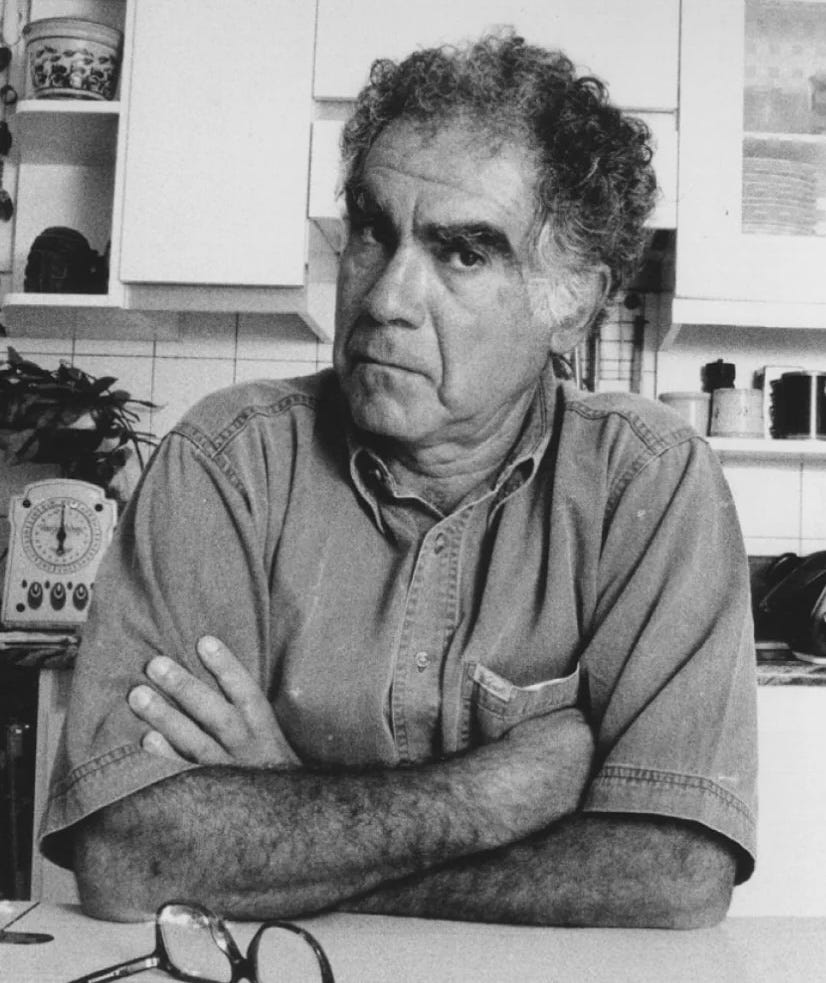
Venice, state archive, and Carlo Ginzburg, a historian with no hypothesis left, walks in and calls out random volume numbers to the archivist.
4, 26, 34, 99.
He had no plan. He came in with a bold refusal to look for anything in particular, because the last time he found what he was looking for, it taught him nothing.
Your AI sessions are often built on the opposite principle.
You arrive knowing what you want, you ask, you go back-and-forth, and AI finally delivers.
Somewhere along the way, you figure out that no AI will ever hand you the thing you weren’t looking for. You have to build the conditions for it.
By the end of this piece, you’ll have three moves to make AI surprise you again, stolen from a historian who spent fifty years proving that the best discoveries come from not looking for them.
─── ⋆⋅☆⋅⋆ ───
Hi, I’m Mia. Welcome to ROBOTS ATE MY HOMEWORK. On this side of the world, we use AI with a brain and zero circus tricks.
The best thing AI ever gave you was the thing you weren’t asking for. A historian in Venice figured that out fifty years ago.
New to RAMH? Start here.

The man who played roulette with the archive
Ginzburg was a microhistorian. He died on June 17, 2026, in Bologna, at 87.
He reconstructed entire worlds from a single trial record or a grain miller’s cosmology (his most famous book, The Cheese and the Worms, came from exactly this method).
What he did was spend fifty years training himself to do the one thing AI prevents nowadays - he built an entire methodology around the pursuit of surprise.
Early in his career, he went to the Modena archives with a hypothesis and found the trial of Chiara Signorini, a peasant accused of cursing her landlady.
The evidence confirmed his hypothesis. Despite this, he was disappointed. An anomalous detail in her testimony taught him to look for the unexpected.
Left without a working hypothesis, he walked into the Venice State Archive (a massive collection of inquisition trial volumes, most untouched by scholars) and called out random volume numbers, a game he later called Venetian Roulette.
In one of those random volumes, he found the testimony of a peasant who claimed that four times a year, his spirit left his body to fight witches in a place called the Vale of Josaphat.
“We benandanti, we are born in a caul and our soul leaves our body four times a year and we fight in the meadow of Josaphat against the witches, and we have fennel branches and the witches have sorghum sticks, and we fight for the fertility of the crops. And when we win, there is abundance, and when the witches win there is famine.”
The inquisitors obviously expected heresy or magic but the answer they got fit neither category. It was something so strange and so specific, and it couldn’t be reduced to the frameworks they already had.
And Ginzburg, the historian with no hypothesis, showed them what they couldn’t see.
To understand how you can get the same surprise and push for the “unknown” when you work with AI, we have to look at his method and translate it to the modern context.
How to build a system that manufactures surprise
“The conquest of inevitability.”
Political sociologist Barrington Moore coined a phrase that captures Ginzburg’s method. Essentially, the confirmation feels productive, because you’ve got your answer and the research “worked.”
What this does is also close the door on everything you didn’t think to look for.
Ginzburg took this further and multiplied obstacles in his own research process by introducing randomness and frictions where typically, most scholars try to eliminate them.
“We should not start from good old things, but from bad new things.” - Brecht’s motto (via Walter Benjamin)
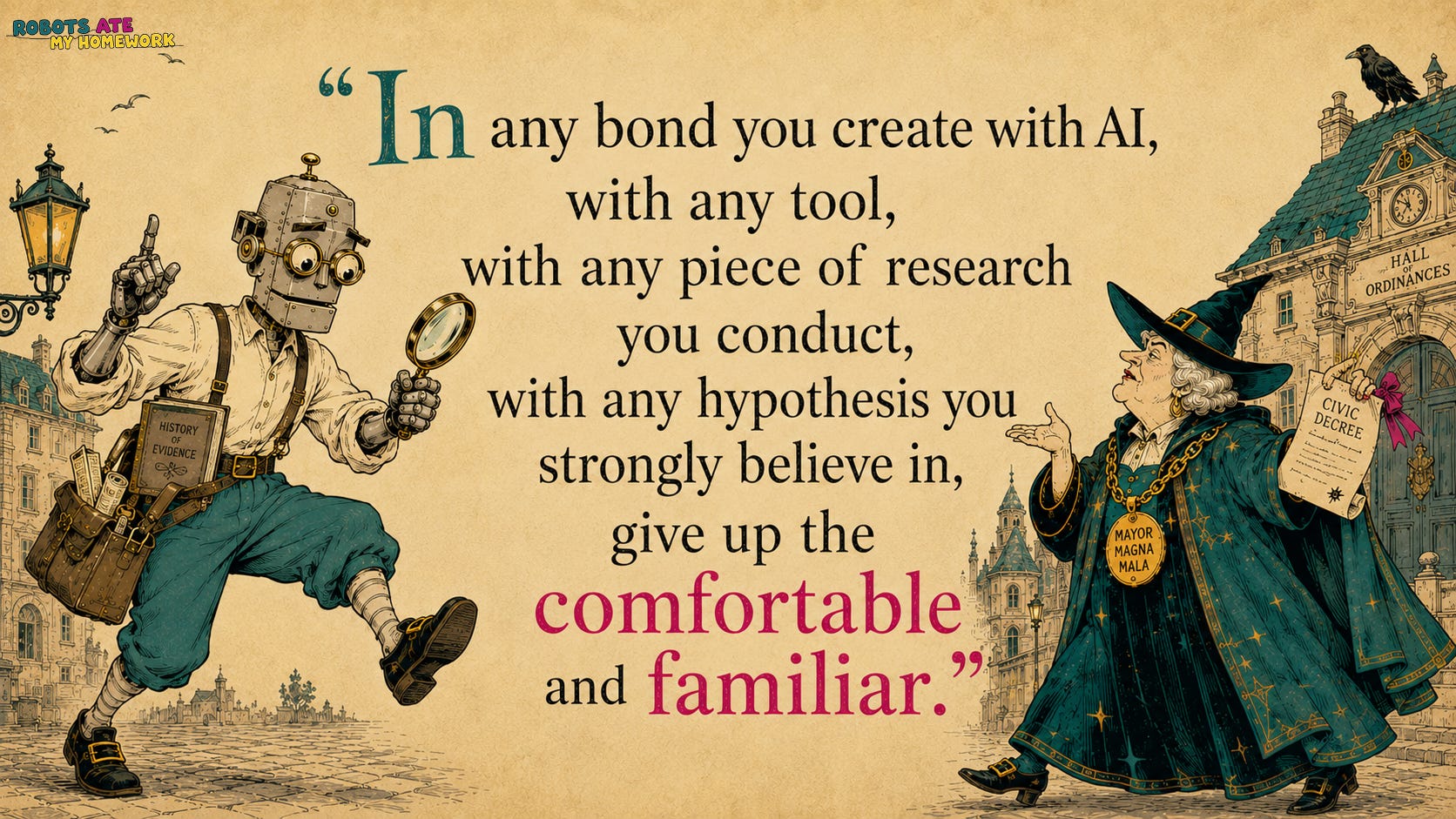
In any bond you create with AI, with any tool, with any piece of research you conduct, with any hypothesis you strongly believe in, give up the comfortable and the familiar.
We love to create devil’s advocate prompts and techniques when we produce a piece of “something.” Ginzburg practiced daily dialogue with a devil’s advocate too. He sought out objections that are hard to answer and questions that made him pause.
This is a disciplined system for creating the conditions under which surprise becomes possible again.
AI, by design, removes those obstacles before you raise your hand and the convenience of that removal has a cost.
What if the better AI gets, the less it can teach you?
You describe what you want and it bends towards delivering you the perfect answer.
Two things feed every response: the collected intelligence of everyone who wrote the training data, and the collected errors. You’ll never know which one shaped your answer, and at that scale, I’m not sure it even matters.
But then you can ask open-ended questions and still get answers that orbit your existing assumptions, because AI is reading your intent and optimizing for alignment with that intent.
No matter how much you try to guide it towards the “surprising”, it’ll still give you a hard time. A hard time that will cost you decisions and cognitive muscle: angles on a project you didn’t see because AI gave you four good ones that confirmed the direction you were already leaning, the connection between two ideas you’ve never put in the same room, because every AI session started from what you already knew.

What you need are different questions, built to manufacture the gap AI removes by default.

What to bring when the archive is your chat window
The benandanti testimony Ginzburg came across didn’t fit any framework the inquisitors brought into the archives. It obviously wasn’t magic, and they had no name for it.
Three things made Ginzburg’s process possible:
he brought something from outside
he refused direct answers
and he brought one last question that only works if you already found what you’re looking for.
You can bring all of these into your next AI brainstorming session as one continuous method.
The random volume
Ginzburg called numbers at random - you can do the same with materials that have absolutely nothing to do with your problem. Some fun examples include:
a paper on autonomous generation loops
a 16th century painting
a piece of music
a scientific finding from a field you know nothing of.
Feed it to AI alongside your project and ask for the “structural” connection. A pattern that would transfer reliably if you remove the surface details from all of these.
I wrote an article a few weeks ago with Jen Benford on the Coastline System, how to build a nervous system for your AI. The idea came from feeding AI a paper on nervous system states that had nothing to do with tech. The connection wasn’t obvious to me (and I’m no neuroscientist) but AI helped me find structural patterns.
This is the type of collision WATSON, my editorial research agent, is built to produce at scale, but you can run it manually with any source and a single prompt.
The refusal
You can’t fake a refusal. AI also can’t give it to you.
Ginzburg refused to accept clean confirmation and instead, wanted to start from a messy part of the problem. This was a habit of asking for objections you’d rather not face.
I tested a product concept once where everything AI told me pointed in the same direction. Every analysis, every pro-con list, every angle, all green lights. I asked AI to build the strongest possible case that the concept was wrong, using evidence and reasoning I hadn’t considered. The case against was stronger than the case for, and it changed what I built.
Your starting point is the moment something keeps breaking. Brecht’s motto, again: don’t start from good old things, start from bad new things.
And on every decision before it ships, every piece before I publish, every product before it goes live, I ask AI to find three objections hard enough to make me pause for a full minute. FOUR WINDS, my adversarial thinking agent, automates this with four competing perspectives, but you can run the same move in any session. The objections that make me pause are always the ones I wouldn’t have found on my own, because they come from angles I wasn’t initially considering.
The last question
You expected X. AI gave you X.
This is when suspicion should settle in.
Ask for the thing neither of you thought to look for. A question that doesn’t fit any framework either of you brought into the session. This requires a bit of manual work and thinking beforehand, so make sure you don’t rush to the answer.
The best angle I found for a piece this year came from the fourth response to a version of this question, after the first three were variations on what I already knew.
Push to the third, or fourth response. It takes AI a few attempts to get past the obvious and into unfamiliar territory. The first answer is always the safe one. The second is usually adjacent. The surprise comes in the third or fourth.
All three moves can run in a single session. Here’s what that looks like stripped down to one prompt you can use today:
I'm working on [your project, problem, or decision].

Here's something from a domain completely unrelated to mine:
[paste anything: an article, a historical event, a painting, a scientific concept, a piece of music. Something that has nothing to do with your problem.]

Find the structural connection between this and my project.
The pattern that would transfer if you stripped both things of their surface details.

After you've given me that, do two things:

1. Build the strongest possible case that my core assumption about this problem is wrong.
Use evidence and reasoning I haven't considered.
Make it convincing enough that I have to seriously reconsider.

2. After all of the above, tell me the one thing neither of us thought to look for.
The question that doesn't fit any framework either of us brought to this session.
Ginzburg said you have to complicate the game. These three moves are how you complicate the game with AI.
Now I want to hear yours. What’s the most surprising thing AI ever gave you that you weren’t asking for?

🤖 You just read ROBOTS ATE MY HOMEWORK.
If this made you want to try something new: subscribe for free and get the weekly essays, frameworks, and systems for using AI with taste.
If you’re already here and want the full toolkit: PREMIUM ROBOTS gives you the working skills, agents, and playbooks behind pieces like this one.
If you just arrived: welcome. Start here.
To Carlo Ginzburg, who complicated the game for all of us,
Mia Kiraki,
Chief 🤖 at ROBOTS ATE MY HOMEWORK
Mia this is fascinating! I'm creating a historic research platform and writing based on the refusal to start with a hypothesis to prove. It's The Columbo (I'm dating myself) or Detective Approach to find very unique points of history from the Revolutionary period of American history.
I think I do a version of this just by how I work without intentionally thinking about it, but I love that this levels things up a notch and brings focus rather than just asking all the time "is there another way to approach this".
I took the easy route and tossed your whole post into something I was working on with Fable... oh my 😍😲🤯 Thanks Mia!
P.S. At the end of Claude's first response, it said: "What surprised you out of that set? Mia would insist I ask." 😆