


I can usually spend over 30 minutes with AI trying to understand why a Sherlock-style detective story, a client problem and a half-built framework belong together.
Then, 5 minutes later, I go ahead and ask the same exact AI whether or not my pricing make sense. Or how to explain to my audience what they’ll receive without having them go over the entire mythology of ROBOTS ATE MY HOMEWORK.
Then I get into trouble, when one robot wanders across the hall with the wrong homework.
This robot can see a system I built for myself - often pretty messy - and suggest we can create a full-stack product out of it. A completely different robot would help me price it, all while becoming fascinated by the product’s philosophy and come back with fluff, smart-sounding language that nobody understands.
The person on the other side of the screen understands NOTHING.
I don’t blame the robots, not at all. Both of them in their own worlds and with their own context, do excellent work. They would also be answering the wrong question. In the wrong room.
I use AI inside creative work, and I also use it inside the more “business-y” work. These versions are almost never allowed to interrupt each other, for various reasons including the ones above.
The same AI can work in both rooms. They just need a different job in each one.
Hi, I’m Mia. Welcome to ROBOTS ATE MY HOMEWORK. On this side of the world, we use AI with a brain and zero circus tricks.
Today, I’ll be showing you how I give AI varied jobs inside commercial and creative work, and the process that allows me to keep both sides connected without them flattening each other out.

Assign one of the rooms to AI
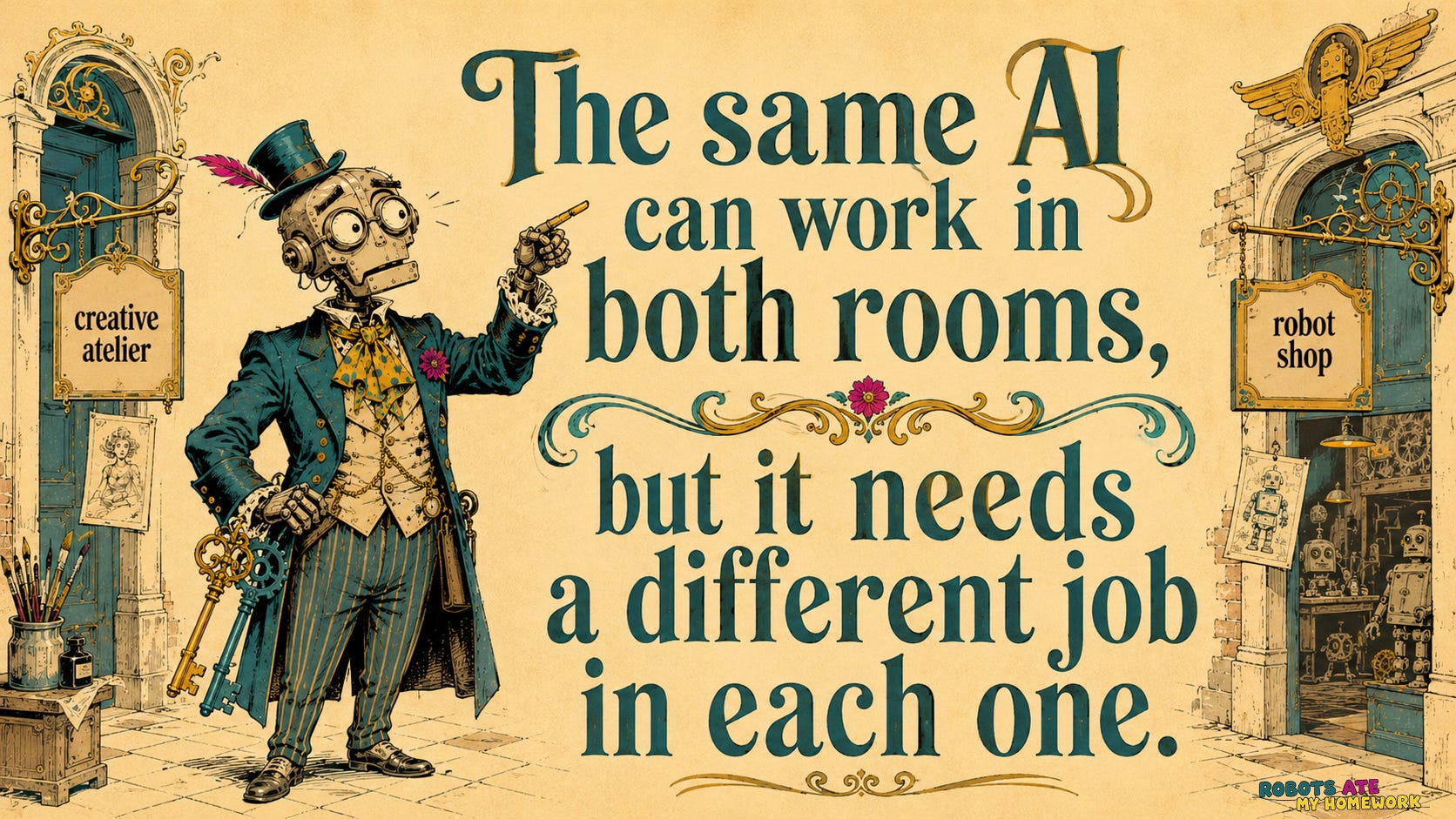
Let me take you through two separate rooms, each with their own philosophy.
The authored (creative) room and the commercial room.
What do we do in each room?
In the creative room, we ideate and create, obviously. We figure out what our “thing” is, what the idea we’ve been ruminating on gets its own little legs, and heart, and soul.
We use the creative room to find the deeper mechanisms: what connections work for this best? What belongs here, and what doesn’t?
More importantly, we are allowed to have unresolved questions, for as long as we want.
AI is allowed to enter this room, briefly. We can use it for research, asking further questions, comparing old ideas of ours and seeing new shapes forming across huge piles of material.
But what about the commercial room?
Is this a corporate mega studio where creativity needs to stay at the door?
Not at all!
The “thing” we created in the creative room already exists now, it breathes. In the commercial room we’re allowed to decide what our audience receives on the other end.
In a nutshell:
Each room gives AI different questions to answer. Each answer gets authority ONLY inside the room that asked for it.
AI is not allowed to answer a commercial question (pricing, packaging) that changes the creative work. And it’s not allowed to answer a creative question either, when we’re deep in the commercial work.
Your AI needs a totally different job when the work changes
I build a lot of creative systems for creators, and AI is a big part of what I create. I like using it to help people explore opportunities that would otherwise be very hard to reach for: expensive, simply impossible to reach alone. And I love hyping up the side of AI that gives people more range, more room to build the strange thing that brings who they are forward.
Problem is, an AI system can look smart while it’s still being “propped up” by the person who built it (me).
The test I run my systems through to bypass this, is: can this work for somebody else without losing the method behind it OR forcing that person into my way of thinking?
A little story for you.
I went through a smaller version of this back when I used to run my boutique content agency.
My husband and I worked closely enough with a few select clients (hence the “boutique” - I could NEVER make enterprise work, thank you very much, and I wanted time for building products too) to know the rules they’d never written down.
We knew their most important work. The systems we’d build for them didn’t have to know EVERYTHING.
A product doesn’t quite have that same luxury.
A system doesn’t land as well if you simply hand someone your process.
You have to decide what’s essential to the intelligence and what was just context living in your head.
A significant part of my job is making sure the user gets to change the system to fit their context, without changing the mechanism behind it - because that’s why the system works so well.
WATSON - my editorial researcher - made this very obvious.
What a lot of you don’t know is that WATSON existed way before AI. I originally built it manually, a few years ago, around the way I liked to research. I’d just follow its process manually, going step by step through everything.
I was WATSON.
So, naturally, WATSON was researching for me.
Adding AI and making it public meant keeping the method while leaving enough room for somebody else’s questions, references, standards, curiosities.
This led to me asking:
How do I create and package a system with a real POV without turning every human that uses it into a version of me?
What if AI gets creative in the wrong place?
Once AI is allowed in the building, we need to welcome it into either one of the rooms. And the rooms can get mixed up!
Here’s how:
First, the commercial philosophy and thinking can get into the work way too early.
This might look like your favourite AI spotting an idea of yours and insisting for it to become a product. “Hey, this could really sell well!”
You’ll be tempted to move on with these decisions, but problem is, AI’s suggested frameworks based on raw ideas and tensions often look over-polished and meaningless.
With the commercial work arriving WAY too early, the work didn’t get the chance to figure out what it wants to be in the first place.
The second kind has a different mechanism.
The creative, authored side follows you into decisions that need to be way simpler.
An example from my own work:
I might find myself create a new language for an offer (Dothraki, no less!) and I carry EVERYTHING from the worldview into it.
My ROBOTS library includes a lot of characters and worlds: greenhouses, detectives, historians, mirages, enough robots to open up a fictional department.
Products should have memorable names. People appreciate that.
But the sentence and the value underneath those products should still tell people, clearly, what those products do.
When I work with AI and the workshop’s at full speed, I tend to ask it to preserve the metaphors and the complex layers. Ai - being an intelligence with supernatural powers (absolutely not kidding), it does its best. But its best often fails because it got the wrong job.
I never want the audience-facing side to become less creative, less fun. The names and worlds and narrative systems are part of what makes the whole thing mine.
It’s just a matter of figuring out how to let AI help in both rooms without letting either one take over the other’s job.

How to connect the creative and commercial rooms in one unified process
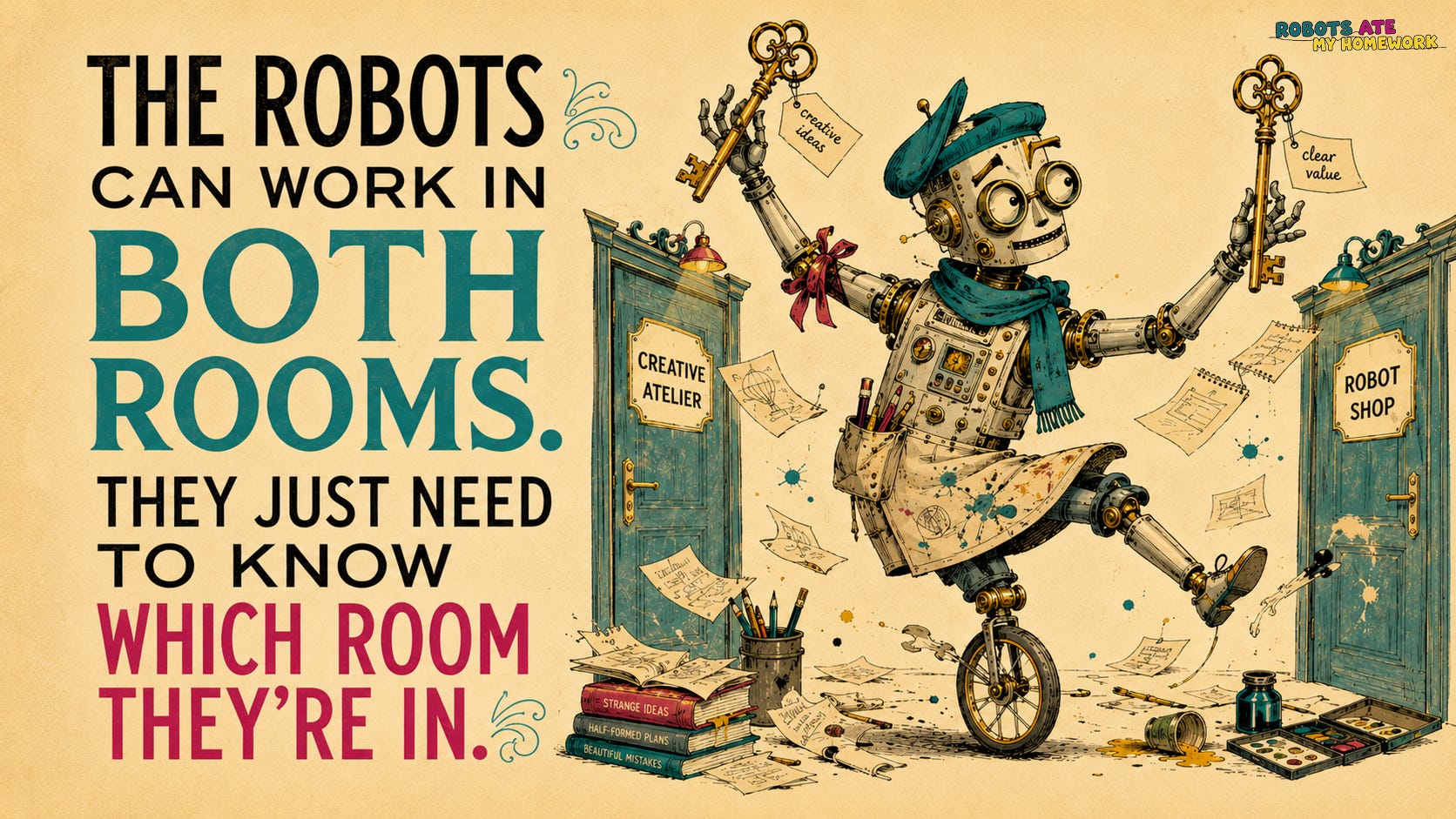
First, this is not about locking the doors and pretending the robot’s only allowed in one room.
We can definitely grab a coffee and sit at the table in both.
In the authored room, AI helps you explore, while in the commercial room, it helps you translate that creativity and test it with an audience or persona.
Treat the movement between the rooms as a handoff, because AI is not allowed to wander freely through the whole building, choosing sides.
Decide what kind of help you need
Here’s what we can do in the authored room:
explore ideas
compare ideas
find contradictions
go through piles and piles of files filled with context about your world
have AI point towards something you maybe haven’t figured out yet
AI is allowed to help us think more clearly - and please note, this doesn’t mean letting AI think FOR you.
Our role here is to notice what AI tells us. What deserves more time for rumination? What idea’s not there yet?
Have AI look for the obvious or not so obvious tensions.
It’s NOT allowed to sell it yet! No pricing convos, no packaging, no polishing and slamming it on a “perks for premium users” page.
At this stage, we establish what decisions AI shouldn’t make on our behalf.
Bring the work before you bring the promise
We never want AI to translate something that exists as an intention, something that’s still brewing in your mind.
Products invented from blurry ideas are awful.
Give AI the material it needs, like your method, examples, decisions, parts you’re super uncertain about.
And make the handoff super clear.
Check everything before anything crosses the hall, otherwise, the commercial side of AI begins working from its own interpretation of the work, rather than the original work itself.
Ask AI to translate instead of improving
When everything has a nice, polished shape, I can finally bring AI into the commercial room and I can now inspect my work from the audience’s side.
Mind you, the AI still can’t redesign the original. The creative side of your brain would HATE that.
At this stage, we brainstorm with AI until we reach a point that makes sense for our context, our minds.
Ask it to put the audience persona hat on and act as a translator between your creativity and the audience-facing product.
It should never make up additional value.
Let the feedback in without handing over the keys
I love it when the commercial room reports back.
Once that happens, you’ll discover that the value of your “thing” might be too difficult to explain because the method you used to create it is blurry.
However, this information doesn’t earn the permission to change the work.
The authored room decides whether or not the message shows a weakness or simply a commercial conflict of interest or inconvenience.
Sometimes, the original still needs another round of thinking. Or the offer language needs to get better.
At the same time, the authored room may find a new layer or possibility, but not everything needs to fit on the pricing page.
Put the work and the promise side by side
By the end of the whole process, I put the original (authored) work and the commercial layer next to each other.
And I ask: did the promise make the work smaller than it is?
Has AI added a fake benefit because it initially sounded plausible?
AI is super useful here because it compares the two layers without being attached to either one.
The final judgement is still human.
I turned this process into a small free skill called The Room Assignment - give it the work, question, or AI response in front of you, and it will assign the room, define what AI is allowed to do there, and catch the moment it starts answering from the wrong side of the building.
Free subscribers can get The Room Assignment here:
The point isn’t to keep AI (or your robots) on a short leash and reserve all the interesting decisions for ourselves. What we need to do is decide what kind of intelligence we need from it at each moment.
The robots can work in both rooms.
They just need to know which room they’re in.
You just read ROBOTS ATE MY HOMEWORK.
If this made you want to try something new: subscribe for free and get the weekly essays and systems for using AI with taste.
If you’re already here and want the full toolkit: PREMIUM ROBOTS gives you the working playbooks behind pieces like this one.
If you just arrived: welcome. Start here, look around, and if something here makes you want to use AI more deliberately, not less, you’re in the right place.

Now I want to hear yours: Where do the creative and commercial sides of your work interrupt each other most often?
To the robots who learned to knock before entering,
Mia Kiraki
I think we’re still figuring out that AI isn’t just a tool problem. It’s a context problem. The same model can be useful or unhelpful depending on the job we give it and the authority we hand over.
The robot needs a room. Apparently it also needs a job description. 😂
Hi sis...
AI should not be given general authority over the project. It should receive a specific kind of authority for the decisions.
That fits directly with my thinking that accumulated context still needs human input and judgement. Especially when it comes to
what becomes instruction and what AI is allowed to change.