


Van Gogh spent his final months in Auvers-sur-Oise in 1890, where he painted prolifically; over a ten-year career he created around 1,000 paintings and more than 2,000 works in total.
The only painting generally accepted as sold during his lifetime was The Red Vineyard, for about 400 francs.
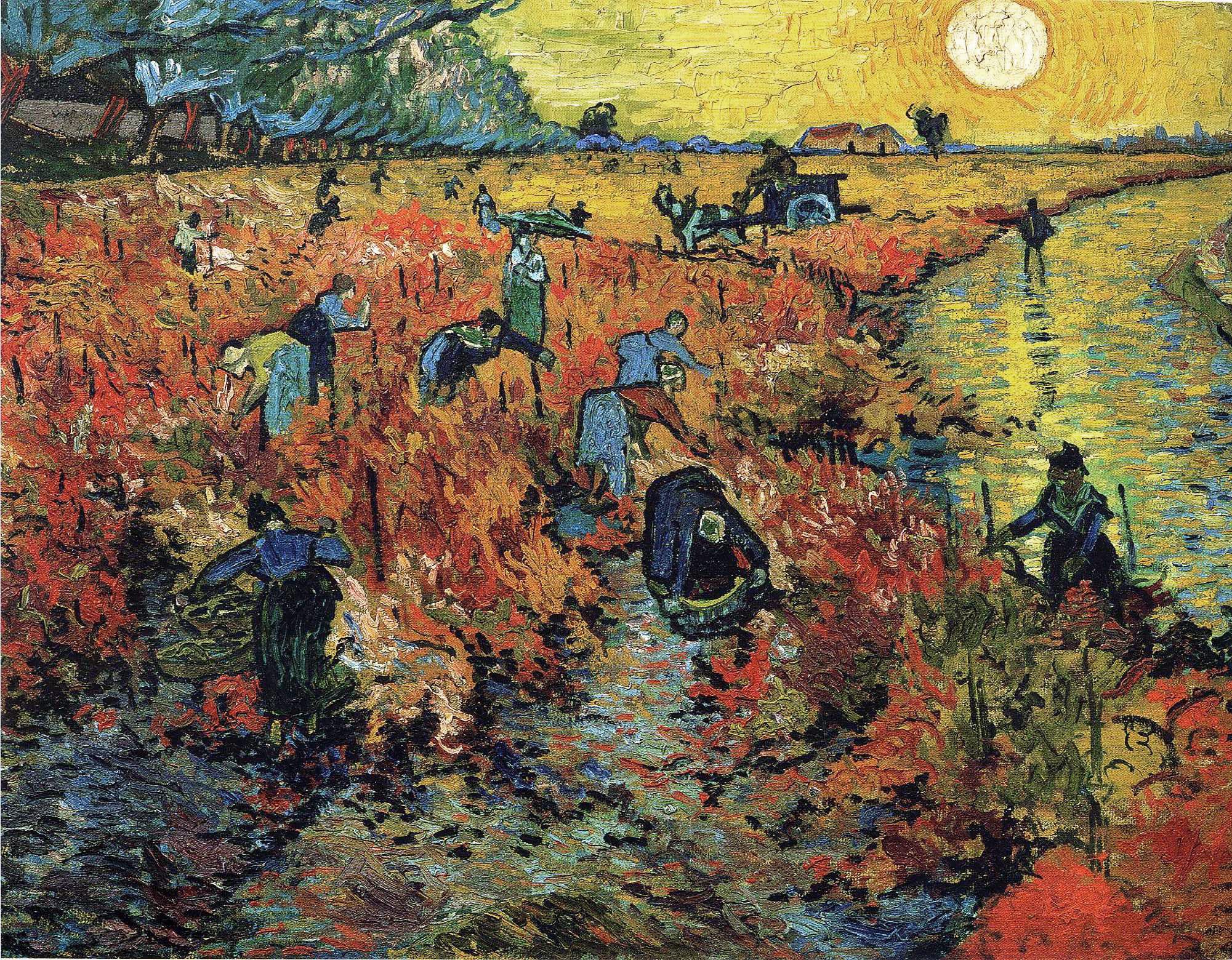
Most artists in Van Gogh’s time, whether playing it safe or pushing boundaries, struggled to sell too. The art market was small and tastes were rigid.
But Van Gogh was different: he painted work so far from the middle that the market couldn’t process it in real time.
The mechanism behind this amazing story is the same mechanism that restructures the market right now. When AI raised the floor of every industry to “competent”, it cleared the middle and made the distinctive work the only thing anyone can see.
Last week I wrote about tacit knowledge, the one you carry that can’t ever be encoded into a prompt, and the creative instincts that live in your hands and not your instructions to an AI:

That was the creative side of the picture.
This is the business side.
The market made your irreplaceable position more valuable and the mechanism behind the “why” tells you exactly where to put your energy.
Today I’ll show you why AI restructured every market in your favor and how to use it.
─── ⋆⋅☆⋅⋆ ───
Hi, I’m Mia. Welcome to ROBOTS ATE MY HOMEWORK. On this side of the world, we use AI with a brain and zero circus tricks.
Van Gogh created over two thousand works of art in ten years and sold one. The market didn’t catch up for decades. AI compressed that timeline to zero, and this post is about what that means for you.

Why “competent” is now the most dangerous place to be
We see the same takes everywhere, and I don’t mean that in a lazy way.
I mean that people’s ideas, their positioning, the way they describe and show what they do, it all started sounding like it came from the same place.
These people and businesses aren’t inherently boring. We just stopped doing the hard part.
We have our fair share of Claude-isms for designing landing pages, Substack note templates, AI copywriters for generating value props, and these are all good tools and we’ve always used them (I have my own note templates). What’s changed now is that we don’t put in the effort to work on them anymore. We give them to AI to build for us.
Of course we only get the average.
MIT Sloan ran blind taste tests, professional copywriters against ChatGPT-4, and the AI won.
People couldn’t tell the difference. They rated the AI content more satisfying, more persuasive. The floor passed the quality check.
Thing is, the same people who can’t tell the difference in a blind test rated AI content lower the moment they knew where it came from. Competent passes the test AND gets scrolled past in the same breath.
I find this both fascinating and terrifying because I’ve spent years trying to figure out what makes my work mine and your work yours, and now I’m competing against a baseline that’s good enough to fool everyone and invisible to everyone.
So what happens when everyone's positioning is okay-ish and nobody's is distinctive?
A decades-long wait is now a fifty-second scroll
Van Gogh waited years for his recognition. His work was too far from the middle for the market to process in real time and art history, naturally, had to catch up.
AI sped that cycle up. We never needed the decades to get from “adequate” to “irreplaceable” and the market didn’t get smarter in the process. We just ran out of the “middle” we were supposed to hide in.
That works in your favor. Every business that refuses to play the “middle” will move in front of the line and the recognition that used to take years now only takes a scroll.

The three components of irreplaceable work and how to find yours
I spent a lot of time trying to answer this for my own business and creative ventures too, and I realized the “be unique” is advice that only describes the final destination. The harder I tried to articulate what made my work mine, the more it sounded like a positioning exercise.
Instead of trying desperately to find my “uniqueness”, I did something counterintuitive - ran my work through AI, over and over, and watched what it had to say about it.
It turns out AI is one of the most meticulous diagnostic tools for irreplaceability, but not in the way you might think. It maps the entire territory of “replicable” and whatever it can’t reach is by definition, the part that’s yours.
After running these experiments on my own work, I found three things that make work irreplaceable. AI makes each of them easier to find, easier to test, and (this is the part that surprised me) way harder to hold onto.
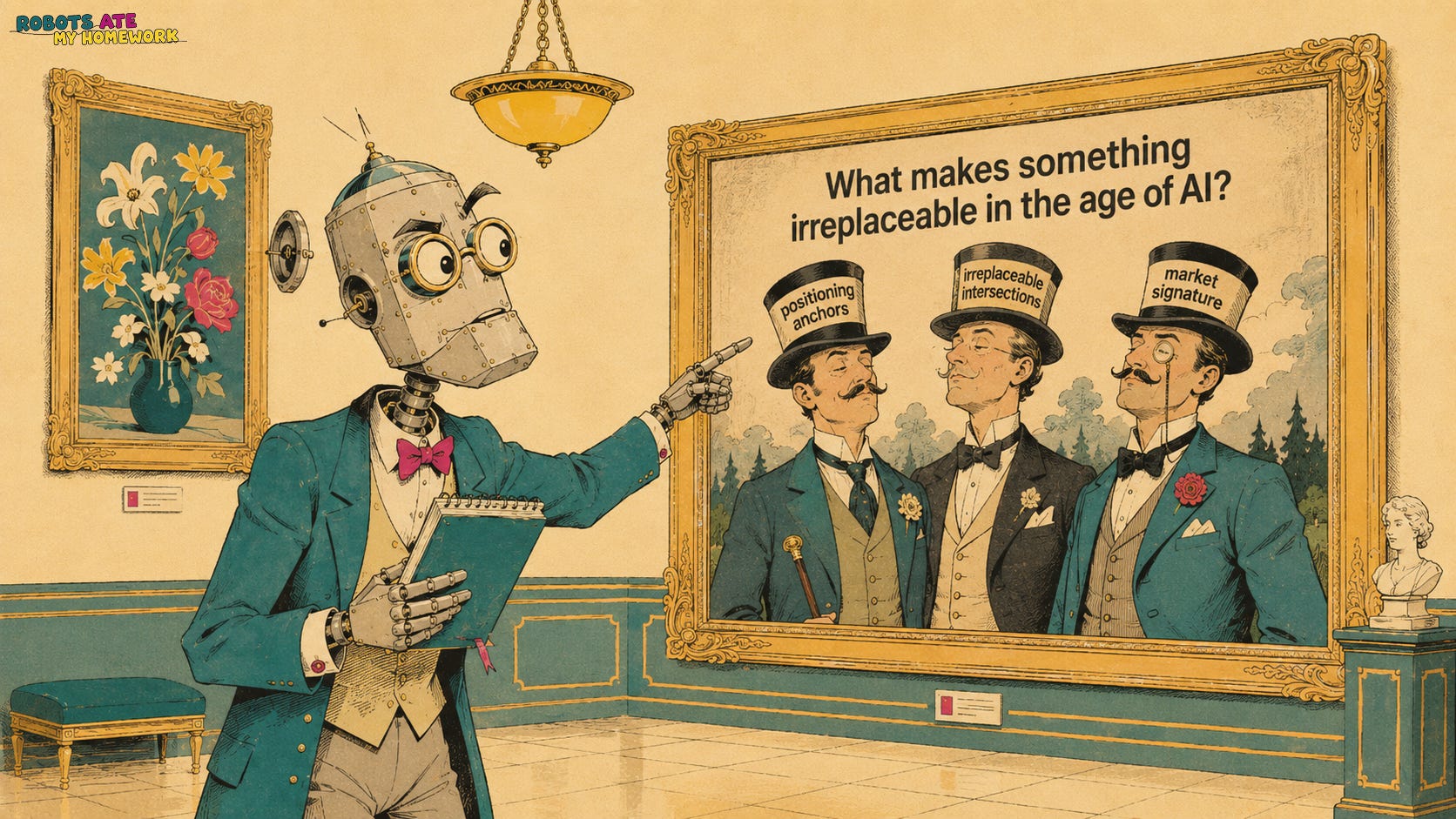
Positioning anchors
When I ran my RAMH positioning through AI and asked it to optimize my strategy for growth, it came back with “take more spicy stances”, “price by the Substack average, $6-8 monthly, $60-80 yearly”, and so on and so forth.
Every recommendation made sense but would’ve totally dissolved what my brand stands for.
Positioning anchors are the business decisions that AI would tell you to stop making, because every AI advisor optimizes for the same metrics: growth, conversion, reach, margin. Your anchors are the places where you keep doing the opposite of what that optimization recommends, like pricing that confuses people who compare you to competitors.
Karo (Product with Attitude) did something interesting a few weeks ago - she built a subscribe button for her Substack that literally runs away from your cursor, and that brought her 70 new subscribers. This is what I call positioning anchors, taking risks that wouldn’t normally be “the norm” but that would absolutely work for a super creative publication like Karo’s.

Think of it this way.
AI is calibrated for the average. When you feed your business decisions through it and it flags something as suboptimal, it’s comparing you against the center of the distribution and whatever worked or didn’t work for others.
Your positioning anchors help you deviate from that center deliberately, where the deviation IS the value, and where “fixing” the deviation would move you toward the middle that just collapsed.
→ Try this. Paste your current positioning into Claude and ask it to suggest improvements for conversion and growth. If your reaction is “but that would change what we actually ARE,” AI’s probably pointing directly at your positioning anchors. Don’t argue with it, notice what it wants to optimize, and write down what you’d lose if you let it.
Irreplaceable intersections
I used to describe myself as belonging to a single lane, like “I do content”, or “I create AI systems” or wait, “I actually write literary fiction too.”
I asked Claude to write a positioning statement that combined my backgrounds and it generated something pretty basic. Why was that? I gave it SO MUCH info.
AI is brilliant at recombining known categories. What LLMs do, statistically, is recombine existing patterns into new configs. Any intersection an AI can generate from a prompt is a recombination, a remix of existing patterns that sounds distinctive (in theory) and dissolves when someone else runs the same prompt.
Your intersection comes from years of living inside more than one field at the same time, long enough that the way you think got permanently bent in directions neither field would’ve taken you on its own.
I spent years learning to see narrative structure everywhere, and years in marketing learning to see persuasion architecture. The way those two clash in my work creates a set of instincts born from the friction between two ways of seeing, instincts that I couldn’t have built without going through both fields.
There's no shortcut here. You can't combine the inputs from the outside and arrive at the same result. You had to go through it.
And AI becomes extraordinarily useful here.
Ask it to replicate something you made, then study where it fails to do so. Those failures are your intersection, drawn in reverse.
→ Try this. Take your best recent work and paste it into Claude with this prompt:
Analyze this piece and then produce something equivalent for a similar context.Look at what's different.
What did it add that you wouldn't?
What did it miss that you consider essential?
What did it get structurally right but somehow flatten?
Market signature
Before AI, being different was cheap and happened almost by accident. The natural variation between people and services and products created enough surface-level distinction that you didn’t have to think too hard about standing out.
Now, “We’re different” is something AI can write for any business in seconds.
I run RobotsOS as a library of skill files and structured AI workflows focused on thinking, and taste, and slowing down, instead of courses or templates to 10x your output, which is harder to explain, slower to onboard, and invisible to (probably) any SEO keyword.
The format is my market signature and communicates that this work is for people who want to do the work with AI, not people who consume and want to generate. The cost of maintaining that choice (in explanation overhead, in slower growth, in a steeper learning curve for new subscribers) is exactly what makes it unfakeable. If I simplified tomorrow, the signal would collapse.
Your market signature only makes sense to people who already understand the system underneath it.
Van Gogh’s brushwork was also a market signature.
The mainstream galleries of his era thought it was a flaw. They didn’t have the framework to see what he was doing, so they judged it by the only standards they had, and by those standards it looked broken.
It took years for the art world to catch up. You don’t have to wait that long. You can show the market how to read your work instead of hoping it figures you out on its own.
→ Try this. Ask the people closest to your work what they find weird, unnecessary, or counterproductive about how you run your business. Don’t defend anything. Then paste the feedback into Claude and ask:
If I were optimizing purely for growth and efficiency, which of these ‘weird’ choices would I eliminate first?The one Claude most urgently wants to fix is almost certainly your market signature and the strength of its recommendation to eliminate it is a direct measure of how strong the signal actually is.
The absorption loop (or: why this isn’t a one-time exercise)
Your irreplaceable position isn’t something you find once.
AI will eventually learn whatever you’re doing now, which means you have to keep moving.
The cycle that used to take decades now runs in months. You can test, measure, and iterate on your irreplaceable position faster than any generation before you, using the very tool that pressures you to keep evolving.
So how do you find this combination and keep it moving?
I built something to answer exactly that.

The Irreplaceable Audit: A structured framework for finding your irreplaceable position
After figuring out the three components, I realized that the hard part was surfacing your own.
We’re awful at seeing our own work clearly, partly because we’re too close to it, and partly because the things that make us irreplaceable feel so obvious to us that we dismiss them as unremarkable.
The Irreplaceable Audit is a skill file you load into your AI. It runs a structured interview about your positioning and will help you see your irreplaceable position from the outside.
How I designed it
The first version of this asked direct questions, like “What makes your business unique?” or “What would you never change?” Every answer came back pretty average, which was the one thing I wanted to avoid.
I rebuilt the interview around sideways questions:
It puts you in scenarios where your uniqueness shows up through your reactions
It asks you to imagine AI optimizing your business and then watches which recommendations make you angry.
It asks about advice you’ve received that felt technically correct and fundamentally wrong.
It has you describe your worst well-paying client and then figures out what your refusal to work with that person reveals about where you stand.
The interview also has two AI diagnostic exercises built directly into the flow (the same ones from earlier in this piece, designed to work inside the audit’s structure).
At specific points, the audit asks you to run your own material through AI and bring back the results. Those answers become primary evidence for your irreplaceable position.
The three phases
Phase 1 maps what you currently lead with. This phase usually surfaces the uncomfortable, that you’re leading with competence (what you’re good at, which AI can replicate) instead of your irreplaceable position (what makes your work structurally yours). Almost everyone starts here. It’s the local maximum from earlier in this piece showing up in your own messaging.
Phase 2 digs for each of the three components with questions designed to get past the rehearsed answers.
Each answer triggers follow-ups that push deeper. It won’t move forward until the answer has enough specificity to be structurally unreplicable. If you’ve used the Brand Strategy Builder, you know the push-back energy. This is that, but calibrated for irreplaceability instead of broad brand positioning.
Phase 3 compiles everything into a Van Gogh Persona.
The Van Gogh AI persona
The Van Gogh Persona is a standing business critic calibrated to YOUR irreplaceable position. You load it into an AI project or run it as a standalone file (or even build it into a skill file), and from that point on it evaluates anything you paste into it.
The persona reads your material and tells you whether you’re leading with your irreplaceable elements or drifting back toward the comfortable middle. It catches competence-first framing, where you’re selling what you’re good at instead of what’s structurally yours. It flags when your market signature is being diluted, when your intersection isn’t showing up in the copy, when your positioning anchors have been quietly optimized away by well-meaning advice or AI suggestions you didn’t question.
The persona diagnoses, and because it’s calibrated to your audit results, it tells you exactly where the drift is happening and which component it’s eroding.
Why a skill file
Two reasons. First, you might run more than one business or product. I have RobotsOS and content strategy AND AI systems / tools through Chillital. Different sides of a business (or different businesses altogether), different irreplaceable positions.
Each one gets its own audit and its own Van Gogh Persona. Each persona then guards every piece of material for that specific business, catching drift wherever it shows up.
Second (and this connects back to the absorption loop), your irreplaceable position moves. What makes you distinctive today might get absorbed into the baseline next year. The audit is designed to be re-run, and the persona is designed to be updated, because standing still is how you drift back into the middle.
Little note:
The Irreplaceable Audit can’t tell you whether your unique position has a market. That’s a different question requiring different evidence (and different tools, like the Persuasion Stack for testing whether your position converts). What the audit gives you is clarity about what you should be testing and leading with, which is a prerequisite for everything that comes after.