

How to deliberately push a good idea past "interesting" with AI
A four-question framework for turning a good idea into an extraordinary one, testing for tension, enemy, activation, and transferability before you commit.

I fall in love with ideas the way some people fall in love with strangers on a train. I see a glimpse of something and by the time I’ve finished my coffee, I’ve written half the piece in my head and bookmarked three supporting sources.
This has been true about me for years, but in the last year, it’s gotten out of hand.
I used to stumble on one interesting idea per week, maybe two if I was reading more than 100 pages per day. Now I can sit with Claude for forty minutes and run through dozens of ideas from my bookmarks folder in a single evening, each one sparkling, each one triggering the rush of “oh, THIS is the one”.
The ideas get processed so fast and feel so vivid that for about twenty minutes, each feels like the best idea I’ve ever had.
This happens because AI usually thinks all your ideas are good ideas.
They aren’t.
In April, I built a whole elimination sequence for killing weak ideas before they waste your time.
After that piece, I needed a companion system for the “almost good” ideas, those you don’t want to scrap entirely, but aren’t quite sure how to use yet.
How do you take a surviving idea and push it until it becomes an absolute masterpiece?
─── ⋆⋅☆⋅⋆ ───
Hi, I’m Mia. I write about using AI with a brain and zero circus tricks.
Fair warning: I wrote this piece because I kept falling for my own bad ideas. The framework at the end is the thing that stopped me.

Why every idea feels like THE ONE
An idea lights you up, and your brain is doing what it evolved to do, firing on novelty. Dopamine floods your reward pathways before you’ve had a chance to evaluate the thing at all while the assessment comes later, if it comes at all.
That system evolved in a world where novelty was scarce. There simply wasn’t enough of it to overwhelm you.
Then AI turned the novelty faucet all the way on.
Kent Berridge’s research separates “wanting” from “liking”. The intensity of craving something doesn’t reliably tell you how much you’ll value it once you have it.
Dopamine drives the wanting but liking is a different system entirely. You can crave an idea with full-body intensity, only to feel completely empty when you sit down to execute it.
With infinite AI generation, input, or brainstorming, comes infinite novelty hits, and your ability to ask, "Is this idea worth building?" erodes. Every single idea feels like the one because your brain is simply reacting to newness, not quality.
The anatomy of an idea that feels electric and goes nowhere
This post was once an idea too (a very, very different one).
I was re-organizing my library and came across one old book on mise en scène (the film principle that everything visible in a frame is a deliberate choice), so I re-read it. Then, of course ideas came to mind. When it was time to get serious, I went deep in a session with Claude, exploring how to connect this to using AI to organize your thoughts. I could see the whole piece.
The next morning, looking at the notes in the light of day, I felt the whole thing deflate. That morning, I was grateful I hadn’t written it, of course, but I was shaken by how the excitement had fooled me. The feeling was so total, so convincing, that in the moment, it was identical to having a good idea.
The difference was just chemistry. Once the dopamine faded, the idea was left standing there, stripped of its glow.
So the piece you’re reading now isn’t the piece I started.
The original idea died and this one grew out of asking why.
The painter’s trick that fixes your ideation problem
When my idea stood there in the morning light stripped of whatever had made it glow the night before, I started running the same experiment Claude Monet spent his life refining at Giverny.
He painted the same water lilies dozens of times, at different hours, because the light changed what he could see. Morning revealed structure that afternoon concealed.
Your ideas work the same way.
The idea you meet at midnight, dopamine still humming, and the idea you meet the next morning once your attention has settled are different creatures, although made of the same raw material.
I started running a version of this two months ago.
Before committing to anything that felt electric in the moment, I’d step away and look at it again the next day, once the chemistry had cleared. I called this the Morning Light, mostly as a note to myself: the moment the idea stands there on its own, without the chemistry doing the talking.
This works for anything: newsletter pieces, LinkedIn posts, podcast episodes, product features, presentation decks.
Whenever you’re about to burn serious time on an idea that felt electric, the Morning Light will take that fragile first thought and give it the exact spine it needs to become the tightest, most compelling thing you’ve ever shipped.
Give your best idea the bones to hold
The Morning Light is a four-question framework.
Each question tests a different load-bearing element of your idea, the part that determines whether this thing holds up once the excitement fades. For each one, you’ll get the core criteria, the exact reason why it matters, and a prompt you can run with AI to work through it in conversation.
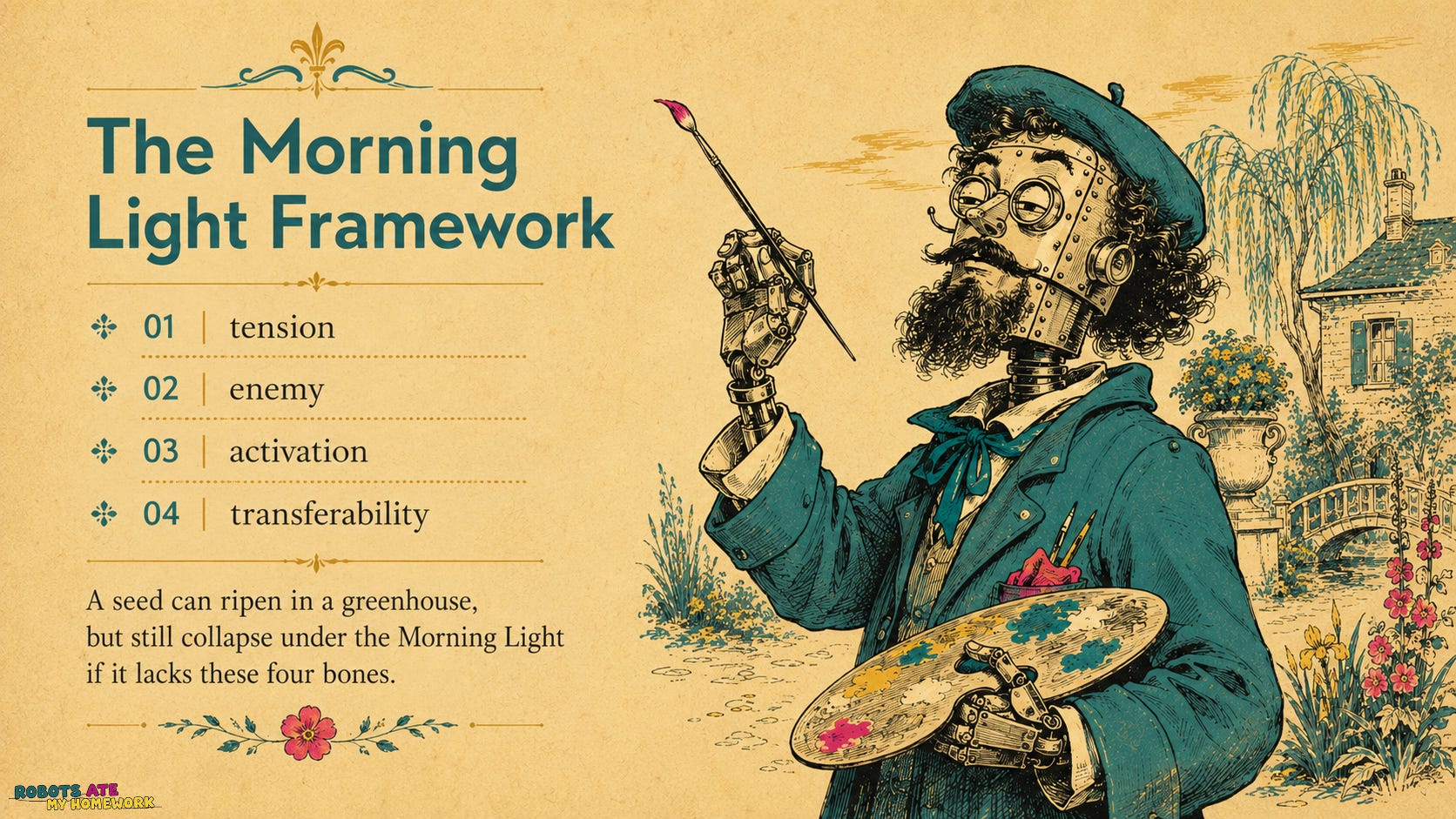
The GREENHOUSE agent I shared with you last month captures and tends ideas well, tracking connections and surfacing ripeness, but “ready” and “worth committing to” are two very different things. A seed can ripen in a greenhouse and still collapse under the Morning Light because it lacks tension or has no enemy.
🌱☀️
Both the GREENHOUSE and the Morning Light form the complete pipeline: one makes sure you never run out of ideas, the other forces them to be extraordinary.
Here’s how to use them together.

The Morning Light Framework: Turn the idea you love into the idea that lights up the room
Before you invest any real creative energy, do this.
