


Have you ever watched The Grand Budapest Hotel by Wes Anderson? I watched it a hundred times! It was one of the films that had a huge impact on my work, from scene setting, to content creation, to how I style all my images.
I wanted to understand how Wes Anderson makes an image feel like an argument. Didion does the same thing with a sentence. Vreeland did it with magazine covers, turning editorial choices into a moral position.
You can point at any of their work and say yes, that’s them. And yet, when you sit down with your own work (a newsletter, a pitch deck, a product image, a landing page) the logic that produced those choices is still invisible to you.
You’ve got their output but you don’t have their decision process.
I’ve spent years inside the work of spectacular creators I admire, absorbing what they’ve made, and I’ve come to the conclusion that access to a creator, a style, a way of doing something is not the same thing as integrating that into your work.
I’ve built a method for building my own apprenticeship now, one that loads directly into my AI session and makes every piece of work I produce sharper.
For you, today:
Why you can study Wes Anderson for years and still not know what he decides when he frames a shot
The three layers inside every master’s work (chose, rejected, governed) and why the rejected layer is the most important
How to make AI extract a creator’s decisions instead of copying their output
Didion’s rejection logic, Anderson’s frame discipline, Vreeland’s editorial nerve applied to content, visuals and branding, and business decisions
The skill file plus the universal extraction prompt for any creator you’ve been studying forever
─── ⋆⋅☆⋅⋆ ───
Hi, I’m Mia. Welcome to ROBOTS ATE MY HOMEWORK. On this side of the world, we use AI with a brain and zero circus tricks.
The reason Wes Anderson’s frames feel like arguments is architecture. Let me show you.

Why exposure doesn’t teach decision-making
I know I say this a lot, but taste really is the last differentiator for anyone building right now, especially when using AI in any shape or form. AI makes production cheap (anyone can generate a competent newsletter or a plausible carousel or a passable pitch deck in seconds), so what’s left of that? Judgement, the thing that says this word and not that one, cut here and not there, this palette for the brand and not that one.
Taste is a skill that you pick up throughout your life. The way a lot of people try to “learn it” is they study creators they admire.
However, you can study Wes Anderson for years and still not know what he decides when he frames a shot. You can read Didion for a decade and still default to hedged prose in your own newsletter. You can follow Vreeland’s career and still pick way-too-safe decisions for your next product.
This has a very simple cause: exposure doesn’t teach you the “why” and the finished output obscures the decisions that produced it.
Apprentices in Medieval Europe learned by watching the master’s hand hesitate before a choice, saw the line they deleted and the composition they threw out, heard them articulate why one thing stayed and another went. They learned the reasons underneath the output.
AI can’t give you this.
Whatever you think AI improves in the final output, it often ends up replicating a creator’s surface-level choices rather than understanding the deeper mechanisms that make those choices effective in the first place.
The real question is, how do you extract the decision principles from any creator’s body of work and apply them to your own projects without ending up with a pastiche?
The three layers hiding inside every master’s work
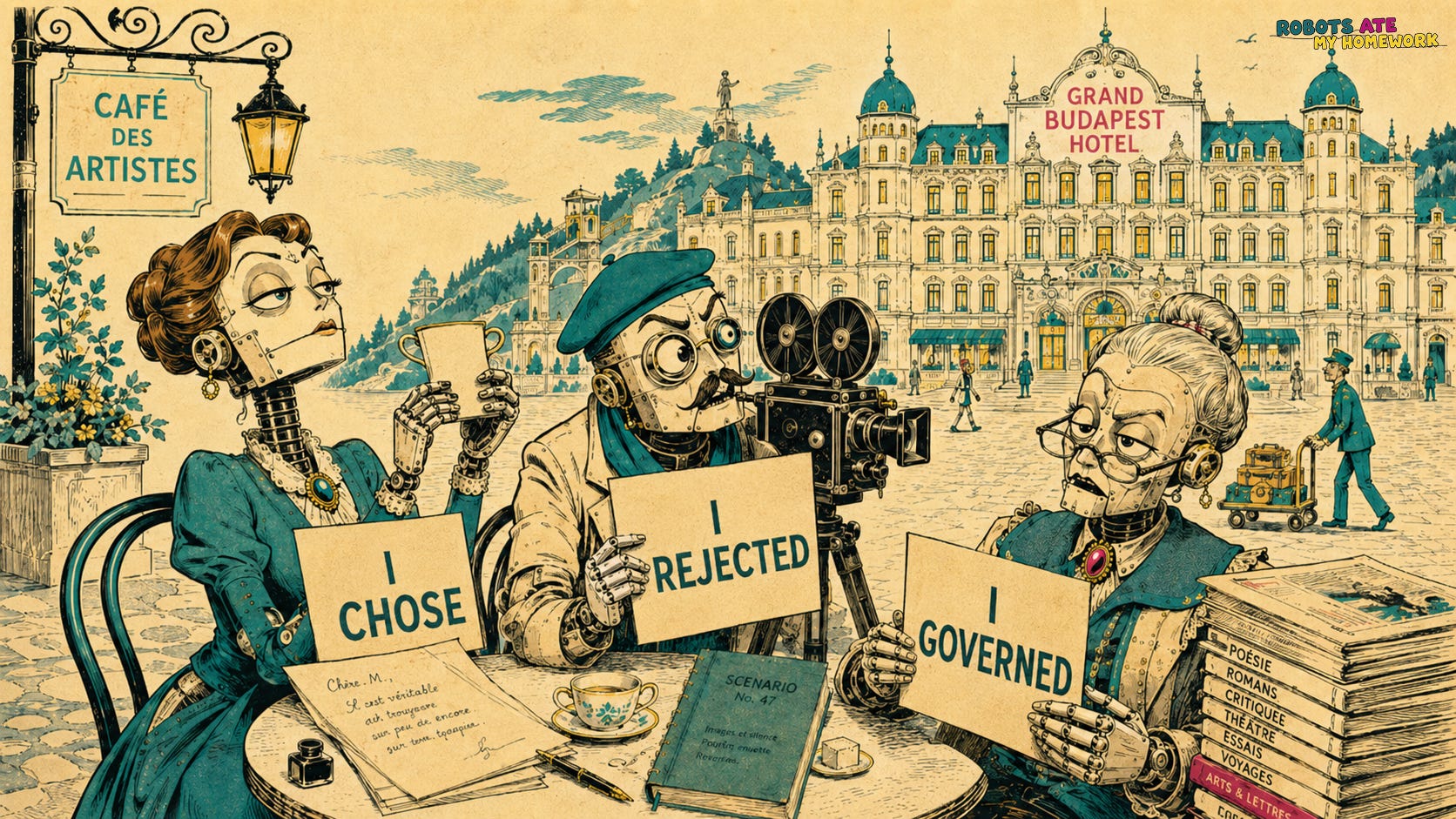
Let’s call these creators (my favorite ones, your favorite ones) “masters.”
A master’s body of work includes three layers of decision:
Chose: the patterns that recur, the choices that appear again and again across their output in structure, in tone, in what details stay and which get cut, in what subjects they return to, in how they compose a frame or a sentence or a page.
Rejected: the patterns that are conspicuously absent, what they consistently avoid even when it would be easier or more popular, what a less rigorous version of that creator would’ve done that this person refused.
Governed: the principle underneath both, the logic that explains why this thing got chosen and why that other thing got cut, the rule they carry from project to project.
We almost always only see the chosen layer, while our discernment is found in the rejected layer. What the creator refuses tells you more about their taste than what they produce. The governing principle is what lets you apply their judgment to work in your own domain, in a form they never made.
A student who understands all three layers walks away with a constraint they can apply to anything they make, while a student who sees only the chosen layer walks away with imitation.
The difference is extraction, and extraction is learnable.
Here’s how it works in practice, on three creators whose work I’ve studied for years.

Get Didion’s rejection logic for your content
Joan Didion’s prose has been parodied for 50 years and AI can approximate the surface in a heartbeat: short declarative sentences, no adjectives, a flat observational tone, essayistic.
You always end up with a pastiche, because copying Didion produces something that looks like her writing without any of the decisions that made her writing work.
Go ahead, open your AI chat and paste this in:
“I want you to rewrite this section [PLACEHOLDER] in Joan Didion’s style”
See what you get. You can use this article.
I bet you didn’t just become Didion, and chances are you’ll spend more time editing than you would have if you’d just written the piece yourself.
My question here, was how does Didion’s decision architecture apply to someone building a Substack, a landing page, a pitch deck, or any piece of content that needs to land.
Here’s what I extracted from her, and how to use it:
What Didion chose (the recurring patterns):
Short, declarative sentences as the default.
An observational register that states what she noticed without explaining how to feel about it.
Specific, concrete details over abstract claims.
Paragraphs that end mid-thought or on an image, rather than on a summary sentence that tells the reader what the paragraph means.
What Didion rejected (the conspicuous absences):
Hedging.
Defensive clauses like “this might seem strange, but” or “you might disagree, but” or “I know what you’re thinking.”
A reflexive self-deprecation.
Adjectives that exist to modify a claim rather than to describe something specific.
The sentence at the end of a paragraph that tells you how to feel about what you just read.
Preparatory sentences.
Every word does work the paragraph needs done while anything that exists solely to signal effort, hedge against disagreement, or reassure the reader, is cut.
I ran the extraction on Didion, loaded the constraint file into my AI session, and asked it to filter the intro and first section of this very piece through her rejection logic. The filter showed me six sentences that existed solely to prepare the reader for the next one. I cut all six and both sections got way better.
That filter, and the method for building one on any creator you admire, is what’s below.
🤖 What’s below this line:
Didion’s application filter → the four-point rejection logic I ran on this piece, ready to paste into your AI session.
Wes Anderson for branding and identity → the full visual decision-architecture extraction, plus the prompt I use to keep GPT image generation inside a deliberate palette and composition.
Vreeland for editorial and business decisions → the extraction that turns “am I choosing this because it deserves attention or because it’s safe?” into a constraint you load before your next launch, pitch, or cut.
The universal extraction prompt → paste any creator’s body of work and get a structured chose/rejected/governed file you can load into any AI session as a constraint.
The Invisible Apprenticeship skill file → all three pre-built extractions for your own, ready to install and use in under 5 mins.
─── ⋆⋅☆⋅⋆ ───
🤖 That’s what PREMIUM ROBOTS subscribers get: better questions, smarter systems, and the deeper analysis to make both your default.