


What’s sitting in your content archive, filed as Item 15087?
120 years ago, sponge divers near a Greek island found a corroded lump of bronze in a shipwreck. It was stored away in a museum in Athens, like any other item, for fifty years, all while being walked past without a second thought.
Then, in 1951, Derek de Solla Price (historian of science and physicist) recognized what the gears were - a 2,000-year old analog computer. Way more advanced than anyone expected.
The museum’s most valuable object was there all along, hidden in plain sight.
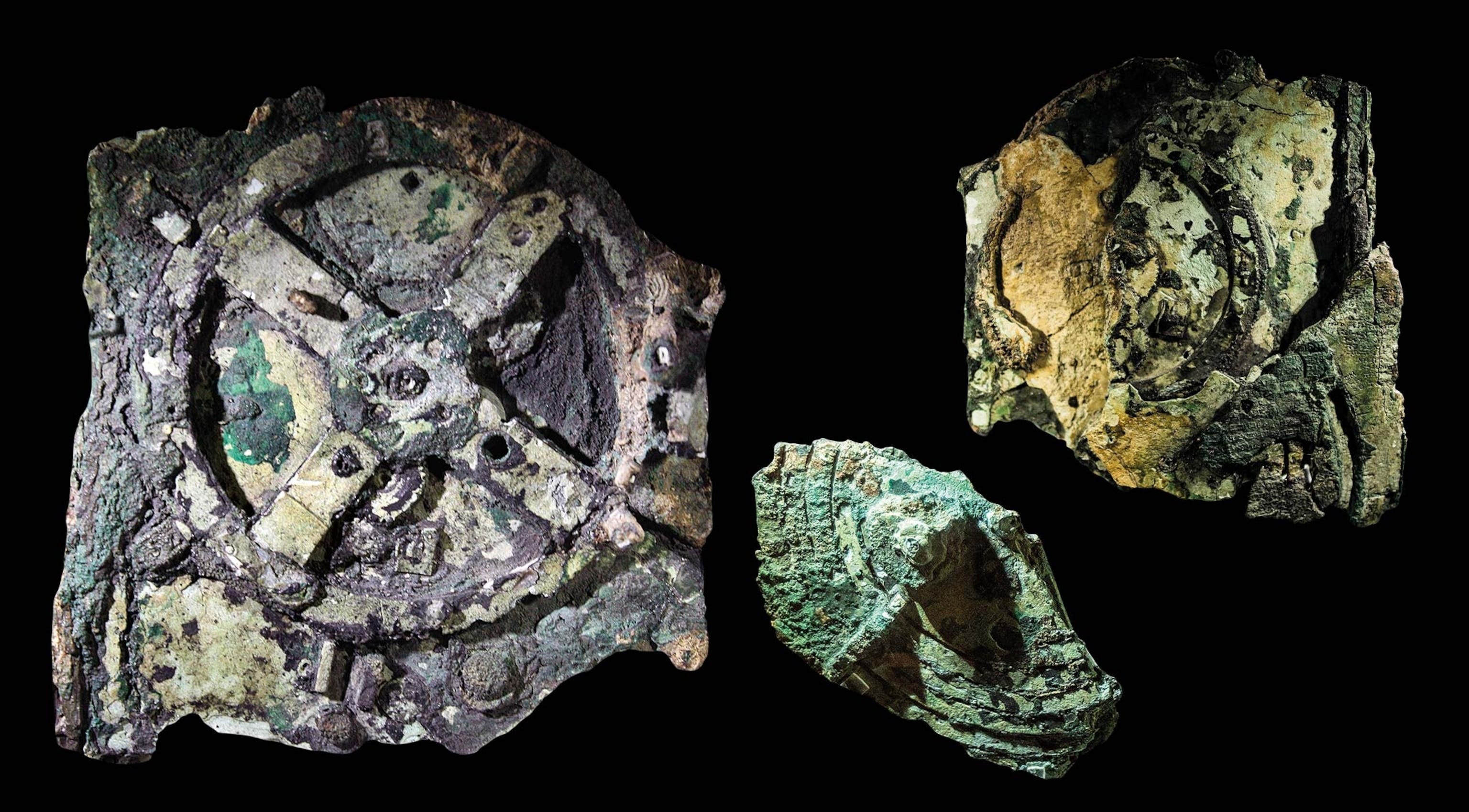
We tend to do the same with our work.
We have years of posts on Substack, essays we write on various platforms over the years, half-finished things, finished things we forget ever existed.
And we’re still stressing about what the hell to build next, what content to write, as if the answer isn’t already sitting in a storeroom we keep adding to and never walk through.
We need to appraise what we have.
In this edition, I will:
Show you why your brain is wired to ignore your own archive and why AI made that wiring worse
Walk you through four unexpected frameworks I found while building an archive appraiser, from museum science to Japanese craft
Hand you MINT, the process that walks your back catalog and classifies every piece as a product seed, lead magnet, flagship, or dead weight
Show you what comes out the other end - a 30-day action plan built from assets you forgot you owned
─── ⋆⋅☆⋅⋆ ───
Hi, I’m Mia. Welcome to ROBOTS ATE MY HOMEWORK. On this side of the world, we use AI with a brain and zero circus tricks.
Price walked past that corroded lump for years before he noticed the gears. Your archive is full of gears you haven’t noticed yet.
Let’s change that.

When was the last time you scrolled through your own archive?
A few words on my process.
Every time I need a new content idea or need to brainstorm a new product, I go looking - I scout, I brainstorm.
You probably do too. We’re wired for novelty and the brain rewards the new.
A fresh idea feels alive, while going back to something you built or wrote six months ago feels like regression. Like you’re out of ideas and scraping the bottom of your own barrel.
We always want to go forward, forward, forward. What’s next, what’s new, what haven’t I said yet?!
AI poured liters of gasoline on this. Novelty is now really cheap, a couple of tokens at best.
You can generate new ideas in seconds. The barrier to “new” dropped so low that going backward to what you already wrote feels even MORE like regression. Why would you scroll through your own old posts when you could generate fresh ones?
You have years of work.
You keep collecting and never appraising - that’s the same hoarding pattern that kills second-brain systems.
I wanted an appraiser, not another idea generator
Let’s go back to 1951. Price, in his storeroom, brought the right instrument to what was already there instead of writing a paper on the theory of the hidden item in the museum.
I wanted that instrument for my own archive - an appraiser of some sorts.
Something that walks through my work the way an art appraiser walks through a collection of items and tells you what’s decorative, valuable, and what you should’ve thrown away years ago.
But, “read my posts and suggest some ideas” is pure generic slop and, if we’re to bring forward our art appraiser personas, we don’t do that here.
So I went looking for how actual appraisers think.
First wall: I didn’t even know what I was looking at
My first attempt was a simple classification post: read each post, tag it by topic, suggest what to do with it.
I ran it on my own archive and I found it basic, and boring, and not at all capturing what I’m really doing / writing about.
Topic tags don’t tell you anything about what a piece MEANS to your body of work.
A post about “voice” and a post about “voice” can be completely different animals (yes, you read that right!).
So, the first real question was “what ARE they, structurally?” What role does each piece play in my collection?
And that’s when I looked into museum science.
Museums have a classification system:
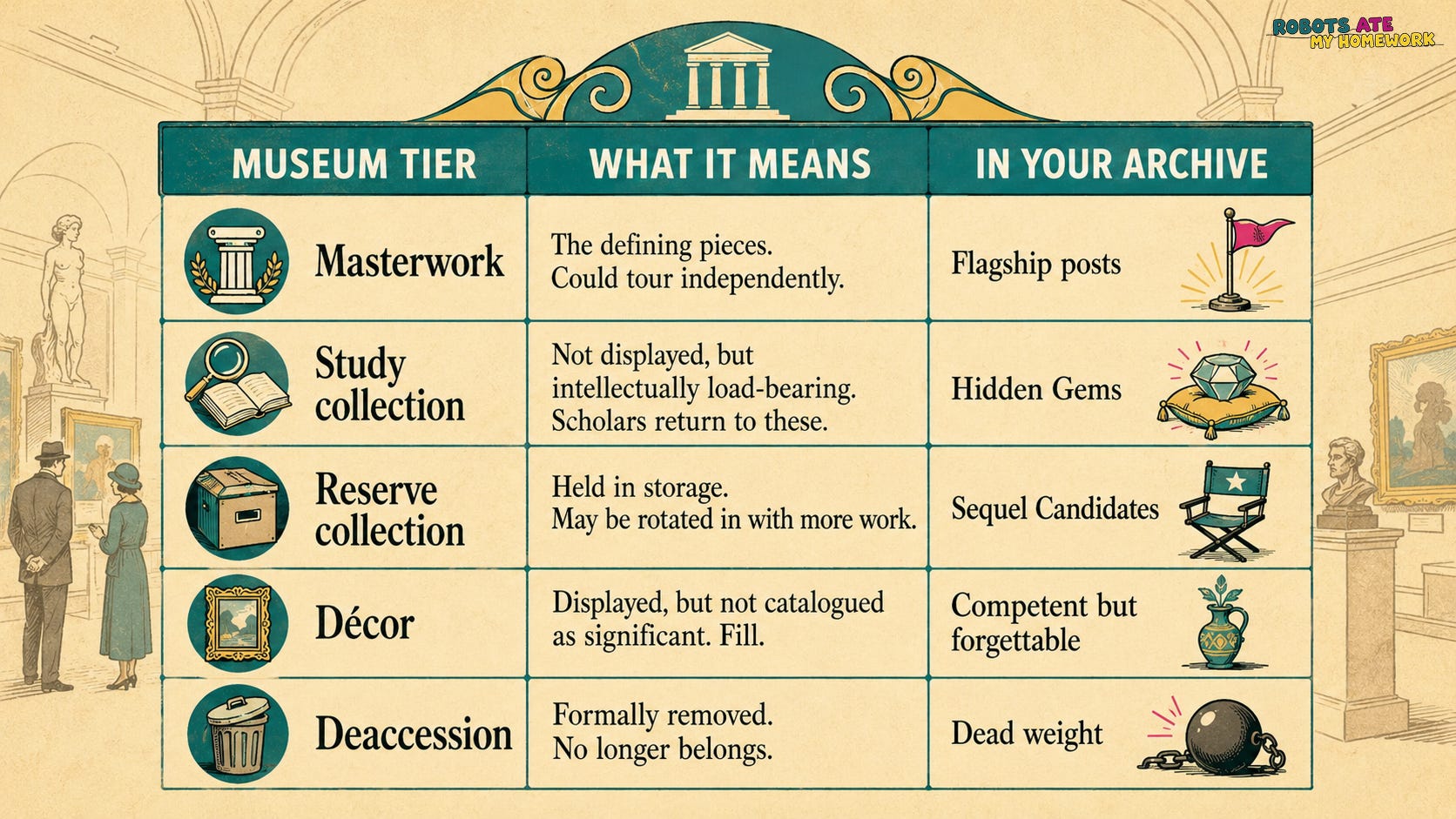
Very valuable information, but one piece of information that stuck with me was that a post with 200 reads can really be a hidden gem, while a post with 5,000 reads can be decor. The traffic will tell you nothing about what that piece means to your body of work.
Significance does.
Second wall: significance isn’t enough
Okay, so now I can tell you what each piece IS.
But that doesn’t tell you what to BUILD.
Knowing you have three hidden gems doesn’t tell you which one is a product seed or lead magnet, or which one is a post that got buried in the infinite archive.
I spent a week on this, trying keyword frequency and “topics you mention most” and asking AI to find “recurring themes.” All garbage, because topics aren’t really products - they’re things you write about. Products come from a tension.
And then I found Christopher Alexander.
He was an architect who, in 1977, wrote a book called A Pattern Language.
His idea was that certain architectural problems appear across different buildings in the same form, so if the same problem shows up in the same shape, from different angles, it’s a structural pattern.
Apply that to content:
If you’ve written about the same tension three times from different angles, that’s a Pattern.
Three posts about content archives, written from three different directions - that’s a half-built product.
This is when I started shaping the idea of MINT, a system that would read your body of work and tell you what’s sitting in it: what’s a flagship, what’s a product seed, and what’s been dead weight for three years.
I thought the concept was enough. I was wrong.
Third wall: products need fuel, not just patterns
So now I could find patterns, which meant I could also find product seeds.
But every product needs content around it, and AI gives you random garbage when you try to come up with awesome copy.
I was about to give up on “automating” content creation entirely for this thing and then I went down a completely different rabbit-hole and found Stuart Kauffman.
Kauffman is a theoretical biologist who coined the term “the Adjacent Possible.”
At any moment, a system can only move to the next step reachable from where it is right now.
Evolution steps, and each step opens new doors, but you can only walk through the ones that are adjacent to where you’re standing.
Your best new ideas aren’t random AT ALL - they’re in the adjacent possible of what you’ve created. One step from where you already are.
I built something around this exact principle - the GREENHOUSE treats ideas as seeds to tend, not files to store, which is the adjacent possible in practice.
A post about voice drift becomes a content seed about how voice drift shows up in client work. A post about decision fatigue becomes a seed about decisions that drain you most.
One little step, not a leap into the void.
I thought it best for MINT to map the idea around each of my posts and look for adjacent ideas, the next steps I hadn’t taken yet, generated from the shape of my own thinking rather than from a generic topic generator.
Fourth wall: what stays free, and what becomes paid?
Quick disclaimer: I’m not only referring to my Substack posts. I fed it multiple non-Substack pieces, as well as pieces from my private archive.
I could classify, find products, come up with new content, but I couldn’t answer the simplest question:
What stays for free, and what becomes paid?
I tried engagement metrics, “most popular posts” - it kept picking my best, most complete posts. Some of them already had products baked in too!
I didn’t love the results. They were… wrong. But I couldn’t figure out why until I remembered - hey, you write about this a lot!
Kintsugi.
The Japanese art of repairing broken pottery with gold lacquer. The crack becomes so valuable, it’s essentially the perfect example of “the flaw is the feature.”
A fully resolved piece of content is satisfying but closed.
The reader walks away with the answer and has no reason to go deeper.
A lead magnet in this context, is a post that centers around a real question that remains unresolved, where you opened a door and left it open on purpose (or not).
The incompleteness is an invitation.
Four frameworks, then. Four lenses, each doing one specific job:
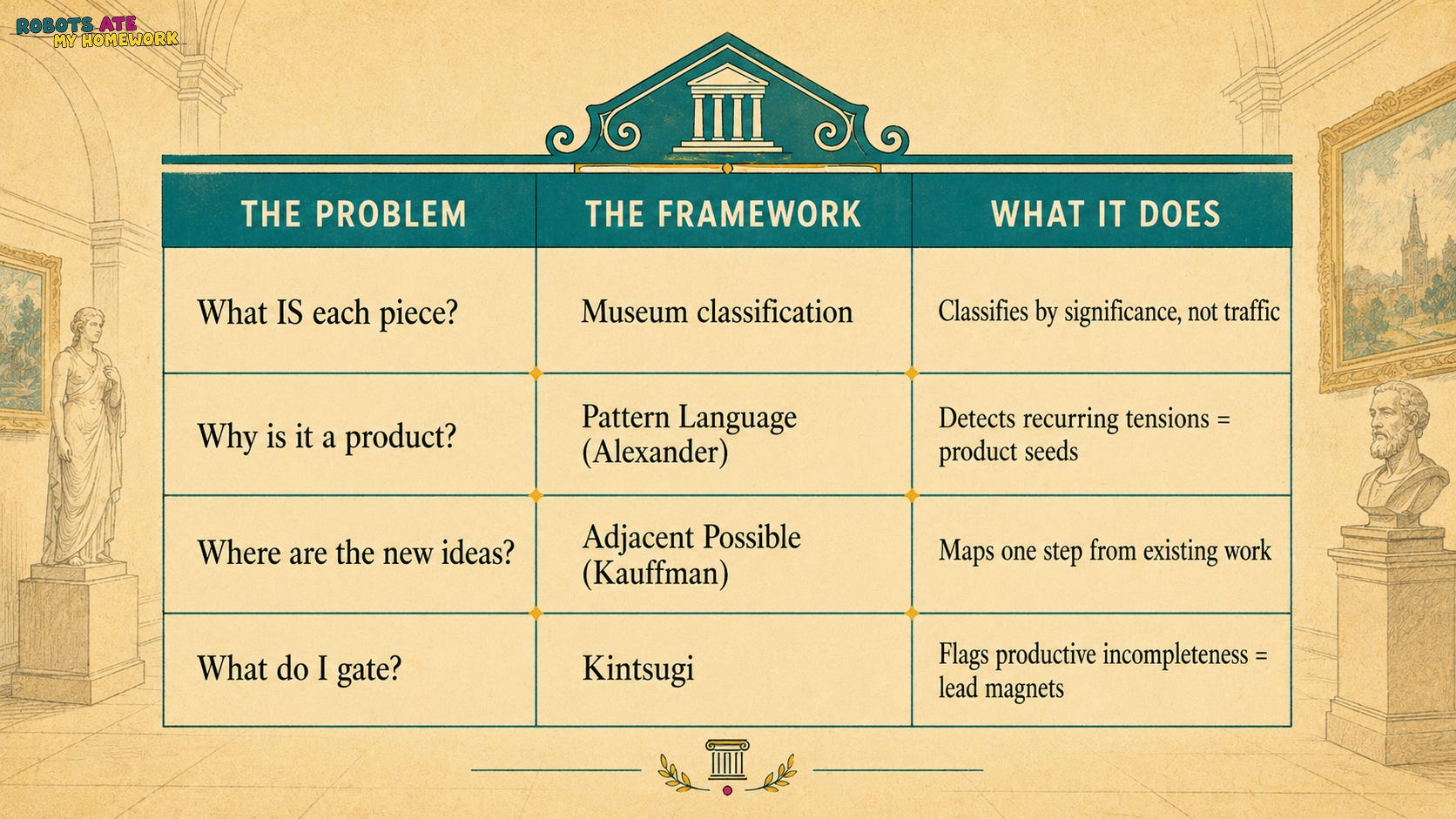
I built MINT to walk through everything you’ve collected, appraise it properly, and hand you back a 30-day plan built from assets you forgot you owned.
🔒 Upgrade to get the full system:
MINT walks your entire archive through four frameworks:
museum classification
pattern language
the adjacent possible
kintsugi
It hands you back a 30-day action plan: what to turn into a product, what to gate as a lead magnet, what to revisit as a sequel, and what to deaccession for good.
─── ⋆⋅☆⋅⋆ ───
🤖 That’s what PREMIUM ROBOTS subscribers get: better questions, smarter systems, and the deeper analysis to make both your default.
Inside the appraisal
You’re about to get the inside of how MINT works.
I’ll walk you through the tiers, the process, the AI that runs it best, and all the questions worth asking after your first run.
And, obviously, give you MINT itself.