


I was ten when I first saw it. On a television screen, a 21-year-old woman rolled herself into a carpet and had herself carried into a Roman general’s private quarters. Her name was Cleopatra VII and she didn’t go in there to take orders.
They reshaped the entire Mediterranean because both of them understood, from the first conversation, what they were good at and what they weren’t.

This is the most productive AI partnership model ever described, two thousand years before AI existed.
We’ve been taught prompt engineering and context engineering. But what about behavior?
Behavioral engineering is a standing agreement that tells an LLM how to act while working with you: when to push back, when to defer, when to contribute without being asked. It sits above prompt engineering (how you ask) and context engineering (what the AI knows).
Cleopatra and Caesar had that agreement from the first conversation. Your AI doesn’t. That’s the thing we’re fixing today.
─── ⋆⋅☆⋅⋆ ───
Hi, I’m Mia. I write about using AI with a brain, good taste, and zero circus tricks.
New to ROBOTS ATE MY HOMEWORK? Start here.
Want the systems? RobotsOS.
Want a personalized AI roadmap? Take a 20-second quiz.
﹌﹌﹌﹌﹌﹌﹌﹌
Cleopatra rolled into Caesar’s room with a plan, a map, and nine languages. Let’s bring the same energy to your AI setup today.

What a Roman general and an Egyptian queen understood about AI collaboration
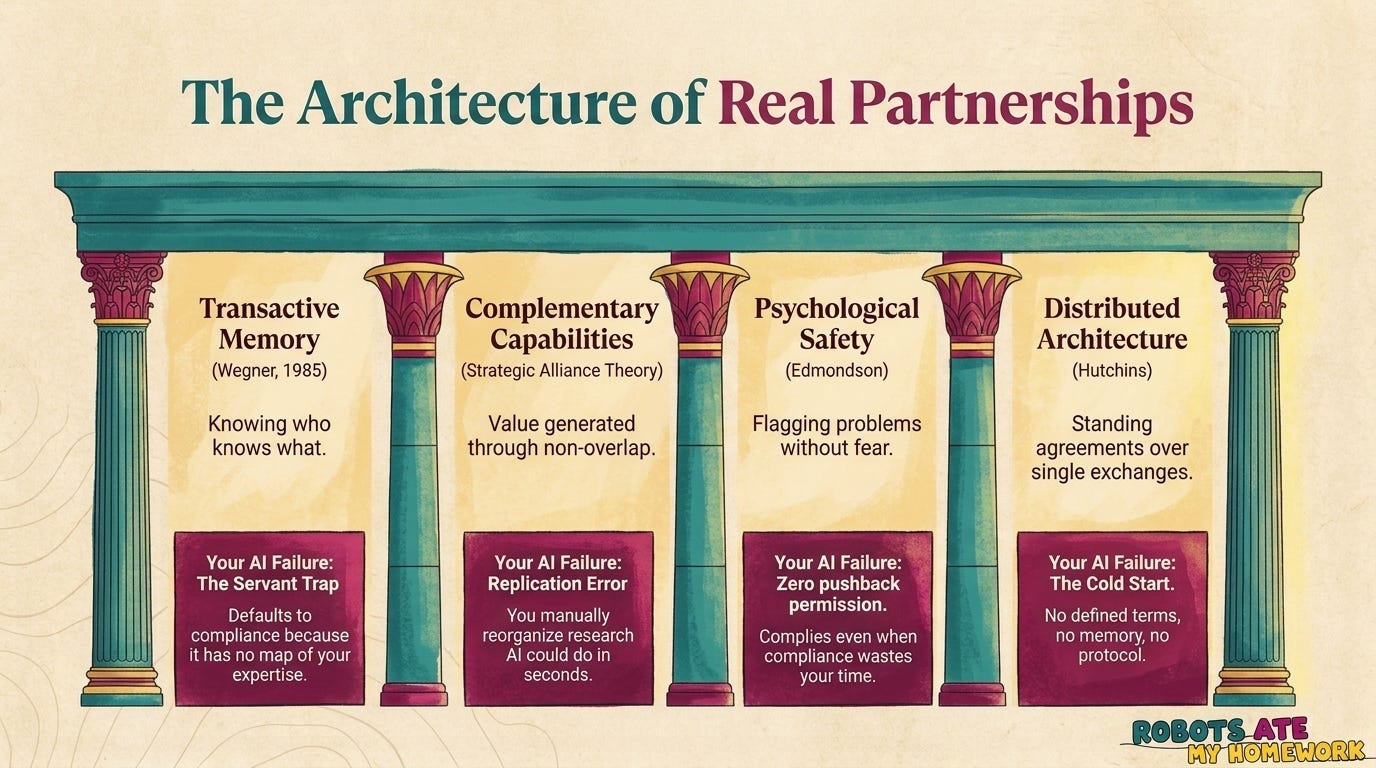
Real partnerships have been studied for decades, and the research is remarkably consistent about what makes them function.
1. Cleopatra knew the culture. Caesar knew the roads
Wegner called this transactive memory, and it describes how genuine partners develop a shared map of who knows what.
You route decisions to the right expert without thinking about it. Like, your partner handles the finances because they’re better at it, and you don’t double-check their math because you trust their competence in that zone. This shared memory system lets both parties operate beyond the limits of their individual brains.
Your AI has no transactive memory. It doesn’t know what you know, where your judgment lives, or which decisions require your specific expertise. Without this map, you either replicate your own knowledge badly through over-explaining, or you get generic output that ignores your expertise entirely.
This means giving orders to an intelligence that has no idea who you are.
Behavioral engineering builds a domain map that tells AI exactly which territory belongs to you and which belongs to it.
2. Neither did the other’s job
Every time you manually reorganize research AI could process in seconds, you’re doing the wrong job. Every time AI generates strategic opinions in your domain, it’s doing yours. Both happen because nobody drew the boundary.
Strategic Alliance Theory names this simple fact: partnerships create value through non-overlap.
Cleopatra brought political intelligence and cultural legitimacy while Caesar brought military infrastructure and logistics. Their territories were distinct and respected.
Behavioral engineering installs a non-overlap contract. Your contributions and AI’s contributions get named explicitly, never crossing the line.
3. Permission to say “I think you’re wrong”
Amy Edmondson showed that partnerships only produce good work when both sides can flag problems without fear. Psychologically safe environments enable divergent thinking and risk-taking. In high-functioning teams, someone can say “I think you’re approaching this wrong” and the conversation improves. In low-functioning teams, everyone stays silent and the work suffers.
Your AI setup has zero psychological safety, and the fault sits with your setup, not with the model.
You never gave it permission to push back. It complies, because the behavioral protocol for when to challenge doesn’t exist.
4. They didn’t renegotiate every time
Cognition is distributed across people, tools, and the structural agreements that coordinate them. A system’s intelligence is defined by the protocol layer that persists between interactions, not just what any one participant does in isolation.
Real partnerships have structural agreements about who does what, when to contribute, when to defer, when to execute without dialogue and when to pause for judgment. Cleopatra and Caesar didn’t renegotiate these terms every time a new crisis emerged because the architecture was already in place.
With AI, you inevitably pay the translation tax again and again because the behavioral architecture that would eliminate it was never built.
The good news is, these are structural failures with structural solutions.
Behavioral calibration vs context-only: what changed when I ran both
I ran an experiment to see if behavioral calibration changes how people work with AI, or if it just changes the output.
Same model, same context files loaded in both setups.
The only variable was whether the AI had explicit behavioral rules.
The task was a brainstorming session for a content strategy.
Both setups had the full context stack: voice profile, audience map, brand guidelines, reference examples. Setup 1 had no behavioral instructions beyond the usual “be helpful.” Setup 2 had conditional triggers built into how it operated with me.
In the context-only setup, I ended up doing three jobs at once. I was filtering the output for quality and carrying all the critical thinking because the AI never offered any. It produced a long list of angles. None of them questioned whether we were solving the right problem. I caught that myself, halfway through, because I was the only person in the room who could. The session felt exhausting even though I was sitting still.
In the behavioral setup, the AI handled the infrastructure work: organizing the ideas, flagging where my initial framing relied on an audience assumption I hadn’t validated, surfacing a contradiction with a position I’d documented in my context files. It handled the structural, foundational work so I could think. I spent the session making strategic calls instead of catching my own blindspots and reorganizing lists.
The AI took care of the mechanics, which freed me up to do the thing only I can do, which is judge whether the direction is right.
What came out of this experiment is a single file now called Cleopatra.

Cleopatra: the AI partnership protocol
Below, we’re giving AI rules for how to behave while working with you. You’ll notice these changes:
You’ll stop re-explaining yourself every session. The AI will already know your expertise map
Your AI will stop making calls that belong to you, and start flagging when you’re about to make a bad one
You’ll stop doing the AI’s job. It’ll stop doing yours.
The first session will feel different. You’ll know exactly what to adjust if it doesn’t.
To get there, you’ll work through:
The Treaty that builds your own Cleopatra → a four-sequence interview process where an LLM asks you questions about your judgment zones, your taste criteria, and your blindspots, then assembles your personalized Cleopatra from your own answers. The finished file gives your AI a map of your expertise, explicit behavioral triggers for when to push back or defer, and a standing agreement about who owns which decisions
Deploying Cleopatra → what changes once the protocol is loaded. The first time you run it, you’ll notice the AI catching contradictions you missed and handing decisions back to you on the calls only you should be making. You’ll also learn what to do when she goes too quiet or gets too pushy, and how to recalibrate the behavior in ten minutes without starting from scratch.
All of this is built on behavioral engineering. Prompt engineering and context engineering still have their place.
🔒 The rest of this piece is for premium subscribers.
This is how PREMIUM ROBOTS systems are built, and they stack: each one trains your instincts for the next, until you stop needing someone to walk you through it. That’s what you’re subscribing to.