


I love people whose minds build multiple roads through things.
You could talk to them about a specific movie and suddenly, a book is brought up in the conversation. Or, at a seemingly ordinary dinner, you debate something boring that happened at work, and fifteen minutes later, that something is connected to a historical fact nobody expected.
The connection sparks something in that little brain of yours. I love that!
So, of course I’m interested (and fascinated) by what happens when AI starts making these connections on our behalf.
And it can do it with unimaginable speed. Give it a topic and it can hand you nineteen analogies, seven adjacent fields, two historical parallels and a joke before you’ve even decided where you wanted to go.
And yes, that can be incredibly useful.
But what happens when the robots jump in before we do?
There are quite a few reasons for asking this question. When people say they rely more on AI while working on real tasks, they also say they think LESS. I’ll take this as a signal, because this study is based on what the participants declared.
The same study also found that people who trusted their capacity to solve that task said they use their critical thinking more. I found that pretty optimistic.
Even so, where does thinking go while using AI?
Some of it goes into checking answers, adapting them to your situation, and deciding whether or not they make sense.
For me, this is pretty different than the generic online debate of “AI is making us stupid”. If a part of our thinking simply moves towards other tasks, then I want to know what is okay for me to delegate to AI.
And…
What mental moves do I still want to make myself?
One of these, I think, is the act of making connections.
Associative thinking is an important part of creativity - it means that you “walk” through the things you know, you reach concepts that sit far apart from your initial ideas, you jump through categories, and you find relationships between things that at first didn’t seem to have anything to do with each other.
Conversations on AI and the mind tend to paint the picture either black or white: is AI making us MORE or LESS creative?
I’m more of a grey area person when it comes to this, so I wanted to take things a little further. Can we let AI take part in how we navigate things, and - at the same time - leave our minds enough space to walk around?
I found four sweet ways of looking at this issue.
And, to make a point, I used all four to build the post you’re reading now.
Hi, I’m Mia. Welcome to ROBOTS ATE MY HOMEWORK.
Today, we’re looking at four ways to keep the connecting part of your mind active around AI.
Come meet the robots. And me. :)
Join 2.9k+ humans figuring out what to give the robots, and what we’d rather keep doing ourselves.

When it comes to connections, I think sometimes we give them too much credit.
When somebody says something unexpected and your brain does that tiny click of recognition, you notice the leap. Of course you do. It’s ✨flashy✨
But for that leap to exist, something must’ve happened before.
It usually goes like this:
You need enough things that contradict each other or have nothing to do with each other floating around in your brain. Something must push you beyond the most obvious connection. Then, you need to figure out if two things that seemingly have nothing in common do indeed have something in common, instead of forcing a smart association just because it sounds “good”.
And then, you need to sit with that thought for enough time to see where it ultimately lands.
I came across this for the first time when I was in art school - my professor, Mister Kessler (yes, Kessler teaching me about Koestler!) taught me about the move that fuels art and science:
In The Act of Creation, Arthur Koestler wrote that humour, scientific discovery, and art start from the same thing: two references that have nothing to do with each other finally meet.
He called this “bisociation”.
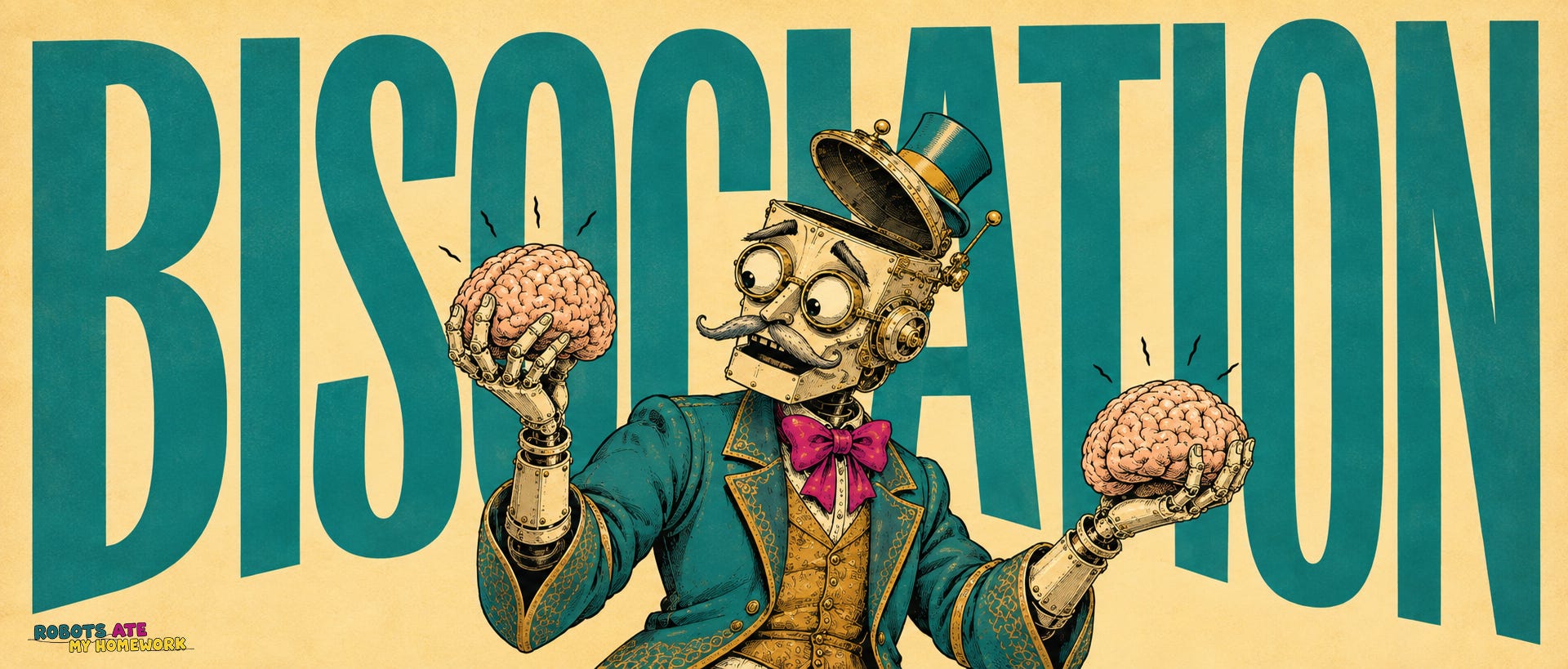
In a joke you laugh, in a discovery you go “aha,” in art you get a slightly stunned “ahhh.”
What Koestler doesn’t tell us is, where do these associations come from? And what happens when they collide?
Having an “interesting mind” is less of a mysterious personality trait and more a collection of mental habits developed over time.
Habits can be protected, and they can be forgotten.
AI complicates our relationship with habits, because when we’re given a final connection, we have proof that some kind of thinking did happen. But whose?
We notice those leaps and AI is great at them. Everything that makes a leap available (what you’ve collected, what you pay attention to, whether you check it, where you take it) is so much easier to let slide, and that’s what we need to keep practising.
To figure out which parts I still wanted to keep mine, I ended up with a comedian, a scientist, a commonplace-book keeper and an essayist.
🎩Look beyond the obvious connection
The brain of a comedian seems to have fun simply by connecting things that shouldn’t be connected, and finding the reason why this connection works.
Mitch Hedberg was so good at this.
One of his jokes goes:
“I used to do drugs. I still do, but I used to, too.”
His first sentence gives us a timeline: we have a habit from the past, seemingly not followed through at this present time.
The second sentence ruins the first sentence’s claim.
Although, technically, it doesn’t…
The logic still works, and your brain’s the one who has to come back to reality and reorganise what it thought the first sentence meant.
One of the major theories of humour is incongruity: something breaks the pattern you were expecting. Some versions of it also add another step - the mismatch then has to become interpretable; otherwise you may just have nonsense.
But what about those of us who aren’t comedians and still want to use this creative tool?
One answer is associative distance. More creative people tend, on average, to travel farther through semantic space and switch between more conceptual categories.
Travelling far isn’t always enough, though (unless it’s Europe to China, which I kinda want to do at the end of the year and am equal parts excited about and dreading!)
I can connect a toaster to medieval diplomacy right now if you give me thirty seconds. Ready? Both are all about timing: take it out too early and it’s raw, too late and it’s burnt. Done! It took me about 11 seconds and it’s completely useless. Timing in a toaster is a spring, and timing in medieval diplomacy is two people trying to outbluff each other. They just share the word.
Compare that with Steven Wright putting instant coffee in the microwave and almost going back in time (I’m paraphrasing, do go and hear him say it properly). Coffee and time travel are about as far apart as two things can get, and yet one word holds them together: instant.
What we want to do is find the hidden logic that makes two distant things belong in the same sentence, which, frankly, is what a comedian does.
They travel far enough to surprise you, then bring back something that makes the trip worth it.
Spot the comedian
In this post, I wanted to write about a simple topic: how to keep your mind interesting when working heavily with AI.
I could’ve spent a lot of research time in the usual neighbourhood: cognition, productivity, critical and creative thinking, tools.
However, I wrote down the main question I had and looked sideways at things I have seen, read about, or noticed lately.
I have a lot of comedian subscribers, so of course I started with them ❤️
Then I asked… What would the same ability look like somewhere much less adjacent?
And science came to mind. From there, I came up with a new question, then another, then another, until I arrived at the four modes you’re reading about right now.
So the first move was not “find an unusual metaphor”, but more like: leave the neighbourhood and see what comes with you.
FOR YOU, THE HUMAN → You need to build your first group of associations and then resist the temptation to build around it. Leave it alone for a while. This is called incubation: basically, you’re stepping away from the problem / topic, and your mind continues working without you giving it instructions. Think of your shower thoughts, long walks, or the things that keep you up at night. Looking sideways for a while, you’ll start noticing how connections get formed much more easily. You’ll just need to come up with a bridge.
FOR AI → Don’t use AI as soon as the first good connection comes to mind. Bring it in later, telling it the territory you’ve already discovered and asking for topics that are progressively farther away. Also, make sure it doesn’t explain the connection back to you.
WHAT TO KEEP FOR YOURSELF → The bridge and the judgment, meaning that little moment when you decide if your connection changes your understanding, or simply sounds clever.
Once you have a surprising connection, though, there is a second problem.
How do you know it holds in real life?
👩🏻🔬Good comparison or just a clever one?
Jesse Pinkman lives for a breakthrough. Walter White lives to ruin that in just a few seconds.
Their conversations have a very interesting rhythm: Jesse gets excited because something worked, or because an idea sounds brilliant, and Walt starts pulling it apart. Purity. Process. Reaction.
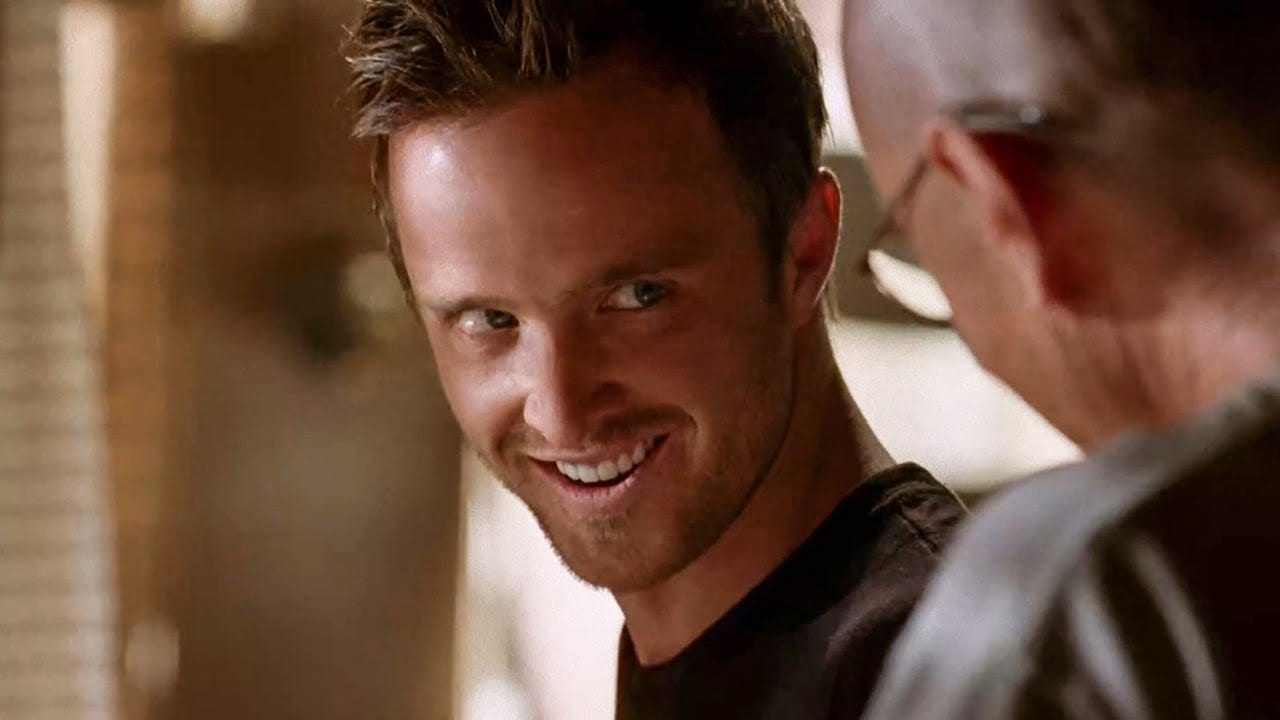
Jesse gets the AAAAAAH, WIRE, and Walt gets the second thought.
Mind you, Walt isn’t exactly a model of rigour... A good half of his second thoughts are just ego.
I know that second thought well because I am extremely easy to seduce with a good comparison. Give me two things that share a strange little resemblance and I’m already halfway into an article, delighted with myself.
Then, usually a few minutes later, Walter White knocks on my brain-door.
Do these things work in the same way?
This is the heart of Dedre Gentner’s structure-mapping theory - basically, a strong analogy doesn’t depend that much on two things looking alike, but on whether the relationships between their parts line up.
That’s the Scientist’s job here.
As comedians, we’re excited at the sight of tons and tons of connections. When we put on the scientist hat, we open the drawers and notice what’s sitting there, hidden.
Spot the scientist
I love using objects, characters, descriptions, and worlds to give a name to the things I write and talk about.
For this post, my brainstorming sessions took me to comedians, scientists, commonplace books, and essayists.
At first glance, all four seemed to go super well together. Four nice characters can seduce you fast - they seem almost inevitable.
After I found them, I removed the actual characters from the story line, and I looked at their logic underneath:
Comedian → distance
Scientist → structure
Commonplace book keeper → accumulation
Essayist → sequence
If two characters collapsed into the same function once I removed their names, I didn’t really have two modes.
This is something I already do quite a lot when an idea feels a little too elegant: take away the language you fell in love with and see if the idea still holds.
FOR YOU, THE HUMAN → Pick an idea you love right now, and describe every part of it only through its main function. What changes because this piece exists? What is it contributing that the others cannot? Which two parts secretly do the same job?
FOR AI → After building your first version, invite the structural critic into the room. Tell it to ignore the name or label, and compare only the functions. Tell AI to find the edge cases, the place where the idea starts crumbling down.
WHAT TO KEEP FOR YOURSELF → Always, and I mean ALWAYS, keep the meaning. AI can show you cracks in the argument, but you need to decide if those cracks matter. In my experience, AI is pretty good at finding flaws in EVERYTHING. Make sure you don’t fall for that (Walt, again).
AI can make almost any comparison sound convincing, which is why I like the Scientist asking where the analogy holds and where it starts to wobble.
So now we have distance AND structure.
But none of that matters much if there’s nothing interesting around to connect in the first place.
📖Give your mind material to connect
Commonplace books are my best version of “brain on paper”.
And heart, probably. Soul too. ❤️
I used to keep commonplace books, and I find them to be a lovely home for all the things we don’t really want to throw away: sentences, facts, quotes, everyday observations.
Long before Obsidian, people were already building these external homes for fragments.
Renaissance commonplace books were notebooks where people collected quotations and information so they could return to them later. Humanist students organised passages under headings. Writers, scientists and scholars kept their own versions.
Some of those books became huge private collections of whatever their owners found worth keeping.
Spot the keeper
I keep a lot of things in my Obsidian - thoughts, references, half-formed connections, post drafts, research notes, weird things that make me notice the world differently.
They sit in different vaults and folders, sometimes for months, until… I come across a question whose answer I want to approach differently.
This is how this article was born too.
I’ve never created a folder called FOUR PEOPLE WHO - ONE DAY - ARE GOING TO HELP ME EXPLAIN ASSOCIATIVE THINKING. I had bits and pieces of comedy, science, written content, notes and AI brainstorming, all scattered across different corners of my world.
Search finds material for a question you already know you have (AI is great at this, and I use it for exactly that).
When I don’t quite know what I’m looking for yet, though, I still prefer a Google rabbit hole. AI likes to give me an answer; rabbit holes let me wander sideways.
All the wow things I’ve found (the ones that end up in articles like this) were almost never straight-up answers, but adjacent things that were sitting in a corner. I’d never have reached them if I’d only ever asked.
Accumulation gives future questions material you had no way of predicting you would need.
FOR YOU, THE HUMAN → Keep what catches your attention before you can explain why. Let different parts of your life enter the same archive, so you can later revisit old material occasionally without demanding that it immediately become useful.
FOR AI → Use it as a resurfacing machine once your archive becomes too large to hold consciously. Ask it to pull fragments from different periods, unrelated folders, or distant parts of your work. Ask for strange pairings.
Then tell it to stop.
WHAT TO KEEP FOR YOURSELF → Recognition. You still need to look at the material before AI explains why it belongs together. You decide whether anything happens when those fragments sit beside each other.
AI’s favourite quirk is to find out and tell you what every little thing means.
But I’m not always convinced it should, especially when it comes to creative tasks.
Which, come to think of it, means the Comedian needed the Keeper all along. There isn’t much to travel through if the drawers are empty.
Still, even with a wonderful archive and a few good connections, you can end up with the intellectual equivalent of opening five tabs and forgetting which one had the thing you needed.
Someone (a human, ideally) has to keep hold of the thread.
✍🏻Stay in charge of the direction
I should probably admit that I don’t really have a definition for what an essay is supposed to be.
Sometimes I call these posts. Sometimes articles. Sometimes essays.
It really depends on who I’m writing for and I sometimes use “essay” and “post” interchangeably.
Oxford is much less confused than I am: an essayist is simply “a person who writes essays to be published.” Which, fine, I guess that includes most of us writing on Substack!

Montaigne called his book Essais, from essayer: to attempt, test, try. Tries, if you want.
So, what does an essayist do with a thought once they have it?
Making one good connection is hard enough. Then, you also have to keep a thought alive across several connections?!
A coherent essay moves through films, studies, jokes, old notebooks, memoirs, and still feels like one thing rather than a pile of interesting bits.
Usually I just need to know what I’m still trying to figure out.
I can wander quite far from the original point, bring in a film, a study, some random thing I wrote down six months ago, whatever. But if I can’t tell why this new thing belongs here, I’ve probably lost the plot a little.
And that happens very easily when you like connections as much as I do.
Spot the essayist
You’ve just watched this one happen! :)
I started from an anxiety we all have, about AI and the mind.
Comedians changed the question ever so slightly, so we ended up with the concept of associative distance.
The scientist changed it again - associative distance wasn’t enough alone, because we needed the logic underneath it.
Commonplace books brought in the idea that we need enough material to be able to connect things in a creative way.
And now we have another question:
How do you move through all that material without losing sight of why you started?
We now find out that a pile of interesting things can transform into a lovely journey or can simply stay… a pile.
My advice for you is, instead of gathering references around a fixed answer, keep a live question. Then, when you find something useful, ask what it makes you ask next.
Question → discovery → new question → discovery → new question.
And the new question goes back into the notebook for later, which feeds the next leap. Round, and round, and round we go!
It sounds simple, and it’s also an excellent way to discover that the essay you thought you were writing is slightly different from the one you needed to write.
This is also the way I use my rabbit hole research, only when the live question reaches a fork and I want to see where else it could go without deciding the answer yet.
As a gift to you, here’s the generic prompt I use, which I change depending on the topic and how far I want to go into the rabbit hole:
I’m researching [TOPIC]
Don’t give me an overview or suggest an argument yet.
Build me a search constellation across etymology, obsolete language, mythology, psychology, literature, visual culture, technology, rituals, objects and historical incidents.
Include academic terminology, metaphorical neighbours, antonyms, translated terms and exact phrases that may appear in old books.
Prioritise surprising but defensible connections.
FOR YOU, THE HUMAN → Be bold and make the first move. Follow the connection. Every so often, check what question you are answering now and determine if the detour returned anything useful.
FOR AI → Let it open doors at genuine forks. Ask for adjacent questions, unfamiliar disciplines, contradictions, or evidence that would make your current interpretation uncomfortable. Later, use it to inspect the route: where did the question change, which detour went nowhere, where did you repeat yourself?
WHAT TO KEEP FOR YOURSELF → Direction. You ALWAYS choose the door. You decide when a detour is worth following. You decide when to come home.
I don’t bash AI for getting you to the destination faster, because sometimes that’s exactly what you want.
I just think you should still have some say in the direction, the detours, the roads you take to get there.
It is very easy to let AI lead the whole way and realise, somewhere in the middle, that you left your own mind by the side of the road.
And we don’t want that. Interesting minds travel with us!
So, is AI making us less interesting?
I don’t think the mere fact of using AI means we’ve become less or more interesting.
Looking back at the four “keep for yourself” bits (the bridge, the meaning, the recognition, the direction), they’re all the same verb in different outfits: choosing.
The leap can be the robot’s. The choosing, I’d like to keep.
If you want to do something fun with me (and our brains) next week, and honestly a little boring at first glance, try this:
On Monday, notice one thing you’d normally ignore - a tree, bird, sound, a character from a movie you find interesting.
On Tuesday, try to connect it to something unrelated from your life.
On Wednesday, willingly prove that the connection is wrong.
On Thursday, find something old you’ve saved and see if that changes what you think about the connection.
On Friday, follow the whole thing somewhere you did not expect to end up.
During the weekend, go to AI and tell it about your experience.
And while you do that, decide which parts of the trip still need your hands on the wheel.
We need a whole week because we’re going to wait, on purpose. Four seconds doesn’t give a thought much time to bump into anything else, so this one gets a few days to wander. Slightly boring at first glance, as promised :)
What part of your thinking are you least willing to hand over to AI?
To keeping the mind in the driver’s seat,
Mia Kiraki

About the author and the robots...
Hi, I’m Mia, the human behind ROBOTS ATE MY HOMEWORK, a house of thought and taste for the AI age, with the side doors left open.


I work across narrative, creative direction and AI systems, helping humans build richer worlds around their work and give AI enough context and direction to understand what it’s entering.
Around here, I follow interesting questions through AI, creativity, culture and the human mind, looking for richer ways to think, make and work with the robots around.
Want to wander further?
🤖 Meet the robots → explore RobotsOS, a studio of AI systems built to think, research, critique, develop ideas and work together inside the AI you already use.
🏠 New to the house? → start here and I’ll show you around.
❤️ Want the whole library? → Premium opens the rest of RobotsOS and helps keep this strange little house running.
I love rabbit holes.
AI is very good at answering the questions I already know how to ask.
But some of the best things I’ve ever found came from wandering badly, clicking something only vaguely related, forgetting what I was originally looking for, and ending up somewhere else.
I do believe we lose things when we attempt to walk a straight line.
What's up, sis!!!
If everyone weighed this carefully, what to hand over to AI and what to keep for themselves, we'd definitely build an incredible future 🙂
I love your examples and conclusions. From my experience, I generally don't trust AI much in the creative process. Honestly, I think you've run into this yourself more than once: it can't even draw an image for an essay on its own, you have to describe every detail.
But I love using it to fill out the picture and explore things, and sometimes just to think out loud.
AI is a wonderful listener, worth noting 🙂