


When ROBOTS ATE MY HOMEWORK was born, I went to AI with it and asked:
“Hey, here are some of the ideas I have. Here’s what I do. Do you think this would work as a newsletter?”
It came back with:
Yep, an AI newsletter!
And once AI decided I belonged to the “AI newsletter” category, it started helping me build one.
Meanwhile, I had 542 suitcases carrying narratives full of detectives, dead historians, visual systems, castles, an old philosophy book, and AI behaviors.
Half my brainstorming time was then spent trying to get away from what an AI newsletter was supposed to publish.
So I gave AI more of the world: my entire context and story.
But context had only solved half of the problem.
I still didn’t know whether AI was suggesting something because it saw a pattern in my work… or because it had already put that work inside a familiar category and started borrowing from everything that usually comes with it.
Then, I arrived at the noun.
During early brainstorming, we want to (ideally) treat categories as hypotheses, because a category is already an interpretation. A label usually decides from the start what belongs before we’ve had a chance to explore what else might be there.
And that’s how we end up with anything about everything.
Hi, I’m Mia. Welcome to ROBOTS ATE MY HOMEWORK.
Today, we’re looking at what AI’s categories do to an idea before you’ve decided what it is.
Come meet the robots. And me. :)
Join 2.8k+ humans building a world around what they know, then teaching AI how to work inside it.

A category never arrives alone
Let’s say you’re building something and, somewhere in the conversation, you call it a cohort.
A whole set of expectations arrives with the noun.
Psychologists call this category-based induction. We do this constantly, and we don’t even think about it.
🥔If something’s a potato, you already have expectations about it - you know what happens when you cut it, what it tastes like when you prepare mashed potatoes with butter.
If something’s a podcast, or a cohort, a completely different expectation arrives with the word.
AI has access to those expectations, drawing from a large body of work. And I’m honestly happy it does, because my human brain can’t possibly access so much information. If I’ve decided to create a cohort, I do want access to all the historical failures about cohorts, and all the edge cases I couldn’t have found alone.
But what happens when the form is still… forming?
A very rich description of what you’re creating sits still beside a familiar noun, and that noun becomes the explanation for everything else.
The ideas that follow may fit the category perfectly, but they usually barely touch the strange parts of the thing you brought in.
Is this noun describing the thing, or has it started designing the thing?
Plant, animal, or something in between

A few centuries before I had the pleasure of robots trying to fit me into a category, European naturalists had a weirder classification issue.
The Vegetable Lamb of Tartary was a legendary creature described as a lamb growing from a plant, attached to its stem and grazing on whatever vegetation it could reach.
I’m sorry to tell you this, but sheep don’t grow on shrubs :(
“Plant” and “animal” gave people two ways of explaining the entity they were looking at. We even used to have a category for entities somewhere between the two; they were called zoophytes, plant-animals.
As the classification changed, so did what counted as a plausible explanation.
Hans Sloane looked at one of the specimens and he claimed that it was a fern rhizome shaped like a lamb. Later, Henry Lee made the connection to European misunderstandings of cotton (the leap from wool growing on trees to lambs growing on trees).
The available categories can fail before the object does.
Give AI a category and let the suspects come through the door
Enough of lambs, potatoes, and plants.
I wanted to look at how LLMs interpret categories.
In 2026, Zilong Liu tested 11 autoregressive LLMs across 297 geographic categories, looking at which examples kept coming back across models and sampling temperatures.
Some were pretty persistent, like Golden Gate → Bridge, or Amazon Basin → Basin.
The study wasn’t testing messy creative brainstorming like mine, so I’m careful about stretching it too far. What interested me was that inside a category, some things are much easier for AI to reach than others.

As soon as you choose a box, AI goes wild inside it
Telling AI to ditch and avoid categories altogether?
That’d be a pretty lame thing to do. We’d be throwing away one of the best things about working with it.
My favourite brainstorming sessions include bringing in information from my mind palace and the world out there that I’d really struggle to hold together myself - if you can do this, props to you!
AI looks through archives and finds repeatable patterns; it pulls obscure references into my work. All this while leaving more room for me to analyse all of this and decide what I keep and what I throw away.
But it’s not all black and white. We can have a little breathing room between the first “hey there, help me brainstorm” and the sudden category assignment.
I want us to have the range first, then add the constraints. And once we choose the shape, I want convergence too, because chosen constraints are incredibly useful.
Make the category show its work
A few months ago, I changed the way I use all that RAMH context during brainstorming. I want AI to understand the scope and depth before assigning categories to literally… anything.
A good rough first prompt to use when you have doubts is:
For every direction you suggest, show me the patterns, examples or decisions in my material that support it. Then separately tell me which parts come from conventions of the category you think this belongs to.
The result is usually a division of labour you can start from:
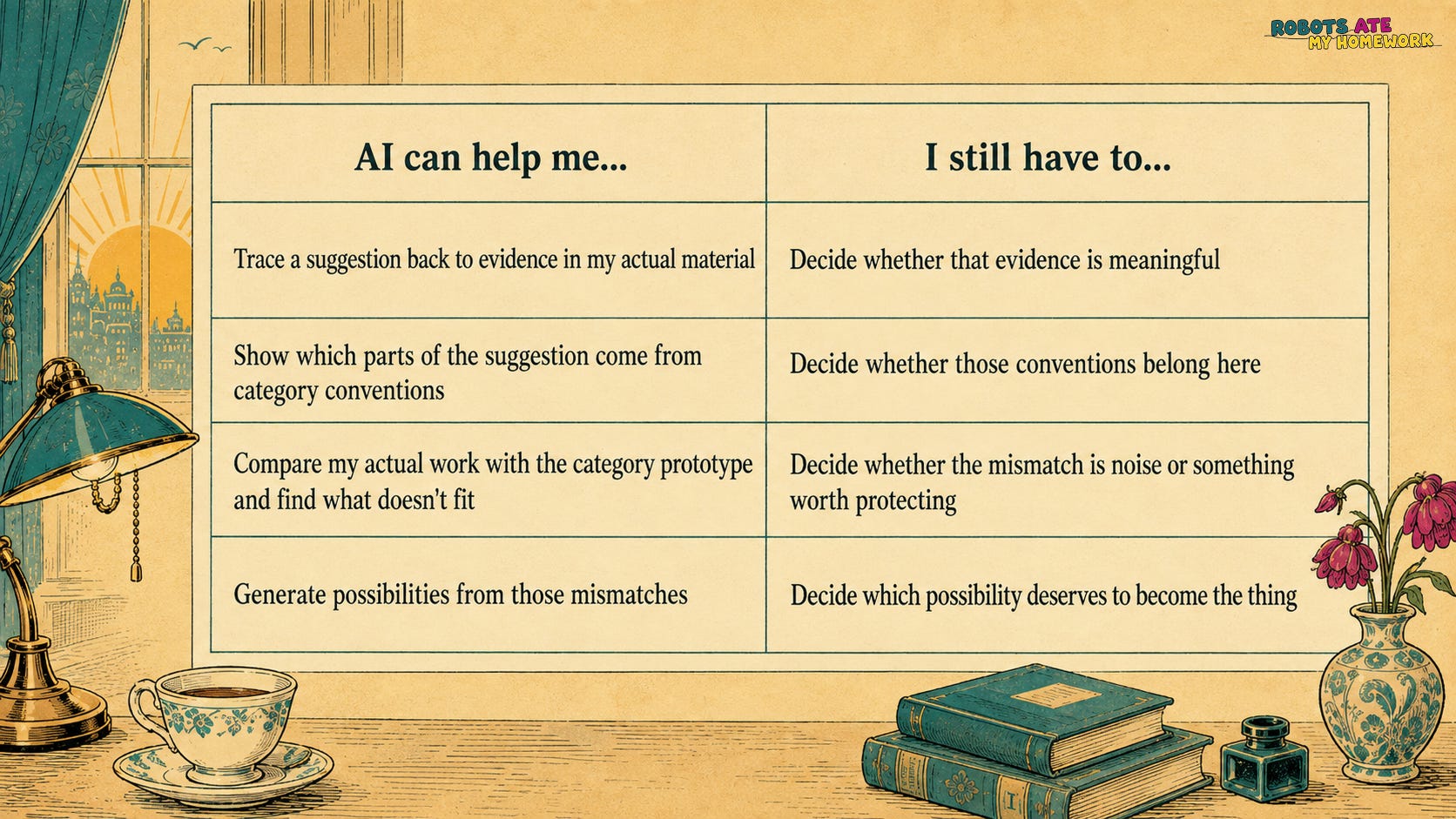
I love that third point.
A category gives us one explanation of something. Whatever it fails to explain is where I want AI to look next:
What in my actual material does this category fail to explain? If those mismatches are meaningful, what possibilities do they create?
AI newsletter might explain why RAMH needs to publish on schedule and why “AI” is in every edition.
Fine. But it does such a terrible job with the rest of it: the narrative, the historians and old films, the strange systems for thinking and making, the questions about taste and interpretation, and the increasingly elaborate project of building a world around your work, then teaching AI how to think inside it.
My job is to decide what belongs. AI can compare the category against the evidence AND then put on its brainstorming shoes and start from whatever doesn’t fit.
And as soon as I decide the category (which doesn’t need to fit into a predetermined description), I open the gates.
GIVE ME ALL OF YOUR KNOWLEDGE.
Show me things I haven’t considered.
Find the edge cases.
Tell me what other people in my space are already doing, what they’re succeeding with, what they’re failing at.
And the category suddenly has a job.
Now, give the strange bits a little more time
I used to think and boast about how the useful fix is mostly better context, more of it, all the time.
I’d never go back to brainstorming without all of this stuff.
But lately, I’ve been adding one more layer of suspicion:
What did AI learn about the context I gave it, and what became available because someone assigned a noun (a name, a category) to it?
I still find the Vegetable Lamb ridiculous, but I now understand a little better how it survived for so long, while people kept trying to explain it with the categories they had available.
Our projects are (hopefully) less dramatic, but the habit is familiar.
A noun can clarify the work and, if we’re not paying attention, become part of the work too.
Sometimes I want that noun to wait.
What category does AI keep trying to put something you’re making into?
To the robots waiting for the noun,
Mia Kiraki
👀 Did you know…
The robots escaped the library last week and they can now come work inside the AI you already use.
The little launch celebration is still going too: Premium is 20% off for a couple more days. :)
About the robots...
Hi, I’m Mia. I write about AI, narrative, culture, language, and the ideas that send humans down unexpected rabbit holes.
ROBOTS ATE MY HOMEWORK is where we keep the interesting parts of the work and give the robots better jobs.
Subscribe for free and get better at noticing what AI misses, directing it somewhere more interesting, and making work that still feels recognizably yours. You’ll also get the RobotsOS starter library to play with.
Get a premium key 🔑 and teach the robots enough about your work that they can finally stop starting from zero.
Damn, I read it twice already. And saved it 😂 So many wisdom moments in one article. Your newsletter is probably the one that makes me think the hardest. Thank you for that!
What I really like about this is that you’re describing almost the opposite of cognitive offloading.
You’re not asking AI to do the thinking for you. You’re forcing it to expose why it reached a conclusion, what assumptions came with the category, and where that category stops explaining the actual material.
That creates more work for the human judgment part, not less.
The line “my job is to decide what belongs” really landed for me. The value isn’t that AI gives you an answer. It’s that you can keep challenging the answer until your own thinking gets sharper.